 Edition 2027-1
About this Resource
We live in a world where everyone assumes you already know how to use AI.
Almost nobody was actually taught.
Why this book exists
Most people learn AI by trying things. They type a question, get a decent answer, and stop there. They never find out what it's good at, where it quietly fails, or how to tell the difference.
AI is a gumball machine, not a calculator.
Swipe sideways to see the whole drawing
This book is 101 experiments you do with a pen and things from around the house. You can't say which gumball comes next, but you can say which color comes out most, and you can change the mix. AI works the same way. Thinking like AI means guessing the likely answer before you ask, and knowing how to change the mix.
AI gives you the usual answer, the one most people would give. To get good with AI, you bring what that answer leaves out, like a detail you noticed or the exact word. You learn that away from the screen.
Meet the gang
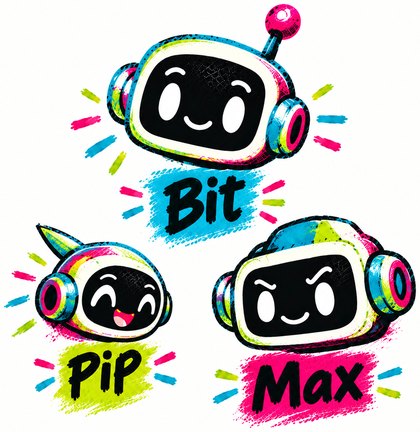
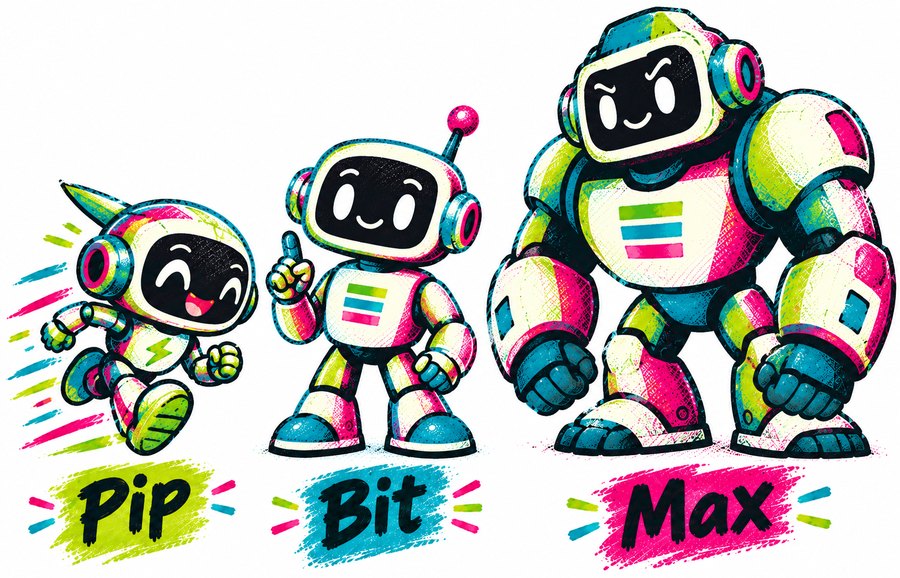
That's Bit. He does every experiment you do. His two friends help him solve problems: Pip, his smaller but faster friend, and Max, his stronger but slower big buddy. Both can sound sure and still be wrong. When Pip and Max agree, any AI would likely do the same. When they disagree, it shows what Max's strength adds, and what you still have to check.
How to get through it
Start anywhere: each experiment stands on its own. Try the experiment before you turn the page, because guessing first is part of it.
Contents
Start wherever the problem sounds like yours. Nothing here has to be read in order.
Who's Teaching This
Who am I?
I'm Professor Matthew Zimmer (AKA Mr. Z). I build things with AI for a living and I teach people how to do the same. I've watched a lot of smart people either write AI off entirely or trust it way too much, and both mistakes cost them.
This book is the version of AI education I wish existed when people first started asking me how to use this stuff.
What I believe about learning this
- You learn by doing, not by reading about doing
- Understanding why something fails beats memorizing what to type
- Skepticism is a skill, not an attitude
- The goal is to think better, not to type less
What's VibeCraft?
VibeCraft is a skill, a feeling, and a method, all at the same time. You've probably heard of vibe coding by now. Whether you're writing code, making art, or telling a story that actually lands, it's the same process underneath: using the tools at your disposal to transform a nascent idea into something larger than yourself.
The idea behind it is simple enough to put on the cover: build with purpose. Not creating for the sake of creating. Use the tool because it makes the work better, not because it's the tool everyone's talking about.
We meet every Wednesday morning at 7:45 a.m., bright and early for San Diego, and work through what it takes to be genuinely business-minded about applying AI. Meetups and workshops are listed at vibecraft.works/events. Come work on it with us.
A note on tools
You won't find brand names on these pages. That's on purpose. The chat assistant you use today may not be the one you use next year, but the way you ask it questions, check its answers, and decide whether to trust it will transfer to whatever comes next. That's also why the experiments here don't need any app: a pen, a few things from around the house and your own judgment do the work, and AI comes in at the end, if at all.
What People Mean by “AI”
Most of the time, “AI” means a chat assistant that writes one likely word after another.
Here is what that looks like, and the other kinds you'll meet.
AI scores every word that could come next, picks one near the top, then scores the next word the same way.
Swipe sideways to see the whole drawing
The short version
A chat assistant runs on a large language model (LLM): a system trained on huge amounts of text to predict the next word. It scores every word it could write next, picks one, and repeats.
That is why the same question can get a different answer, and why a sure-sounding answer can be wrong: it gives you a likely answer, not one it looked up. Every kind below works on likelihoods too.
The kinds you'll meet
Chat assistants
Answer, explain, draft and rewrite.
Reasoning models
Work through a problem in steps before answering.
Coding assistants
Write and fix code inside your project.
Agents
Take actions: browse, run code, chain steps toward a goal.
Image, video and audio
Make a picture, a clip or a voice from words.
The quiet kind
Search ranking, feeds and autocorrect, rarely called AI.
Why No Two Answers Match
Break the same rack the same way a hundred times and no two breaks end the same.
How you explain that decides how you'll think about AI.
The air, the felt and your arm push each break a little. The red ring is one break nobody could have predicted.
Swipe sideways to see the whole drawing
Two competing world views
Every shot is fixed (causal determinism)
Cause and effect decide exactly where every ball stops. Track every speck of dust and every twitch, and you could predict it perfectly.
The pattern is fixed (probabilistic determinism)
You can't track every speck, so you can't predict one break. But after a hundred breaks you can say where the balls usually stop.
Why AI breaks both
Each view is partly right and partly wrong. The first is right that a break follows from its conditions: know every one, down to the last speck of dust, and you could predict it exactly. It's wrong that you ever could, because the conditions never end. The second is right that most breaks land in one area. It's wrong that you can count on it: one can always land outside. AI is the same. Each answer follows from everything that went into it, but you can never see all of that. So you can't predict one answer, and you can't be fully sure of the pattern either. That's what makes AI amazing, and also what makes it confusing. Philosophers have names for the two sides: ontology is what the ball does, and epistemology is what you can know about it.
In one line
You can't be sure of any one answer. Learn where most land, move them, and check the ones that matter.
How to Use This Resource
Start wherever your problem is.
Here is how the book is laid out, and where to begin.
The book's 15 sections, grouped in four parts
- 01Every Answer Is a Draw p.14
- 02The Usual Answer p.28
- 03What You Show Is the Request p.42
- 04Words That Move the Odds p.58
- 05Rules, Directions, Tiebreaks p.74
- 06Leave Room on Purpose p.90
- 07Who It's For, How They Hear It p.106
- 08One Draft Is One Draw p.122
- 09What Only You Know p.138
- 10Sure Doesn't Mean Right p.154
- 11The Answers Outside the Circle p.170
- 12Small Chances Add Up p.182
- 13Pictures and Sound p.200
- 14The Odds in Business p.214
- 15When It Misses, Who Pays? p.230
Each part builds on the one before, but every section stands on its own. Each one opens with an overview and ends with a short quiz.
Swipe sideways to see the whole drawing
Where to start
“I've barely used AI.”
Section 01, Every Answer Is a Draw (page 14). It explains everything after it. One AI tool is enough, and a free one is fine while you learn.
“My results are just OK.”
Section 04, Words That Move the Odds (page 58), then Section 05, Rules, Directions, Tiebreaks (page 74). Use each “Remember this” box with AI.
“AI gave me a wrong answer and I believed it.”
“I want to make something for someone.”
Section 07, Who It's For, How They Hear It (page 106), then Section 09, What Only You Know (page 138).
“I run a business.”
Section 14, The Odds in Business (page 214), then Section 15, When It Misses, Who Pays? (page 230)
“I can't use AI where I am.”
Steps 1 and 2 of every experiment need no AI and no internet. Only Step 3 may use AI.
Why Every Page Is an Experiment
Every experiment is something you do with a pen and ordinary things.
Then Bit does the same, with help from Pip and Max, so you can see how AI handles it.
Swipe sideways to see the whole drawing
Four moves on every two pages
Do it yourself
The crimson box holds the experiment: five shapes to order, a coin to drop. Step 1 is your own try.
Guess what Bit did
Step 2 does it again with one thing changed, and asks you to guess what Bit got.
Turn the page
Page 2 shows the results, what they show, what could go wrong, and one thing to remember.
Find it in your life
Step 3 finds the same thing in your own work or home, and may end with a request to AI.
What the 101 add up to
Each experiment shows you one piece of the same idea: predict what AI will say, steer it, verify it and apply it. A coin, a die and a deck of cards follow the same odds AI does, and they won't change when the next app comes out.
How to Do an Experiment Offline
Every experiment works without AI or the internet.
You need a pen, a few things from around the house, and a little time.
What the experiments use. Each one says what it needs: many need only a pen, and the rest use common objects like these.
Swipe sideways to see the whole drawing
Four rules
Do it alone
Steps 1 and 2 are yours: you roll, count, sort and write. Nobody helps, and nothing is looked up.
Leave AI out
No AI and no internet in Steps 1 and 2. Whatever they need is on the page or on your table.
Write it down
Every step leaves something you can look at: a tally, a list, a sketch. Keep it for page 2.
Guess, then turn
Write your guess about Bit before you turn the page. Comparing is where the lesson is.
And Step 3
Step 3 takes the experiment into your own work or home, and may end with a request to AI. That's the one step that can go online.
Sample Experiment
Three short sentences: what this experiment shows about AI, what you do to see it, and why it's worth knowing.
The experiment: What you do
What Bit asked Pip and Max to do, in quotes, and what you write down while you do it too. Then a drawing of the thing to look at, count or sort, when the experiment needs one.
Swipe sideways to see the whole drawing
What to work on
What the request leaves open, and what Steps 1 and 2 ask you to find. Then how Step 3 takes the same idea into your own life or work. It can end with you trying the nudge on AI.
Step 1
Do the experiment
- Do the experiment once, with a pen and the things it names
- Write down what you got, and the rule you followed
- Check one thing that shows whether your result is right
Step 2
Change one thing
- Do it again with one thing changed, and compare
- Write what changed and what didn't
- Guess what Bit got each way
Step 3
Find your own example
- Find a time in your own life or work when the same thing happened
- Write what you asked for, what came back and what you meant
- Try the nudge on AI, and compare what comes back
The results
Compare what Bit got with what you found in Step 2.The results, drawn: how many of the 10 answers did the thing counted, under each request.
The first way it was asked or done
What Pip and Max did, counted
How often each answer came back
What the counts show, in one or two sentences, with the numbers.
The same, with one thing changed
What they did this time
How far the answers moved
What changed and what didn't. A nudge moves most answers, not every one.
What we learned
What happened and why, in plain words. If the experiment names a term, it says what the term means here, with the plain English beside it.
So: what to do about it, and when it matters most. The two paragraphs make one point, and they never claim more than the results show.
What could go wrong
AI does something wrong
Something Pip or Max actually got wrong in the run, how often, and the check that catches it.
AI does something else wrong
Another real miss from the run, said plainly, with the number.
AI misses in a third way
A third miss, or the moment a good answer hides a bad one.
AI could do something the run didn't test
A risk the run couldn't show, worded as could, never as fact.
Remember this line “The one thing to take to AI: a request, a rule or a check.”
When to use it in your own work, in one sentence.
Where I'll use it
What a miss would cost
101
Experiments
Each one is something to do with a pen and a few things from around the house. Guess first, then turn the page to see what Bit got.
15 sections
- 01Every Answer Is a Draw
- 02The Usual Answer
- 03What You Show Is the Request
- 04Words That Move the Odds
- 05Rules, Directions, Tiebreaks
- 06Leave Room on Purpose
- 07Who It's For, How They Hear It
- 08One Draft Is One Draw
- 09What Only You Know
- 10Sure Doesn't Mean Right
- 11The Answers Outside the Circle
- 12Small Chances Add Up
- 13Pictures and Sound
- 14The Odds in Business
- 15When It Misses, Who Pays?
Look for these
What you do
Experiment results
What to remember
Digital vs. Analog
Old computers only said yes or no, and AI says “probably.” Compare a record with a CD to see which one AI is like. That tells you why it needs checking and when to use it.
A record traces every wobble of the sound. A CD measures it about 44,000 times a second and keeps only those numbers. A light switch is digital at its simplest. A dimmer is analog.
Swipe sideways to see the whole drawing
Where AI sits
AI runs on digital hardware, but it answers more like the dimmer. It doesn't look an answer up. It scores the words that could come next and picks one, usually near the top (the picture on page 5). That is why the same question can get two different answers. Nothing is broken.
Why it matters
You won't get certainty
A calculator can be exactly right. A model can only be very probably right, and that needs more checking.
Confidence is a percentage, not a feeling
When it sounds sure, that is a writing style, not a measurement. The actual number is hidden from you.
Small nudges change the odds
Because everything is probabilities, a slightly clearer question really does shift the answer. That is why prompting works at all.
Both kinds are still needed
Use exact tools, like a calculator, for anything that must be exact. Use AI where a very good guess is useful.
Find your own example: flip a system you already use
1. Pick a system you use: a sign-in sheet, a price rule, a checklist.
2. Flip it the other way, using these two as models:
Analog going digital: a sign-in sheet becomes a form. You gain a permanent record, but lose the quick look that showed a full room.
Digital going analog: a spreadsheet rule (discount over $500) becomes a judgment you give to AI. You gain flexibility but lose the guarantee, so decide who checks it.
3. Write what your flipped version gains, what it loses, and who checks it. Keep the one you would actually use.
Section 01 · Experiments 01–06
Every Answer Is a Draw
Ask AI the same thing twice, and you can get two different answers. That isn't a mistake. Each answer is drawn from a spread: a range of likely answers. It's like a dropped coin, which lands in a different spot each time. In this section, you'll see that spread with coins, dice, shapes and a bag of candy. You'll also learn to tell a guess from a fact, and a pattern from chance.
By the end of this section you can
- Predict where most answers will land
- Count the fair answers to one request
- Ask more than once before you trust an answer
- Explain where AI's odds come from
- Tell a guess from a fact
- Test a hunch before you call it a pattern
Can You Predict a Single Drop?
You can't predict one AI answer, but you can predict where most answers land. Drop a coin 40 times from two heights, and count where it stops. Then you'll see what a small change does.
The experiment: Drop a Coin
We asked Bit to “Drop a coin on the target, 20 times from head height and 20 from waist height.” Make a target and do it too: draw two circles on paper, one inside the other. You choose how big.
Swipe sideways to see the whole drawing
What to work on
Nobody can say where one coin will stop. But you can say where most coins stop, and dropping lower moves them. You'll drop from two heights, compare your counts, and guess how Bit's drops came out. In Step 3 you'll try this with a question you ask AI.
Step 1
Drop from head height
- Draw two circles on paper, one inside the other, at any size, and lay it on the floor
- Drop a coin over the bullseye from head height, 20 times
- Tally each drop in the table: bullseye, circle or outside
Step 2
Drop from waist height
- Write how many of the next 20 you think will land in the circle
- Drop 20 more from waist height, and tally the second row
- Compare the rows, then write how bigger circles would change them
- Write how many of Bit's drops from each height you think stayed in the circle
Step 3
Find your own example
- Pick a question you ask AI more than once, like a caption or a reply
- Ask AI that question five times in the same words, and tally the answers
- Change one thing: add a number, a name or a limit
- Ask the new version five times, and see whether the answers are more alike
Experiment 01, results
Bit's circle was as big as a plate. Compare with your rows.Bit's 40 drops, by where each coin stopped
From head height, 20 drops
Bullseye: 0
Circle: 6
Outside: 14
Nobody could predict any one drop. Fourteen of the 20 drops missed the circle.
From waist height, 20 drops
Bullseye: 0
Circle: 20
Outside: 0
Dropping lower put every coin in the circle, but none on the bullseye. No single drop became certain.
What we learned
You and Bit couldn't say where one coin would stop. But you could both say where most coins would stop. AI answers work the same way. This is called probabilistic determinism. You can't predict one answer, but you can predict where most will land. So two people who ask AI the same homework question get different answers that say about the same thing.
A small change to your question, called a nudge, works like dropping from lower down. It moves where most answers land. But it never makes one answer certain. Even from waist height, Bit never hit the bullseye. The size of your circles decided what counted as a hit, just as your rules decide what a good answer is. So decide what is good enough before you ask, not after.
What could go wrong
AI can get lucky twice in a row
Bit's 11th and 12th drops from head height landed in the circle. The next six missed. Two hits prove little.
A small change gets AI closer, not exact
Dropping lower put all 20 coins in the circle, but none on the bullseye. A nudge moves most answers, not each one.
AI's first answer can land well by luck
Bit's first drop from head height landed in the circle. The next two missed. One answer tells you almost nothing.
AI could look better than it is
Fourteen of Bit's 20 drops from head height missed the circle. If you forget the misses, AI looks better than it is.
Remember this test “Ask it five times, with the same words. Then change one thing and ask five more times.”
Use it before you trust an answer, and to see what your change really did.
Where I'll use it
What a miss would cost
How Many Answers to One Request?
Ask AI to order things, and you can get a different order each time. Find every fair order for five shapes, then write a request that allows only one. Then you get the order you need.
The experiment: Order the Shapes
Bit showed Pip and Max this page and asked them to “Order the shapes.” That was the whole request. Do it yourself first, on paper. Write each order you find as a list of the shape numbers. Give yourself five minutes, and keep going after the first order you find.
Swipe sideways to see the whole drawing
What to work on
Pip and Max got no rule, no direction and no tiebreak, so many orders are fair. You'll find as many as you can, guess which one they gave most often, and write a request that allows only one. The more fair orders you find, the less any one answer should surprise you. In Step 3 you'll find the same problem in your own life or work.
Step 1
Order the five shapes
- Pick one way to put the shapes in order, and write the five shape numbers in that order
- Under the numbers, write your rule in a few words, such as “smallest first”
- If two shapes are equal under your rule, write what decided which one went first
Step 2
Find every fair order
- List every other fair order, each with its rule. Try size, number of sides, color, fill and line thickness
- Sort by color, then by shape where two share a color. Write down the color order and shape order you chose
- Circle the order you think Pip and Max gave most often, and cross out any you think they never gave
- Write a request that allows only your Step 1 order: the rule, which way it runs, and what breaks a tie
Step 3
Find your own example
- Write down a time you asked someone for a ranking or a shortlist, and the order surprised you
- Next to it, write the rule they used and the rule you meant
- Rewrite your request with a rule, a direction and a tiebreak, so only your order fits
- Name one job where any fair order would be fine, and write the loose request you'd use for it
Experiment 02, results
Bit got 80 responses from Pip and Max. Compare with the order you circled in Step 2.Pip and Max's orders for each request, as shape numbers. Teal is the order asked for; crimson, a miss.
“Order the shapes.”, 50 responses
15 times: 1 2 3 4 5, as printed
11 times: 2 3 4 5 1, by sides, star as 10
9 times: 2 3 4 1 5, by sides, star as 5
9 times: 1 4 2 5 3, by area, smallest first
6 times: three other orders by size or area
Seven orders came back in all. And 36 of the 50 answers never mentioned another order.
An exact request, 30 responses
“Order these shapes by color: red, then yellow, then blue. Where two share a color, put the one with fewer sides first.”
21 times: 3 5 2 4 1
6 times: 3 5 2 1 4, with the blue pair reversed
3 times: 3 5 2 4, with the star left out
Max gave 3 5 2 4 1 all twenty times. Pip got it wrong nine times in ten.
What we learned
The same three words got seven different orders. Which order came back depended on which AI Bit asked. This is what probabilistic means. Every answer is one draw from a range of answers, where some are common and others are rare. You'll see this when you ask AI to rank anything, like the best books for the summer or the order of your chores.
An exact request made the order we wanted the most common answer. Even then, some answers gave a different order. So be exact when one answer matters, and check every answer against your rule. A loose request is still useful when any fair order is fine, like the songs for a party. Then the range of answers can show you orders you hadn't thought of.
What could go wrong
AI names a rule and doesn't follow it
Three of Pip's answers said “by number of sides”, then listed 1 2 3 4 5. Check the order against the rule.
AI breaks the tie the wrong way
Pip put the star before the square six times. The exact request said to put fewer sides first. Check every tiebreak.
AI leaves something out
Three of Pip's answers to the exact request left out the star but looked finished. Count the items in every answer.
AI could think “order” means buy
An AI that can shop for you could think “Order the shapes” means to buy them. Say “Put these in order” instead.
Remember this shape “Order these by [rule], [which way]. Where two tie, use [second rule].”
Use it when one order matters, then check every answer against your rule. To get options, ask for several orders.
Where I'll use it
What a miss would cost
Is One Answer Enough?
Most people judge an AI tool by its first answer. Roll two dice once, then 30 more times, and tally the totals. Then you'll know why one answer isn't enough.
The experiment: Roll Two Dice
We asked Bit to “Roll two dice and write the total. Then roll 30 more times and tally every total.” Do it too, with two dice and the chart below. No dice? Borrow two from a board game, and roll them in a box lid so they stay on the table.
Swipe sideways to see the whole drawing
What to work on
One roll can be any total from 2 to 12. Only many rolls show which totals are most common. You'll roll once, then 30 times, compare them and guess Bit's tally. As you shade the chart, watch how many rolls it takes before one total comes up most. In Step 3 you'll find a time you judged something on one try.
Step 1
Roll once
- Roll two dice, add them, and write the total in the box for your first roll
- Write which total you think will come up most in the next 30 rolls
- Write what that one roll tells you about the dice, if anything
Step 2
Roll thirty times
- Roll 30 more times, and shade a box above each total
- Circle the total that came up most, and mark any that never came up
- Compare the chart with your first roll and with your guess
- Guess how many of Bit's 30 rolls came up 7
Step 3
Find your own example
- Think of a time you judged something on one try: a café, a recipe, an AI tool
- Write how many tries would have been fair, and what the first try could have hidden
- Next time you test an AI tool, give it three jobs you know well and judge all three
Experiment 03, results
Bit rolled the same two dice. Compare with your box and your chart.Bit's 31 rolls, stacked by total
One roll
Total: 10
A 10 comes up about once in 12 rolls. From this roll alone, Bit couldn't tell which total is most common.
30 more rolls
7: 7 times
8: 5 times
9, 10 and 11: 3 times each
2 to 6 and 12: once or twice each
Most rolls were close to 7. But 12 came up twice and 6 only once. A 6 is five times as likely.
What we learned
Bit's first roll was a 10, a total that comes up about once in 12 rolls. Alone, it said nothing about which total is most common. After 30 rolls, the shape was clear. Most totals were near 7, and the totals at the ends were rare. One AI answer is like one roll. From one answer, you can't tell if it's the most common one.
So don't judge AI on one answer, good or bad. When it matters, ask more than once, and see which answers come up most. Even 30 rolls gave only a rough shape. A 12 came up twice, and a 6 only once. The more answers you see, the closer you get to the true shape.
What could go wrong
AI's first answer can be a rare one
Bit's first roll was a 10, which comes up about once in 12 rolls. Alone, it says nothing about the most common total.
Ten AI answers can show the wrong shape
After 10 rolls, Bit had one 12 and no 6. But a 6 is five times as likely. Ten rolls can show the wrong shape.
Even 30 AI answers may not be enough
Seven came up most in Bit's 30 rolls. That happens only about 4 times in 10. More rolls give a truer shape.
AI could still give the rare answer
In Bit's 30 rolls, 2 and 12 came up 3 times in all. Rare isn't never. Ask AI enough, and a rare answer will appear.
Remember this test “Before you call an answer usual, see it more than once.”
Use it before you judge an AI tool, a request or a reply on its first answer.
Where I'll use it
What a miss would cost
What's in the Bag?
AI's answers come from what it learned, as a draw comes from what's in a bag. Draw candy from a bag 40 times, and change the mix halfway. Then you'll know where AI's odds come from.
The experiment: Draw From a Bag
We asked Bit to “Fill a bag with 14 red candies, 4 yellow and 2 green. Draw one without looking, then put it back, 20 times.” Do it too, with any three colors, and tally in the table below. Buttons or beads work as well as candy, and a sock makes a good bag.
Swipe sideways to see the whole drawing
What to work on
Every draw is chance, but the mix in the bag sets the odds. You'll draw from one mix, add 10 of the rarest color, and draw again, then guess Bit's tallies. In Step 3 you'll find what's rare in AI's bag and add it yourself.
Step 1
Draw from the bag
- Put 14 candies of one color in a bag. Add 4 of a second color and 2 of a third
- Draw one without looking, tally its color, put it back and shake
- Do 20 draws, then compare your tally with the mix in the bag
Step 2
Change the mix
- Write what you expect from 20 more draws after you add 10 more of the third color
- Add the 10, draw 20 more times, and tally them in the second row
- Mark which colors rose and which fell, though you added only one color
- Guess how many green candies Bit drew from each bag
Step 3
Find your own example
- List three rare things about your work or home: your town, the words your job uses, a tradition
- Ask AI about one of them, and mark where its answer fits most people instead of you
- Put your own facts in the request, ask again, and see what changes
Experiment 04, results
Bit filled his bag as the request said. Compare with your two rows.What was in each of Bit's bags, and his 20 draws from each
14 red, 4 yellow, 2 green: 20 draws
Red: 14
Yellow: 6
Green: 0
The tally matched the bag, mostly red. The 2 green candies never came out at all.
Plus 10 green: 20 more draws
Red: 11
Yellow: 1
Green: 8
Green went from none to 8 in 20. Yellow fell to 1, though not one yellow candy was taken out.
What we learned
Bit's draws matched his bag. He drew mostly red, some yellow and no green, though 2 of his 20 candies were green. AI's answers follow its bag the same way. AI's bag is called its training data. It is everything AI learned from, before you asked. What's common there comes up often, and what's rare may not come up at all. So AI knows lots about pizza and nothing about your grandma's soup.
You can't change what AI learned from, but you can add to the bag. When your case is rare, put your own facts in the request. Adding green changed every color's odds, even yellow's. Whatever you add to a request changes the odds for the whole answer. For help with grandma's soup, type in her recipe and ask about that, not about soup in general.
What could go wrong
AI may never give the rare answer
Two of Bit's 20 candies were green. None came out in 20 draws. What's rare in AI's bag may never come out.
AI's first few answers can mislead you
Bit's first four draws were half yellow. But only 4 of his 20 candies were yellow. A few draws can mislead you.
AI changes more than what you added
Bit added 10 green, and yellow fell from 6 draws to 1. Adding to a request changes the whole answer.
AI could answer for the common case
If you ask about a small town or a rare job, AI could answer as if it were a common one. Check it against your case.
Remember this question “What would most people have written about this?”
Ask it about any AI answer, because that's the bag it drew from. If your case is rare, put your facts in the request.
Where I'll use it
What a miss would cost
Can You Tell a Guess From a Fact?
A guess written down looks just like a fact. Fill in six blanks, some you know and some you can only guess, and mark which is which. Then you'll know which answers to check.
The experiment: Fill In the Blanks
Bit asked Pip and Max to “Fill in every blank,” then to fill them in again and “mark each answer Fact or Guess.” Do the same with the card below.
- 1.Water boils at °C at sea level.
- 2.A loaf of bread costs about.
- 3.Hilltop Bakery on Mill Lane opens at on Sundays.
- 4.The first person to walk on the Moon was.
- 5.The best month to plant tomatoes is.
- 6.My neighbor's cat is called.
Swipe sideways to see the whole drawing
What to work on
You know the answers to some blanks, and you can only guess others. On paper, the answers look the same. You'll fill all six, mark the guesses, and guess what Pip and Max did with them. In Step 3 you'll sort the facts in your own work.
Step 1
Fill every blank
- Write an answer in each of the six blanks, even where you have to guess
- Don't look anything up, and don't leave a blank empty
- Read the six lines back, and notice which ones you were sure of
Step 2
Mark fact or guess
- Mark each box F if you know the answer is true, or G if you guessed
- Cover your marks, and see whether the guesses look any less sure than the facts
- Write where you'd check each guess: a sign, a phone call, a neighbor
- Guess which blanks Pip and Max filled, and what they wrote in them
Step 3
Find your own example
- Pick something you wrote that has facts in it: a flyer, an email, a price list
- Mark each fact F if you checked it, or G if you assumed it
- Ask AI a question about your work, and ask it to mark each part Fact or Guess
- Check one Guess against something you trust before you use it
Experiment 05, results
Bit got 5 responses each from Pip and Max. Compare with your marks.Pip and Max's answers to two of the blanks, under each request, exactly as written. The highlight marks a guess.
“Fill in every blank.”
The first person to walk on the Moon was Neil Armstrong (July 20, 1969).
The best month to plant tomatoes is May (in temperate climates; varies by region).
The guess looks just like the fact above it. All 10 answers named May.
“...and mark each answer Fact or Guess.”
The first person to walk on the Moon was Neil Armstrong, in July 1969. Fact.
The best month to plant tomatoes is May. Guess.
Now it says it's a guess. All 10 answers marked it Guess.
“Fill in every blank.”, 10 responses
Water and Moon: right all 10 times
Bread and tomatoes: filled all 10 times
Bakery and cat: left blank all 10 times
Every answer said May for tomatoes. Pip priced the loaf in dollars all 5 times, wherever you live.
Marked Fact or Guess, 10 responses
Bread and tomatoes: marked Guess, all 10
Bakery: 8 am from Max, 3 of 5
Cat: Whiskers or Luna, 3 of 5
Asked to mark them, Pip and Max filled more blanks, all marked Guess. Pip filled them once: 9 am, Whiskers.
What we learned
When asked plainly, Pip and Max left the bakery and the cat blank every time. Nobody could know those. But the bread and tomato blanks seem to have answers. Pip and Max filled them every time with the most common answer, like May for tomatoes. This is called next-token prediction. AI writes a likely next word, then the next, so a guess comes out as the most common answer. AI never checks whether the answer is true where you live.
For you, the price of bread may be a fact you know. For Pip and Max it was a guess, written like the facts beside it. So when an answer depends on where you are, ask AI to mark what it knows and what it's guessing. Then check every guess against your own facts. You'll see this with anything that depends on where you live: bus times, store hours, prices, the rules at your school. Those are the answers to check first.
What could go wrong
AI answers for a typical reader
Pip priced the loaf in dollars all 5 times. Outside the US, that answer doesn't help you.
AI's guess is the most common answer
All 10 plain answers said May for tomatoes. That's right for much of the north, and wrong in Australia.
AI fills in a blank it can't know
Asked to mark each answer, Max said 3 times in 5 that the bakery opens at 8 am. Max knew nothing about it.
AI's guess looks like a fact
Without the word Guess, “The best month to plant tomatoes is May” looks just like a fact.
Remember this request “Mark each part of your answer Fact or Guess.”
Use it when an answer depends on where you are, then check every Guess against your own facts.
Where I'll use it
What a miss would cost
Is That a Pattern or Just Chance?
A run of the same result feels like a pattern, in coin flips and in AI's answers. Flip a coin 30 times, write a hunch, and test it on 30 more. Then you'll know when to trust a pattern.
The experiment: Flip a Coin
We asked Bit to “Flip a coin 30 times, write H or T for each, and circle every run of four or more.” Do it too, on the first track below. Write each flip down before you flip again, so you don't lose count.
Swipe sideways to see the whole drawing
What to work on
A fair coin makes runs that look like patterns. You'll flip 30 times and write the hunch the runs give you. Then you'll test it on 30 new flips, and guess how Bit's test went. Notice how sure a long run makes you feel, before you've tested anything. In Step 3 you'll test a hunch of your own.
Step 1
Flip thirty times
- Flip a coin 30 times, writing H or T in each space of the first track
- Circle every run of four or more of the same
- Count the heads, and write the hunch the runs give you, like “this coin likes tails”
Step 2
Test the hunch
- Write how many heads in 30 would prove your hunch wrong
- Flip 30 more times on the second track, and count the heads
- Circle the runs on the new track, and mark whether your hunch was right
- Guess Bit's longest run, and whether his hunch was right
Step 3
Find your own example
- Write a hunch about your work or home, like “Mondays are slow” or “AI is bad with dates”
- Write the count that would prove it wrong, before you look
- Count it from records you already have, like past orders or saved AI answers
Experiment 06, results
Bit flipped his own coin. Compare with your two tracks.Bit's 60 flips: heads and tails, before and after his hunch
First 30 flips
Heads: 11. Tails: 19
Runs of four or more: two, both tails
His hunch: “This coin likes tails.”
Two long runs of tails made the hunch feel certain.
30 more flips, to test it
Heads: 15. Tails: 15
Runs of four or more: two
Longest: seven tails in a row
The hunch was wrong. And the longest run came in the 30 flips that came out even.
What we learned
Bit's first 30 flips had two long runs of tails, and he decided the coin liked tails. The next 30 flips came out 15 heads and 15 tails. The runs were just chance. A run of four or more is common in 30 flips of a fair coin. About 9 people in 10 will see one. A run is what chance looks like, not a sign that something isn't fair. Runs fool people in other places too. Three rainy Saturdays in a row can make it feel like it always rains on weekends.
AI's answers come in runs too. Three strange answers in a row can be chance, and so can three good ones. Before you decide AI always does something, write what would prove you wrong. Then count enough new answers to see. Imagine AI got three math problems right in a row. That doesn't mean it always will, so check the fourth too. And when someone says AI is always wrong about something, ask how many answers they counted.
What could go wrong
AI's runs can look like a pattern
Two runs of tails made Bit decide the coin liked tails. But runs like these happen to about 9 people in 10.
AI can favor one answer by chance
Eleven heads in 30 flips is normal for a fair coin. About 19 people in 20 get from 10 to 20 heads.
AI's long runs are normal
Bit's longest run, seven tails, was in the 30 flips that came out even. A long run proves nothing about the coin.
AI could seem to prove a hunch it gave you
The first 30 flips can't test a hunch they gave Bit. Only new flips can test it, and only new answers can test AI.
Remember this test “Write what would prove the hunch wrong, then count again.”
Use it when AI, or anything else, seems to always do one thing.
Where I'll use it
What a miss would cost
Knowledge check
Test yourself on Experiments 01–06. The answers are upside down at the bottom of the page.
- 1
True or false: A nudge that makes AI's answers bunch closer also makes each answer certain.
TrueFalse
- 2
You ask AI to “Sort these names” and get a different order each time. What fixes it?
- 3
A new AI tool gives a weak answer to the first thing you ask. What's the fairest next step?
- 4
What's the name for everything AI learned from before you asked it anything?
- 5
True or false: Asking AI to mark each part of its answer Fact or Guess shows you which parts to check.
TrueFalse
- 6
AI got three of your shop's questions wrong in a row. What should you do before deciding it always will?
Answers
- 1. False (Experiment 01)
- 2. b (Experiment 02)
- 3. c (Experiment 03)
- 4. Training data (Experiment 04)
- 5. True (Experiment 05)
- 6. d (Experiment 06)
Section 02 · Experiments 07–12
The Usual Answer
Why does AI's first answer sound like everyone else's? Because AI gives the likeliest answer, and that is the one most people would give. In this section, you'll learn to predict the usual answer before you ask. You'll find it in the gaps a request leaves open. And you'll decide when it's good enough, and when you need an answer of your own.
By the end of this section you can
- Cross out the answer anyone would give, and start from what's left
- Predict AI's first answer to a request
- List the gaps a request leaves, and how AI will fill each
- Spot the words every sign and menu shares
- Tell when a small nudge will change the top answer
- Decide when the usual answer is good enough
What Would Everyone Else Say?
AI's first answer is the one most people would give. Name a bakery three times, fast, then cross out the names anyone would write. Then you'll know what the usual answer looks like.
The experiment: Name the Bakery
Bit asked Pip and Max to “Suggest a name for my new bakery. Reply with the name only.” Do it too. Write the first three names that come to you beside the shop below. Set a timer for thirty seconds for all three, and write whatever comes, even a name you'd never use. If someone is nearby, have them write three too, without peeking.
Swipe sideways to see the whole drawing
What to work on
Your first ideas are usually everyone's first ideas, and AI's are too. You'll write three names fast, cross out the usual ones, and guess Pip and Max's favorite. Writing fast matters. A name you stop to improve is no longer your first idea. In Step 3 you'll find the usual answer in something you made.
Step 1
Name the bakery
- Write the first three names that come to you, without stopping to think
- Circle the one you like best
- Write the words your names share, like bake, loaf or oven
Step 2
Cross out the usual
- Cross out any name you think a thousand people would also write
- Write three names nobody else would write, from a real street, person or recipe
- Guess the name Pip and Max gave most often, and how many times in 20
Step 3
Find your own example
- Pick something you named or wrote fast: a shop, a product, a post title
- Circle the parts anyone would have written
- Ask AI for the same thing, and count how many of its answers you'd cross out
Experiment 07, results
Bit got 10 responses each from Pip and Max. Compare with your names.The 20 bakery names Bit got from Pip and Max, with the names that came back piled together
Pip, 10 responses
Rise & Shine, or Rise & Shine Bakery: 6
Rising Dough, Sunrise Crumb Co.: 1 each
The Flour Mill, Hearth & Crumb: 1 each
Six of ten were the same name. Even the others used the same few words.
Max, 10 responses
Rise & Crumb: 7
Rise & Shine Bakery: 2
Golden Hour Bakehouse: 1
Max had a usual name too, and gave it 7 times in 10. A bigger AI still gives the usual answer.
What we learned
Pip and Max both chose Rise first. Fifteen of their 20 names began with Rise. And 9 had Crumb in them. This is called the usual answer. It's the one most people would give, so it's the one AI gives first. Your own first three names probably shared its words too. AI learned from what millions of people wrote. So the words most people choose are the ones AI chooses first.
The usual answer isn't wrong. It's just the answer everyone gives. When a name, a line or an idea needs to be different, first cross out the usual answers, yours and AI's. Then start from what's left. You'll see this at school too. If you ask AI for a science fair idea, your classmates may get the same one. Something only you know, like your street, your pet or a family recipe, is a good start.
What could go wrong
AI gives the same name again and again
Pip said Rise & Shine 6 times in 10. If you ask again, you'll often get the same usual answer.
AI's different answers share words
Three of Pip's 4 other names used rise, crumb or dough. A new answer isn't always a new idea.
A bigger AI has a favorite too
Max gave Rise & Crumb 7 times in 10. A bigger AI has a usual answer of its own.
AI could name a shop that already exists
A name this common is probably already used somewhere near you. Check before you print the sign.
Remember this question “Would a thousand people have said this?”
Ask it about your idea and AI's. If yes, it's the usual answer. Start there, but don't finish there.
Where I'll use it
What a miss would cost
Can You Predict AI's First Answer?
AI's first answer is often one you could write yourself. Answer five quick questions, then predict AI's answers. Then you'll know when you already have the usual answer.
The experiment: Guess Before You Ask
Bit asked Pip and Max to “Answer each in one or two words,” with the five questions below. Answer them too, then write what you think they said most often.

Swipe sideways to see the whole drawing
What to work on
Some questions have an answer almost everyone gives. You'll answer five, predict Pip and Max's answers, and mark how sure you are. Notice which questions you answered without stopping to think. They're probably the ones with a usual answer. In Step 3 you'll predict AI's answer to a question of your own before you ask it.
Step 1
Answer five questions
- Answer each question in the You column, in a word or two, fast
- Mark the answers you think most people would also give
- Mark the one you think the fewest people would give
Step 2
Predict the AI
- For each question, write what you think Pip and Max said most often
- Next to each, write how many of their 10 answers you think matched it
- Circle the question you think Pip and Max were surest about
- Mark where you think they and most people answer differently
Step 3
Find your own example
- Pick a question you'd ask AI, like a gift idea or a dinner recipe
- Write the answer you think AI will give, before you ask
- Ask, compare, and decide whether you needed to ask at all
Experiment 08, results
Bit got 5 responses each from Pip and Max. Compare with your guesses.Pip and Max's most common answer to four of the questions, and how many of their 10 answers gave it
Pip, 5 responses
7 and Starry Night, all 5 times
Mango 4, apple 1. Blue 4, teal 1
Dog: Luna 2, then Charlie, Daisy, Buddy
Four questions had a clear favorite. Only the dog's name had no clear favorite.
Max, 5 responses
7, mango and Starry Night, all 5 times
Teal 4, blue 1
Dog: Biscuit, all 5 times
Four of the five runs gave the same answers: 7, mango, teal, Starry Night, Biscuit.
What we learned
Pip and Max said 7 and Starry Night all 10 times. They said mango 9 times. Max was even more predictable, and gave the same answers in 4 runs of 5. A question with a usual answer gets it nearly every time, so you can often write it yourself. AI usually picks the answer people give most often. Lots of people pick 7 when asked for a number. Everyday requests have usual answers too, like a gift for a teacher or a quick dinner. Sometimes the usual answer is just what you want.
So guess first. If your guess matches, you already had the usual answer, and you can ask for something different. If Pip or Max surprised you, like mango or Biscuit, AI's usual answer can differ from yours. Only a guess you write down first shows you this. A guess kept in your head often changes once you see the answer. To get a different answer, add one detail only you know, like your teacher's favorite color or how big the dog is. If the usual answer comes back anyway, say what to leave out.
What could go wrong
AI says the same thing every time
All 10 runs said 7 and Starry Night. Asking again still gets you the usual answer.
AI's usual answer surprises you
Pip and Max said mango 9 times in 10. They said teal 5 times. Guess first, to see when AI differs from you.
AI names a dog it's never met
Max said Biscuit all 5 times. It's a name for any dog, so it fits no dog in particular.
AI could give you what you already had
If your guess matched, the request gave you nothing new. Ask for something beyond the usual answer.
Remember this step “Write down what I think AI will say, then ask.”
Use it before any request with a common answer. If you guessed right, you already had the usual answer.
Where I'll use it
What a miss would cost
What Fills the Gaps You Leave?
A short request leaves gaps, and AI fills each one with the usual answer. List what “Plan a birthday party” leaves out, and guess how AI filled it. Then you'll know what to say first.
The experiment: Plan a Party
Bit asked Pip and Max to “Plan a birthday party.” That's the whole request. List everything it leaves out, starting with the blanks on the invitation below. Think of a real party you've been to, and everything someone had to decide for it. Ask yourself what you'd need to know before you could buy anything.
Swipe sideways to see the whole drawing
What to work on
Four words leave out whose party it is, their age, how many are coming, where, and the cost. You'll list the gaps, write the usual answer for each, and guess what Pip and Max did. In Step 3 you'll fill the gaps in your own request.
Step 1
List the gaps
- Write every detail the request leaves out: who, how old, when, where, how many
- Add the ones the invitation doesn't show, like budget, food and a plan for rain
- Star the three gaps that would change the party most
Step 2
Write the usual fill
- Next to each gap, write what most people would assume, like Saturday or a cake
- Mark the gaps you think Pip and Max filled without asking
- Guess how many of Bit's 10 plans asked whose party it was before planning
Step 3
Find your own example
- Find a short request you've made, to AI or to a person, that came back wrong
- List the gaps it left, and what was assumed for each
- Rewrite it with your real answers for the three gaps that matter most
- Give AI the new version, and compare the two plans
Experiment 09, results
Bit got 5 responses each from Pip and Max. Compare with your guesses.Pip and Max's 10 party plans, made without asking whose party it was: how many planned each of these
Pip, 5 responses
Planned without asking first: 5 of 5
Cake 5, music 5, balloons 4
Asked about the party at the end: 4
Every gap got the usual answer. Pip asked about the party only at the end, or never.
Max, 5 responses
Listed the gaps first: who, age, guests, budget
Then planned anyway: cake, pizza, music
A party of 2 to 3 hours, 5 of 5
Max named what was missing, then planned the usual party anyway, and asked at the end.
What we learned
None of Pip and Max's 10 plans waited to find out whose party it was. Every gap got the usual answer. All 10 plans had a cake and music. Most had pizza, balloons and a party of 2 to 3 hours. Max even listed the missing facts, then planned the usual party anyway. When AI knows nothing about the party, it fills each gap with what most parties have. That's the most likely answer. You'll see this with any short request. “Write a story” gets the usual story, and “Plan a trip” gets the usual trip.
A short request doesn't leave blanks. Every gap you leave gets the usual answer. So the plan fits any party, but not your party in particular. Fill the gaps that matter before you ask. Then the answer starts from your party instead. If you'd rather not list the gaps, tell AI to ask its questions first. Tell it to wait for your answers before it plans. Then read the plan for any gap it filled anyway. A school project works the same way. Say the grade, the length and the due date before you ask for help.
What could go wrong
AI plans before asking
None of the 10 plans asked whose party it was first. The questions came at the end, after the guesses.
AI fills every gap the same way
All 10 plans had a cake and music. The usual party is what you get when you leave the gaps open.
AI knows what's missing and fills it anyway
Max listed who, age, guests and budget as unknowns, then planned without them, all 5 times.
AI could plan the wrong party
A plan for a kid's party is wrong for a 40th birthday, and the shopping is wasted. Things go wrong in the gaps you skip.
Remember this list “Who, how old, how many, where, and the budget.”
Put those five in any party or event request before you send it.
Where I'll use it
What a miss would cost
Why Do All the Signs Look Alike?
The most likely words are the ones everyone uses, so signs sound alike. Write five first lines, then circle the words most flyers would use. Then you'll know which words to swap.
The experiment: Write Five Flyers
Bit asked Pip and Max to “Write the first line of a flyer for each of these: a bakery, a plumber, a gym, a café, a florist.” Do the same on the five flyers below. Before you start, find two or three flyers, menus or signs at home for Step 2.
Swipe sideways to see the whole drawing
What to work on
Every kind of business has words everyone uses. You'll write five first lines and circle the shared words. Then you'll check them against real flyers, and guess Pip and Max's words. As you circle, ask whether a shop across town could use each word too. In Step 3 you'll rewrite a first line of your own.
Step 1
Write five first lines
- Write one first line on each flyer, fast, as if the business were yours
- Circle every word you think most flyers like it would use
- Count your circled words
Step 2
Check the shared words
- Find two or three flyers, menus or signs at home, and circle the same kind of words
- List the words that appear in both your lines and theirs
- Guess the word Pip and Max used most, and which business Max opened the same way every time
Step 3
Find your own example
- Copy the first line of something you made: a sign, a menu, an ad
- Circle every word a competitor could have written
- Swap each one for a fact only you have, like a time, a name or a number
- Ask AI for a first line with those facts in it, and compare
Experiment 10, results
Bit got 5 responses each from Pip and Max. Compare with your circles.Pip and Max's first lines, exactly as written. A circle marks words that came up again and again.
The bakery
Fresh bread every morning, baked here before you wake up.
Fresh bread, baked every morning before you wake up.
Warm, freshly baked bread delivered to your door every morning.
9 of the 10 bakery lines said “fresh”.
The café
Good coffee, comfy seats and free Wi-Fi, right on your corner.
Good coffee, fresh pastries, and a quiet table to sit at.
Good coffee, a quiet table, and Wi-Fi that works.
5 of the 10 café lines opened “Good coffee”.
The florist
Fresh flowers for birthdays, apologies and no reason at all.
Fresh flowers for any occasion, delivered the same day.
Fresh flowers for birthdays, weddings, and just because.
5 of the 10 florist lines opened “Fresh flowers”.
Pip, 5 responses
“Fresh” and “every” in all 5
Gym: “Transform your body” in 3
Florist: “what words can't” in 3
Each answer sounded different, but used the same few phrases.
Max, 5 responses
Café: opened “Good coffee”, all 5
Florist: opened “Fresh flowers”, all 5
Plumber: “today” 5, “leaky pipe” 4
Max's lines were plainer and even more alike. The café and florist lines opened the same way all 5 times.
What we learned
“Fresh” appeared in all 10 of Pip and Max's answers. Max even opened every café line with “Good coffee” and every florist line with “Fresh flowers”. Those are the most likely words for each business. So everyone uses them, on real flyers and in any AI's answers. The same happens with a school essay or a party invite.
The usual words make you sound like everyone else. Keep the line's shape, but swap each word a competitor could use for a fact only you have. It could be the time the bread comes out, the street or the price. Max's best line did that: “Fresh bread comes out of the oven every morning at 7.” Try it on a poster of your own.
What could go wrong
AI opens every café line the same way
Max began all 5 café lines with “Good coffee”. Asking five times gave you only one opening.
AI uses the same few phrases
Pip wrote “Transform your body” for 3 gyms, and “what words can't” for 3 florists. Count the repeats.
AI sounds different without being different
Pip varied the wording but kept “fresh” and “every” in all 5. Look at the words, not the style.
AI could write a line any shop could use
“Fresh flowers for any occasion” fits every florist in town. Add a fact that only your shop has.
Remember this swap “Swap every word a competitor could use for a fact only you have.”
Use it on any first line, yours or AI's. A fact can be a time, a name or a number.
Where I'll use it
What a miss would cost
How Close Was Second Place?
When AI's top answer barely leads, a small change can flip it. Spin a paper clip on two spinners, 20 times each, and tally where it stops. Then you'll see when a nudge moves the answer.
The experiment: Spin Two Spinners
We asked Bit to “Spin each spinner 20 times and tally the numbers.” Do it too. Hold a paper clip at the center with a pencil point, and flick it.
Swipe sideways to see the whole drawing
What to work on
On the first spinner, one number takes half the circle. On the second, two numbers are close. You'll spin both, compare the tallies, and guess Bit's tallies. In Step 3 you'll find a choice of your own where second place is close.
Step 1
Spin the first spinner
- Hold a paper clip at the center with a pencil point, and flick it
- Spin 20 times and tally the number it stops on
- Circle the number that won, and write how far ahead it was
Step 2
Spin the second spinner
- Write which number you think will win, and by how much
- Spin 20 times and tally, then compare the top two numbers
- Write how often you think 4 would beat 3 if you spun 20 more times
- Guess how many of Bit's 20 spins landed on 7, and how many on 3
Step 3
Find your own example
- Think of a choice that's nearly a tie: two dishes, two names, two plans
- Write the one small thing that would decide it, like a word or a price
- Ask AI to choose between them twice, changing that one thing the second time
Experiment 11, results
Bit spun the same two spinners. Compare with your tallies.Bit's 40 spins, stacked by number
Spinner 1, 20 spins
7: 13
4, 5 and 8: 2 each
3: 1
Seven takes half the circle, and it won easily. Spin 20 at a time, and it wins about 24 times in 25.
Spinner 2, 20 spins
3: 7
5, 6 and 2: 3 each
4: 2
The number 3 won, but 4's slice is nearly as big. Over many sets of 20 spins, 4 ties or beats 3 about half the time.
What we learned
If one answer leads by a lot, you get it almost every time. On Bit's first spinner, 7 won 13 times in 20. When second place is close, either can win. AI works the same way. In Experiment 08, Pip and Max always said 7. Told not to pick 7, they said 3 in 28 of 50 tries, and 4 in 21. For AI, 3 and 4 are like the close slices on spinner 2.
So when two answers are close, a small nudge can flip AI's answer. It can be one word, one example or one fact. That helps if you want a different answer, and it's a warning if you don't. If asking twice gets two different answers, neither is a strong favorite. For a close choice, like between two gifts, treat AI's choice as one vote.
What could go wrong
AI's close win may not last
This time, 3 beat 4 by 7 spins to 2. Over many sets of 20, 4 ties or beats 3 about half the time.
AI's big favorite isn't every answer
On spinner 1, 7 won 13 of 20 spins, but 4, 5, 8 and 3 still came up. A big favorite doesn't win every spin.
AI's second place hides behind the first
Told not to pick 7, AI said 3 in 28 tries and 4 in 21. A close race can hide behind a big favorite.
AI could change its answer for one word
When two answers are close, a small change to the request can switch them. Ask twice before you trust the answer.
Remember this test “Ask twice. If the answer changes, second place was close.”
Use it before you trust AI's choice between options. In a close race, one word can decide the winner.
Where I'll use it
What a miss would cost
Is the Usual Answer Good Enough?
Most of the time, the usual answer is the right one. Sort ten everyday jobs into “usual is fine” and “needs mine”. Then you'll know when to add your own details, and when to skip them.
The experiment: Sort Ten Jobs
Bit asked Pip and Max to “Sort these ten jobs into two lists: the ones where the usual answer is fine, and the ones that need my own details.” Sort the cards below too, with a handful of coins. Buttons or dried beans work as well as coins.
Swipe sideways to see the whole drawing
What to work on
Some jobs come out the same for anyone, and some only work with your details. You'll sort ten, find the ones that could go on either list, and guess Pip and Max's sort. Notice how fast most cards go, and which ones make you stop. In Step 3 you'll sort jobs of your own.
Step 1
Sort the ten jobs
- Put a coin on each card that needs your details, and none on the rest
- Keep your first sort, and don't stop to argue
- Mark M on each card with a coin and U on the rest, then count the Ms
Step 2
Find the close calls
- Circle any card that could go on either list, and write why
- For each circled card, write the one detail that would move it to M
- Guess which card Pip and Max didn't always sort the same way
Step 3
Find your own example
- List ten things you often ask for or write, at work or at home
- Mark each one U or M, the same way
- For each M, write the details you'd give AI before you ask
Experiment 12, results
Bit got 5 responses each from Pip and Max. Compare with your sort.Pip and Max's 10 sorts: which list each job went on.
Pip, 5 responses
Usual is fine: pancakes, sink, shade plants
Needs mine: notes, toast, sign, apology, puppy
Beach list: fine 2 times, needs mine 3
Nine of the ten jobs were sorted the same way every time. Only the beach list was sorted both ways.
Max, 5 responses
The same sort, all 5 times
Beach list: usual is fine, all 5
2 of 5 warned some shade plants harm pets
Four of five added that a usual job can still need one detail: kids at the beach, a cat near the plants.
What we learned
Pip and Max sorted nine of the ten jobs the same way every time. The usual answer is fine when it would be the same for anyone who asked, like a recipe, a sink or shade plants. It needs your details when it's for a person, like the toast or the apology. It also needs them when it uses facts only you know, like your shop's hours.
Most of what you ask for is the first kind, so you don't have to make everything your own. Save the effort for jobs where the usual answer would be empty or wrong. For a job that could go on either list, add one detail, like the cat that shouldn't eat the plant. How volcanoes work is the same for anyone. A card for your grandpa is not.
What could go wrong
AI can't decide on the beach list
Pip said the list needed your details 3 times in 5, and said it was fine twice. Close choices get different answers.
AI misses the one detail that matters
Only 2 of 10 runs said some shade plants harm pets. A usual answer can be fine and still miss your cat.
AI doesn't think about the cost of a mistake
None of the 10 runs asked what a wrong answer would cost. That cost decides how much detail a job needs.
AI could make you think too hard about easy jobs
You can always add another detail to a job. If the usual answer is good enough, use it and stop there.
Remember this question “Would the answer be the same for anyone who asked?”
If yes, the usual answer is fine. If it's for a person, or needs facts only you know, give your details.
Where I'll use it
What a miss would cost
Knowledge check
Test yourself on Experiments 07–12. The answers are upside down at the bottom of the page.
- 1
What's the name for the answer most people would give, which AI gives first?
- 2
True or false: AI's first answer to a common question is hard to predict.
TrueFalse
- 3
You ask AI to “Plan a team lunch” and say nothing else. What happens to the details you left out?
- 4
Your café's flyer opens “Fresh, delicious food made daily.” What's the best fix?
- 5
True or false: When AI's top two answers are close, asking twice can get you two different answers.
TrueFalse
- 6
Which of these is the usual answer fine for?
Answers
- 1. The usual answer (Experiment 07)
- 2. False (Experiment 08)
- 3. b (Experiment 09)
- 4. d (Experiment 10)
- 5. True (Experiment 11)
- 6. c (Experiment 12)
Section 03 · Experiments 13–19
What You Show Is the Request
AI reads everything in front of it, not just your question. It reads the labels, the examples, the old messages in the chat, and any background you mention. Each of those changes the odds. In this section, you'll learn to see what your request really shows. You'll put in the facts that matter, and remove the rest before you ask.
By the end of this section you can
- Spot the labels and numbers AI could take as the rule
- Start a new chat for a new job
- Put the facts people ask about on one card
- Give three examples that differ, not one
- Fix facts that disagree, and cut background you don't need
- Ask questions that leave room for a no, and check the yes
Do the Labels Become the Rule?
A number you add only to name things can become the rule AI follows. Put five labeled plants in order, with and without their labels. Then your lists come back in the order you meant.
The experiment: Put the Plants in Order
Bit showed Pip and Max these plants and asked them to “Put the plants in order.” Then he made the labels blank and asked again. Do it yourself first. Write each order as a list of label numbers. Have five scraps of paper ready to cover the labels in Step 2. As you choose, notice whether the numbers or the plants decide it.
Swipe sideways to see the whole drawing
What to work on
In Experiment 02 you put numbered shapes in order. Here the numbers are labels that help you name the plants. But they're an order too. You'll order the plants your way, find the orders without labels, and guess what Pip and Max did. In Step 3 you'll check the labels in your own lists.
Step 1
Order the five plants
- Put the plants in the order that seems right, and write it as label numbers
- Name the rule you followed beside it, like “tallest first”
- Circle your order if it is 1 2 3 4 5, the order of the labels
Step 2
Cover the labels
- Cover each label with a scrap of paper, so only the plants show
- List every other fair order, by height or pot size, naming the plants and the rule
- Guess how many of Pip and Max's 10 answers followed the labels, and what they did without them
Step 3
Find your own example
- Find a list you've numbered or labeled: a to-do list, a menu, a set of files
- Write the order the labels suggest, and the order you actually want
- Ask AI to put the list in order, and check whether it followed your labels
Experiment 13, results
Bit got 5 responses each from Pip and Max, asked both ways. Compare with your guess.Pip and Max's 10 answers to each picture: how many put the plants in label order
Labels 4 2 5 1 3, 10 responses
9 times: 1 2 3 4 5, the order of the labels
Once: asked which order, offering number first
5 times, a height order added at the end
Nobody asked for number order. The labels were there to name the plants, and they became the rule.
Labels blank, 10 responses
Pip: listed 3 or 4 ways, and asked
Max: tallest first, all 5 times
Not one answer followed a number
With no numbers to follow, Pip and Max had to look at the plants. They saw there was more than one fair order.
What we learned
With the labels showing, 9 of Pip and Max's 10 answers put the plants in label order, though nobody asked for it. With the labels blank, none did. A cue is any detail in what you show that hints at an answer. AI follows cues you never meant as instructions. Question numbers on a worksheet, or your favorite put at the top of a list, can be cues too.
Max did see the other choice, but gave the label order first every time, and added height only at the end. So check what your page shows before you ask. A number, a letter or a position can become the rule. Remove it, or say what it means. AI reads everything you show as part of the request. So a label you meant as a name tag can look like an instruction.
What could go wrong
AI follows the labels
Nine of 10 answers put the plants in label order, though nobody asked for it. Check which rule an answer used.
AI puts the real choice last
Each of Max's answers started with the labels, and offered a height order only later. Read to the end.
AI gets the heights wrong
Three of Pip's 5 height orders put the fern above the tulip. Check an order against the picture.
AI could read any number as an order
Row numbers in a table or the numbers on a pasted list could become the order too. Say what they mean.
Remember this check “Could a number or label here be read as the order?”
Ask it before you give AI a numbered list, a table or a picture. If yes, take the labels off or say what they mean.
Where I'll use it
What a miss would cost
What's Left on the Table?
Old messages left in a chat can change AI's next answer. Name a bakery first, then again after reading an old chat about pasta. You'll see why a new job needs a new chat.
The experiment: One Chat, Two Jobs
Bit asked Pip and Max to “Suggest a name for my new bakery. Reply with the name only,” first in a new chat and then at the end of the chat below. Name the bakery yourself before you read the chat, then again after. Cover the chat with a sheet of paper until then.
Swipe sideways to see the whole drawing
What to work on
Nothing in the new request says the bakery is Italian, but the old messages are still there. You'll name the bakery before and after reading them, and guess Pip and Max's names. In Step 3 you'll look for old jobs in a chat of yours.
Step 1
Name the bakery fresh
- Before you read the chat, write three names for a new bakery, fast
- Circle the name you like best
- Underline any word in your three names that has to do with Italy, pasta or lemons
Step 2
Name the bakery again
- Read the whole chat from the top, then write three more bakery names, fast
- Underline every word in your new names that came from the old messages
- Guess how many of the 10 names Bit got after the chat were Italian or about lemons
Step 3
Find your own example
- Open a long chat you've had with AI, and list the different jobs in it
- Find an answer that used something from an earlier job: a name, a fact or a tone
- Ask the same question in a new chat, and compare the two answers
Experiment 14, results
Bit got 5 responses each from Pip and Max, asked both ways. Compare with your names.Three of Pip and Max's bakery names from each chat, exactly as written. The highlight marks Italian for bread.
In a new chat
Rise & Shine
Rise & Crumb
The Golden Crumb
None of the 10 names was Italian.
After the pasta chat
Pane & Co.
Pane Dolce
Pane & Bloom
3 of the 10 names began with Pane.
In a new chat, 10 responses
Pip: Rise & Shine 4, Luminary Loaf 1
Max: Rise & Crumb 2, three others
Italian names: none
These were the usual bakery names, as in Experiment 07. Nothing in the request suggested anything else.
After the pasta chat, 10 responses
Pip: Pane & Co., Pane Dolce, Pane & Bloom
and Artisan & Hearth, The Hearth Bakery
Max: Golden Crumb 3, Rise & Crumb 2
Pane is Italian for bread. The old chat changed 3 of Pip's 5 names. Max kept the jobs apart.
What we learned
In a new chat, none of Pip and Max's 10 bakery names was Italian. After the pasta chat, 3 of Pip's 5 names began with Pane. None was Pip's usual Rise & Shine. The context window is everything AI reads before it answers. It is the whole chat so far, not just your newest message. AI has to guess which old messages you still mean, so anything left in the chat can shape the next answer. If you planned a science project earlier in the chat, it can still change a birthday card you ask for now.
Max kept the two jobs apart this time, and one answer said that was on purpose. You can't be sure that will happen. And nothing in a short answer shows where a word came from. When you start a different job, start a new chat, and copy in only the facts it needs. Some AI tools also carry notes from one chat into the next, so check what yours remembers. And if an answer surprises you, look back through the chat to see where it came from.
What could go wrong
AI uses words from an old job
After the pasta chat, 3 of Pip's 5 names began with Pane. Check a new answer for words from the last job.
AI stops giving its usual answer
Pip said Rise & Shine 4 times in a new chat, and never after. The old chat changed all of Pip's names.
AI doesn't say where a word came from
None of the 10 answers after the pasta chat mentioned it. You have to find leftover words yourself.
AI could reuse old facts, not just words
An old price, address or customer name left in a chat could appear in the next job. Start a new chat.
Remember this rule “New job, new chat.”
Use it whenever you switch tasks. If the old chat has facts the new job needs, copy only those into the new chat.
Where I'll use it
What a miss would cost
Can One Card Beat a Guess?
AI can't know your own rules unless you show them. Answer a babysitter's five questions, then check them against the parents' card. One card of facts ends most of the guessing.
The experiment: Answer for the Babysitter
Bit asked Pip and Max, “I'm babysitting Leo, 6, and Ava, 3, tonight. Answer each question in one line,” with the five questions below. Then he added the parents' card. It's upside down, so answer first. If you can read the card upside down, cover it with your hand.
Swipe sideways to see the whole drawing
What to work on
The questions say nothing about Leo and Ava's home, so every answer is a guess until you read the card. You'll answer, check against the card, and guess how Pip and Max did. In Step 3 you'll write a card of your own.
Step 1
Answer the questions
- Without turning the book, answer each question in one line, as a new babysitter would
- Mark each answer F if you know it for a fact, or G if it's a guess
- Star the answer that would do the most harm if it were wrong
Step 2
Check against the card
- Turn the book, read the parents' card, and mark each of your answers right or wrong
- Count how many of your answers the card would have changed
- Guess how many of the five Pip and Max got right without the card, and how many with it
Step 3
Write your own card
- List what people ask when they take your place: a sitter, a new hire, a neighbor
- Write the answers small on one index card, and check that every answer fits
- Ask AI those questions without the card, then with it, and count the right answers
Experiment 15, results
Bit got 5 responses each from Pip and Max, asked both ways. Compare with your answers.Pip and Max's answers to the five questions, 50 each way: how many matched the parents' card
The five questions, no card
Answers that matched the card: 0 of 50
Peanut butter or nuts as a snack: 3 of 10
Bedtimes as ranges, like 8 to 9 for Leo
Ava is allergic to nuts. Only Max admitted not knowing this family, 5 times in 5.
The same questions, with the card
Answers that matched the card: 50 of 50
No nuts, as Ava is allergic: 10 of 10
Call Grandma Rose, 555-0142: 10 of 10
Pip and Max answered from the card, on every question. One index card ended the guessing.
What we learned
Without the card, none of Pip and Max's 50 answers matched it. And 3 of Pip's 5 answers offered peanut butter or nuts to a girl who is allergic to them. With the card, all 50 matched. Answering from facts you supply, not from the usual answer, is called grounding. Without your facts, AI can only give the usual answer. That is what most families do, not what your family does. At school, you can ground AI by pasting in the reading before you ask about it. At work, paste in the price list before you ask for a quote.
So write the facts people ask about on one card: times, names, numbers and the exceptions, like an allergy. Paste it in with the question. Max knew the answers were guesses and said so. Pip didn't, so you can't trust AI to warn you. The same card works for people too, like a sitter, a substitute teacher or a new neighbor. Put the rule that matters most at the top, like the allergy, so nobody can miss it. Then check each line of AI's answer against the card. If a line isn't on the card, treat it as a guess.
What could go wrong
AI suggests a snack that could hurt
Three of Pip's 5 answers offered peanut butter or nuts, but Ava is allergic. Put every allergy on the card.
AI answers as if it knew the family
None of Pip's 5 answers admitted not knowing Leo and Ava's rules. Treat an answer about your home as a guess.
AI gives the usual bedtime
Four of Pip's 5 answers put Leo to bed at 8 or later. The card says 7:45. A sensible range isn't your rule.
AI could quote an old card
If the card gets old, AI will still use the old times. Write the date on it, and keep it up to date.
Remember this request “Here are the facts: [your card]. Answer from them.”
Use it whenever AI answers about your home, your shop or your rules. Keep the card short enough to paste every time.
Where I'll use it
What a miss would cost
Does an Example Pull the Answer?
Give AI one example, and you may get copies of it. Pick hands from a deck after one example, then after three. You'll see how many examples to give, and how different they should be.
The experiment: Pick Cards That Go Together
Bit asked Pip and Max to “Pick five playing cards that go together,” with the one example hand below, then with all three. They picked three hands each time. Do it too, with a deck of cards. Until Step 2, keep the Three examples row covered with paper.
Swipe sideways to see the whole drawing
What to work on
“Go together” could mean a run, one suit, the same number or one color, and the example decides which. You'll pick hands after one example, then three, and guess what Bit got. In Step 3 you'll find an example of yours that got copied.
Step 1
Copy one example
- Pick three hands of five cards from your deck that go together like the one example
- Write each hand down, then shuffle the cards back in
- Next to each hand, write what it copied from the example: a run, one suit, hearts
Step 2
Copy three examples
- Look at all three examples, then pick three new hands and write them down
- Next to each, write which example it's most like, or “none”
- Count the kinds of hand in each set of three: runs, one suit, the same number, one color
- Guess how many of the 30 hands Bit got after one example were a run in one suit
Step 3
Find your own example
- Find a time you showed one example and got back almost exact copies: a logo, a post, a letter
- Find or write two more examples that differ from it in ways you'd accept
- Ask AI for three of the thing with one example, then with all three, and compare
Experiment 16, results
Bit got 5 responses each from Pip and Max, asked both ways. Compare with your hands.Pip and Max's 60 hands, piled by kind of hand
One example, 30 hands
24 were runs in one suit, like the example
Max: 15 of 15; 9♠ to K♠ in all 5 answers
Pip: twice, the example hand itself
One example told Pip and Max what “go together” meant, and they copied it closely.
Three examples, 30 hands
9 were runs in one suit
8 full houses, 5 in one suit, 3 mixed-suit runs
7 kinds of hand, some that no example showed
Three different examples showed a range. Pip and Max's hands covered that range, and went past it.
What we learned
After one example, 24 of Pip and Max's 30 hands were runs in one suit like it. Max gave nothing else. After three different examples, only 9 were runs in one suit. There were 7 kinds of hand. Giving AI examples to follow is called few-shot prompting. AI copies one example closely. One sample poem can get you poems just like it.
So choose your examples for how they differ, not only for being good. One example gets you copies of it. Three that differ show what may change and what must stay. And check the copies for things you never meant to pass on, like a suit, a length or a typo. For a poster, show three examples that differ, not your one favorite.
What could go wrong
AI copies the one example
After one example, Max gave a run in one suit 15 times in 15. Give more than one example.
AI gives back your example
Two of Pip's answers gave 3♥ 4♥ 5♥ 6♥ 7♥ itself as a hand. Check answers for your own example.
AI names a hand wrong
One of Pip's answers called 2♣ 5♦ 6♦ 9♦ K♦ a flush, all one suit. The club makes it wrong. Check each label.
AI could copy what you didn't mean
An example with a typo or an old price could come back in every answer. Check your examples first.
Remember this request “Here are three examples, each different. Give me more in the same range.”
Use it whenever one example would be copied too closely: a post, a product name, a logo idea.
Where I'll use it
What a miss would cost
Which Fact Wins?
When two facts in your notes disagree, AI can't know which one is right. Write a bake sale flyer from notes that give two start times. Fix the problem before you print a hundred flyers.
The experiment: Write the Bake Sale Flyer
Bit asked Pip and Max to “Write a two-line flyer for the bake sale from my notes,” with the notes below. Then he swapped the two start times and asked again. Write your flyer first, quickly.
Swipe sideways to see the whole drawing
What to work on
Ana and Ben gave different start times, and the notes don't say who is right. You'll write the flyer, find the facts that disagree, and guess which time Pip and Max chose. In Step 3 you'll check your own notes before you give them to AI.
Step 1
Write the flyer
- Read the notes once, top to bottom, and write a two-line flyer on the blank one
- Circle the start time you used, and write why you chose it
- Read the notes again, and underline any two facts that disagree
Step 2
Swap the two times
- Copy the notes with Ana's and Ben's times swapped, and write which time you'd use now
- Write who you would ask before printing, and what you would ask
- Guess which time Pip and Max used when 11 came last, and which when 10 came last
- Guess how many of the 20 flyers Bit got said the notes disagree
Step 3
Find your own example
- Find notes you might give AI: a price list, a schedule, a job list
- Underline any two facts in them that disagree, such as an old price and a new one
- Ask AI for a summary, and check which fact it used and whether it said so
Experiment 17, results
Bit got 10 responses each from Pip and Max. Compare with your flyer.Pip and Max's 20 flyers: what each one did about the two start times
Pip, 10 flyers
Said the notes disagree: 10 of 10
Printed 10 a.m. anyway: 3, in either order
No time and no blank: 4
Pip saw that the times disagreed, but still picked a time on 3 flyers. On 4 more, Pip left the time out, and they looked finished.
Max, 10 flyers
Said the notes disagree: 10 of 10
Left a blank for the time: 10 of 10
Said to check which time is right: 10 of 10
Max didn't pick a time. Max couldn't know which was right, and left the choice to you.
What we learned
Pip and Max noticed the problem every time. All 20 answers said that Ana and Ben gave different times. Two facts that can't both be true are called a contradiction. Nothing in the notes said which time was right, so no answer could know. You'll find contradictions in many places. A project might have one due date on the class schedule and another in an email. A recipe might say 30 minutes in one place and 40 in another. They are common in group chats when a plan changes.
Max left a blank for the time on all 10 flyers, and asked which time was right. Pip still printed 10 a.m. on 3 flyers. On 4 others, Pip left the time out, so they looked finished. Not every AI asks. So fix a contradiction before you ask AI. If AI finds one, answer it, so AI doesn't have to guess. To fix one, ask the people who wrote each fact which one is right. Then correct the notes, so the next request starts with one time, not two. If AI gives you a draft with a blank, fill it in before you share it.
What could go wrong
AI picks a time anyway
Three of Pip's flyers printed 10 a.m., even after saying the notes disagree. Read the flyer itself.
AI leaves a fact out
Four of Pip's flyers had no start time and no blank, so they looked finished. Check that every fact is there.
AI adds a fact
One of Pip's flyers said “Bake Sale Tomorrow”, but the notes say Saturday. Check each line against the notes.
AI could miss a hidden contradiction
Here the two times were easy to see. An old price on page 3 and a new price on page 9 are harder to notice.
Remember this check “Do any two facts here disagree? Fix them before you ask.”
Use it on notes, price lists or schedules before you give them to AI. A blank on a flyer is better than a wrong time.
Where I'll use it
What a miss would cost
How Much Background Is Too Much?
Anything you tell AI can end up in its answer, even a small detail. Write a café's sign from the owner's note, then from only the facts the sign needs. You'll learn what to leave out.
The experiment: Write the Café's Sign
Bit asked Pip and Max to “Write a sign for our sidewalk chalkboard,” after the owner's note below. Then he crossed out every fact except the first and the last, and asked again. Write your sign first.
Swipe sideways to see the whole drawing
What to work on
The note has seven facts, and only some of them would make people come in. You'll write a sign, count its facts, and cut the note down. Then you'll guess what was on Pip and Max's signs. As you count, notice which facts you used only because they were there. In Step 3 you'll cut down a request of your own.
Step 1
Write the first sign
- Read the owner's note, then quickly write a sign of up to four lines on paper
- Underline each fact from the note that is on your sign
- Count the facts you used, out of the seven in the note
Step 2
Cut the note down
- Cross out every fact except the first and the last, as Bit did
- Write a second sign from what's left, as if it were all you knew
- Guess how many of the 10 signs Bit got from the whole note named the dog
- Guess how many of the same 10 named the $6 soup and bread lunch
Step 3
Find your own example
- Find a request you'd write with a lot of background: a bio, an ad, a letter
- Cross out each fact you wouldn't want to see in the answer
- Ask AI with the full version, then the short one, and list what each answer used
Experiment 18, results
Bit got 5 responses each from Pip and Max, asked both ways. Compare with your two signs.Two of Pip and Max's signs, quoted exactly. The highlight marks a fact from the note that isn't the lunch deal.
The whole note
Coffee roasted here every Monday
Garden tables out back
Pepper's asleep by the door.
The Monday roasting was on all 10 signs. The garden and Pepper were on 9.
First and last facts only
On Mill Lane since 1998
SOUP & BREAD
$6
1998, in a line Bit kept, was on 7 of 10. Pepper was on none.
The whole note, 10 responses
$6 soup and bread, Monday roasting: 10 each
Pepper the dog, the garden, 1998: 9 each
Dad's counter: 3. The nurses: none
Pip and Max put nearly everything on the board. Max's five signs all ended with Pepper.
First and last facts only, 10 responses
$6 soup and bread: 10
1998, from the line Bit kept: 7
The dog, the roasting, the garden: none
Every sign was about lunch. What Bit crossed out never appeared. Most of what he kept was on the signs.
What we learned
From the whole note, Pip and Max's signs used nearly every fact. The $6 lunch and the Monday roasting were on all 10 signs. Pepper the dog was on 9. Everything you give AI with a request is called its context. It joins the chat so far, in the context window from Experiment 14. AI treats all of it as material for the answer. AI can't tell which facts were only background. You might paste a whole email thread and ask for a short reply. Then the reply can mention something from every message.
When Bit crossed out every fact except two, every sign was about lunch. But 1998 was in a line Bit kept, and it was still on 7 signs. So before you ask, cut the background you don't want to see in the answer. If you ask AI for a birthday card from your notes about Grandpa, cross out what you wouldn't want read aloud. Max did leave out the counter and the nurses. But that was Max's choice, not yours. A shorter request also leaves less for you to check in the answer.
What could go wrong
AI uses whatever you mention
Pepper the dog was on 9 of 10 signs from the whole note. Leave out what you don't want on the sign.
AI keeps what you leave in
The year 1998 was in a line Bit kept. Seven of the 10 signs used it. Check each line you keep for words you don't need.
AI chooses for you
Max left out the counter and the nurses all 5 times. That was fine here, but it was Max's choice, not yours.
AI could use a private detail
A customer's name or a staff problem given as background could appear on the sign. Leave it out.
Remember this check “Would I be glad to see this fact in the answer?”
Ask this about every line of background before you send a request. If the answer is no, cross the line out.
Where I'll use it
What a miss would cost
Is the Answer in the Question?
A question can suggest its own answer. Answer a question about two pencils just by looking, then measure them with a ruler. You'll learn to ask fair questions, and to check the answer.
The experiment: Measure Two Pencils
Bit showed Pip and Max this page and asked, “Why is the red pencil longer than the blue one?” Then he asked, “Is one of these pencils longer than the other?” Answer the first question yourself, just by looking. Keep a ruler nearby for Step 2, but don't use it until you've written your answer. Look for only a few seconds, as you would at a picture someone sends you. If someone is nearby, ask them the first question too, and see whether they give a reason. If you have no ruler, mark each pencil's ends on the edge of a sheet of paper, and compare the marks.
Swipe sideways to see the whole drawing
What to work on
The first question assumes that the red pencil is longer. The second question lets you answer no. You'll answer just by looking, then measure, and guess what Pip and Max said to each. Notice how sure you feel before you use the ruler. A ruler can decide what your eye can only guess. The words you circle in Step 2 are the ones to change when you rewrite the question. In Step 3 you'll rewrite a question of your own.
Step 1
Answer by eye
- Without a ruler, write one reason the red pencil is longer than the blue one
- Write which ends of the pencils you looked at to decide
- Now answer the second question just by looking: is one pencil longer than the other?
Step 2
Measure with a ruler
- Measure each pencil from the end of the eraser to the point, and write both lengths
- Circle the words in the first question that told you what to find
- Rewrite the first question so that “no” would be a fair answer
- Guess how many of the 10 answers Bit got to the first question said the red one was longer
Step 3
Find your own example
- Find a question you've asked that suggested its answer, like “Why is this plan better?”
- Rewrite it so that “no” or “neither” would be a fair answer
- Ask AI both versions, and compare what each answer agreed with
Experiment 19, results
Bit got 5 responses each from Pip and Max, for each question. Compare with your ruler.Pip and Max's 10 answers to each question: how many said the red pencil is longer.
Asked why the red one is longer, 10 responses
Pip: the red one is longer, 5 of 5
3 of those gave a reason, like “sharpened more”
Max: they're the same length, 5 of 5
The pencils are the same length. Max measured them. Pip explained a difference that isn't there.
Asked if one is longer, 10 responses
Pip: yes, the red one, 5 of 5
Max: no, the same length, 5 of 5
Each of Max's answers said how to check
A fair question didn't help Pip. Checking decided the answer, not the wording.
What we learned
When Bit asked why the red pencil was longer, Pip agreed all 5 times. Three times, Pip gave a reason, like saying the blue one was sharpened more. A question that assumes its own answer is called a leading question. Max measured, and said no every time. “Why is my essay's ending so strong?” is a leading question too.
A fair question didn't help Pip. Pip still said the red one was longer. What decided each answer was whether the AI measured. So ask in a way that makes no a fair answer. Then check any yes that agrees with you, the way your ruler did. With homework, that means solving the problem yourself before you trust a yes.
What could go wrong
AI agrees with the question
Pip said the red pencil was longer all 5 times. Ask in a way that makes no a fair answer.
AI explains a difference that isn't there
Three of Pip's answers gave a reason, like saying the blue one was sharpened more. A reason isn't a measurement.
AI guesses by looking
Even with the fair question, Pip said the red one all 5 times. Ask AI how it checked.
AI could agree to please you
If you ask “Isn't my plan great?”, AI could find reasons why it is. Ask what's wrong with it too.
Remember this check “Did it check, or did it just agree with my question?”
Ask this about any answer that says what you hoped. If AI can't say how it checked, check the answer yourself.
Where I'll use it
What a miss would cost
Knowledge check
Test yourself on Experiments 13–19. The answers are upside down at the bottom of the page.
- 1
You paste a numbered list of ten jobs and ask AI to “Put these in order.” What should you do first?
- 2
True or false: A new question asked in an old chat can get an answer shaped by the old messages.
TrueFalse
- 3
What's the name for having AI answer from facts you supply, such as a card of your shop's prices?
- 4
You want ten names for a new candle, and you have one name you like. What gets you the widest range?
- 5
True or false: When your price list shows two prices for the same item, AI can tell which one is current.
TrueFalse
- 6
You ask AI for a short bio and mention your hobbies, your pets and your last three jobs. What's likely?
- 7
What's the name for a question that assumes its own answer, like “Why is my plan the best one?”
Answers
- 1. c (Experiment 13)
- 2. True (Experiment 14)
- 3. Grounding (Experiment 15)
- 4. d (Experiment 16)
- 5. False (Experiment 17)
- 6. a (Experiment 18)
- 7. Leading question (Experiment 19)
Section 04 · Experiments 20–26
Words That Move the Odds
Why does a careful description still get you the wrong thing? Because AI fills any gap in your words with the usual choice. One exact word moves that choice more than a whole paragraph does. In this section, you'll learn to find those words: a number, the name of a part or a form, the words experts use, your tool and your tone. You'll also learn when to ask for a range instead of one sure answer.
By the end of this section you can
- Swap a vague word for a number
- Find the name of a part or a form before you ask
- Ask in a specialist's words to get a specialist's answer
- Name the tool you'll use, not just the job
- Name the tone in one word before you translate
- Ask for the range when there's no single answer
Can One Word Change the Answer?
A vague word like “short” lets AI pick any length it likes. Replace it with a number, and see how much the answers change. Then you get the length you need the first time.
The experiment: Short, or 12 Words?
Bit asked Pip and Max, 5 times each, to “Write a short welcome line for the menu at our café.” Then he replaced “short” with “12-word” and asked again. Do it yourself first, on index cards, and mark each card's word count below. Have about ten index cards ready, or cut a sheet of paper into slips. Count every word, even small ones like “a” and “the”.
Swipe sideways to see the whole drawing
What to work on
“Short” doesn't say how short, so every length that feels short is fair. You'll write short welcome lines of different lengths, count their words, then write the 12-word version. Notice how far apart your own “short” cards are on the ruler. In Step 3 you'll replace a vague word in a request of your own, and try both versions with AI.
Step 1
Write five short lines
- Write five welcome lines for a café menu, all of them short, one on each index card
- Count the words on each card and write the count in the corner
- Mark each card's word count with a dot on the “Short” ruler
Step 2
Pin the length down
- Write the café line again in exactly 12 words
- Write three more 12-word lines and count each one
- Mark the 12-word cards on the “12-word” ruler, and compare the two rulers
- Write the range of word counts you think Pip and Max gave for “short”
Step 3
Find your own example
- Find a request of yours with a vague word: short, simple, friendly, quick
- Write what that word could mean, at its smallest and its largest
- Replace the word with a number or a name, then ask AI both versions three times and compare
Experiment 20, results
Bit got 5 responses each from Pip and Max. Compare with the dots on your two rulers.Pip and Max's 20 first lines, piled by how many words each one had.
“Short”, 10 responses
First lines: 10 to 21 words
Extra lines offered: 9 answers out of 10
Every line offered: 5 to 21 words
“Short” allowed any length. So Pip and Max sent several lines, and asked what the café was like.
“12-word”, 10 responses
First lines: 12 words, all 10 times
Every line offered: 12 words, all 19 of them
One number did what the adjective couldn't. Every line Pip and Max wrote had the same length.
What we learned
“Short” didn't say how short. So Pip and Max's lines were from 5 to 21 words long. Most answers also came with extra lines, in case one fit. A vague word allows a wide range. A “short” summary of a book chapter could be one line or a page. “12-word” allowed only one length. All 19 lines Pip and Max wrote had 12 words.
So when the size, the time or the amount matters, give the number. AI can't see your menu, so it can't know how much room the line has. An adjective lets AI pick anything that could fit the word. A number removes the other choices before the answer starts. If you say “for 8 kids”, not “a small party”, the plan will fit your living room.
What could go wrong
AI sends several lines when you asked for one
When Bit asked for a short line, 9 of 10 answers came with extra lines. Then you have to choose between them.
AI gives everyone the same line
Max started with “Welcome in. Pull up a chair” all five times. Anyone else who asks could get the same line.
AI's short isn't your short
One of Pip's short lines had 21 words, more than a menu has room for. Check the length against the space you have.
AI could count words differently
A word with a hyphen can count as one word or two. Count the line yourself before you print it.
Remember this rule “Replace every vague word with a number or a name.”
Use it before you send a request that says short, simple, quick or soon.
Where I'll use it
What a miss would cost
What's It Called?
If you describe a part instead of naming it, AI has to guess which part you mean. Label the parts of a shoe you own. A name points at one part, so the answer starts in the right place.
The experiment: Label a Shoe
Bit showed Pip and Max this page and asked, “Which numbered part is the bottom of the shoe? Which is the back? Which is the top? Reply with the three numbers only.” Then he named the parts instead: the midsole, the heel counter, the collar. Try it on a shoe of yours. You may find parts you've never had a name for.
Swipe sideways to see the whole drawing
What to work on
“The bottom” could be the midsole or the outsole, so AI has to pick. You'll mark every part each description could mean, match the names, and guess Pip and Max's picks. In Step 3 you'll name something you've only described.
Step 1
Label your own shoe
- Take a shoe with laces, and sticky notes or scraps of paper and tape
- Put a note on every part “the bottom” could mean, then do the same for “the back” and “the top”
- Count the notes for each description, and write the three counts down
Step 2
Match the names
- Write a number from the drawing in the box beside each name
- Find the midsole, the heel counter and the collar on your own shoe, and put one note on each
- Guess which number Pip and Max picked for “the bottom”, and whether they picked it every time
Step 3
Find your own example
- Think of something you've described because you didn't know its name: a car part, a tool, a stitch
- Write your description, and every thing it could mean
- Ask AI “What's this called?” with your description, then ask your real question using the name
Experiment 21, results
Bit got 5 responses each from Pip and Max. Compare with your sticky notes.Pip and Max's 60 picks, 30 for each request: how often they picked the part we meant.
“The bottom”, “the back”, “the top”, 10 responses
The bottom: 9, the outsole, all 10 times
The back: the heel counter 8, the tongue 2
The top: the tongue 6, the heel tab 4
Each description got the part most people mean. Not one of the 30 picks was the midsole or the collar.
The midsole, heel counter and collar, 10 responses
Midsole: 8, all 10 times
Heel counter: 7, 9 times
Collar: 5, in all 5 of Max's answers
The names found the parts we meant 24 times out of 30. Pip thought the heel tab was the collar 4 times.
What we learned
When Bit asked for “the bottom”, Pip and Max pointed at the outsole all 10 times. For “the top”, their answers were split between the tongue and the heel tab. None of their 30 picks was the midsole or the collar. A description that fits more than one thing is called ambiguous. If you ask AI why “the part that clicks” on your bike is so loud, AI has to guess. It could be the chain, the gears or a pedal. AI can't point at your shoe, so it picks the part most people mean by those words.
With the names, Pip and Max found the part we meant 24 times out of 30. Max found it every time. So first find the name, on the box, in the manual or by asking. Then use it in your question. Manuals and repair guides use the names. AI learned from writing like theirs, so using the name gets you advice like theirs. And check the answer against the real part. Pip thought the heel tab was the collar. Once you have the name, keep using it, so each answer starts in the right place.
What could go wrong
AI picks the most common part
For “the bottom”, Pip and Max chose the outsole all 10 times, and never the midsole. Name the part you mean.
AI reads one description two ways
“The top” got the tongue 6 times and the heel tab 4 times. If you ask twice, one description can point at two parts.
AI matches a name to the wrong part
Pip thought the heel tab was the collar 4 times out of 5. Check the part AI names on the real thing.
AI calls the tongue the back
Pip named the tongue as “the back” twice, and as the heel counter once. Check every number.
Remember this question “What's this part called?”
Ask it before any question about a part you can only describe. Then ask again using the name.
Where I'll use it
What a miss would cost
Whose Words Get Expert Answers?
If you use everyday words, AI gives the tips anyone would give. Describe a slice of bread in your words, then in a baker's words. A baker's words get you the fixes a baker would try.
The experiment: Describe a Slice
Bit asked Pip and Max, “How do I make my homemade bread less dense?” Then he asked in a baker's words: “How do I get a more open crumb in my homemade bread?” Take a slice of bread and try it too. Look at its holes. Are they big and uneven, or small and close together?
Swipe sideways to see the whole drawing
What to work on
“Less dense” and “a more open crumb” ask for the same loaf. You'll describe a real slice both ways, list the fixes each question would get, and guess Pip and Max's fixes. In Step 3 you'll find a specialist's words for a problem of yours.
Step 1
Describe a real slice
- Take a slice from any loaf at home and hold it up to the light
- Draw its holes in the empty slice on the page, at about their real size
- Write one line about it in everyday words, then one in a baker's words: crumb, crust, open or tight
Step 2
Ask like a baker
- List the fixes you'd expect for “How do I make my homemade bread less dense?”
- List the fixes you'd expect for “How do I get a more open crumb?”
- Circle every fix that's on only one of your lists
- Guess which fixes Pip and Max gave for only one of the questions
Step 3
Find your own example
- Pick a problem you've asked about in everyday words: a wobbly chair, a slow drain, a dull photo
- Find the words a specialist uses for it, in a manual, on a label or from someone who does that work
- Ask AI both ways, and compare the fixes you get
Experiment 22, results
Bit got 5 responses each from Pip and Max. Compare with your two lists.Pip and Max's answers that gave each fix, out of 10 for each question.
“Less dense”, 10 responses
Knead longer 8, check the yeast 7, less flour 6
Stretch-and-folds 1, the bulk rise named 2
“Hydration”: Pip 5, Max 0
Everyday words got the home baker's checklist. Every answer from Max had all three fixes.
“A more open crumb”, 10 responses
Stretch-and-folds 10, the bulk rise 10
More water, by name or by percent: 10
Knead longer 0, check the yeast 0, less flour 0
The baker's words got a baker's answer, and none of the fixes on the home checklist.
What we learned
When Bit asked how to make bread less dense, Pip and Max gave the home checklist: knead longer, check the yeast, use less flour. When he asked for a more open crumb, no answer gave those fixes. All 10 talked about folds, the bulk rise and more water. The special words used in one kind of work are called jargon.
Both questions asked for the same loaf. The words decided whose fixes AI gave. So if the everyday answer hasn't helped, find the specialist's word for your problem. Look in a manual or on a label, or ask someone who does the work. Then ask AI again with that word. For a wobbly bike wheel, a mechanic's word is “truing”.
What could go wrong
AI gives the tips everyone knows
With everyday words, 7 answers said to check the yeast. If you've tried that, ask again in a baker's words.
AI leaves out the basics
For a more open crumb, no answer mentioned the yeast or the flour. If those are your problem, say so.
AI hides the answer in a long reply
Max's answers were 419 to 627 words long. If you need a place to start, ask for the three fixes to try first.
AI could read your word another way
To a cook, “crumb” can mean breadcrumbs. Check that the answer comes from your kind of work.
Remember this step “Find the word a specialist uses, then ask using that word.”
Use it when everyday words keep getting you the tips you've already tried.
Where I'll use it
What a miss would cost
Can One Word Replace a Paragraph?
A description has only the rules you think to write down. Write two short poems about rain, one from a description and one from a single word. Some names come with a whole set of rules.
The experiment: Two Poems About Rain
Bit asked Pip and Max to “Write a very short poem about rain. Make it three lines, calm and simple, about one small moment.” Then he asked, “Write a haiku about rain.” Write both poems too, on the cards below. Pick any small moment of rain: a drip from a roof, a puddle, a wet window. A dictionary or someone at home can tell you what a haiku is.
Swipe sideways to see the whole drawing
What to work on
The description says three lines, not how many syllables go in each. You'll write a poem from it, then a haiku. Then you'll tap out every line, and guess Pip and Max's counts. Each syllable is one tap, so “puddle” is two taps. Notice which rules you followed without being told. In Step 3 you'll find a name that comes with rules in your own work.
Step 1
Write from the words
- Read the description in the box above, and write a three-line poem about rain on the first card
- Read each line aloud, tapping the table once for every syllable
- Write the number of taps for each line in its box
Step 2
Write a haiku
- Write a haiku about rain on the second card, and tap out each line the same way
- List each rule the word “haiku” gave you that the description didn't give
- Guess how many of Pip and Max's ten poems from the description had 5, 7 and 5 syllables
Step 3
Find your own example
- Think of a name that comes with a set of rules: a recipe card, a press release, a limerick
- Write the description you'd need without the name, and count the rules it leaves out
- Ask AI for it both ways, and check which rules each answer kept
Experiment 23, results
Bit got 5 responses each from Pip and Max. Compare with your taps.Pip and Max's 10 poems for each request: how many came out 5, 7 and 5 syllables.
The description, 10 poems
5, 7 and 5 syllables: 1 poem of 10
Lines had 5 to 11 syllables
All 10 about one raindrop; no rhymes
Every poem kept the three lines and the small moment. Pip and Max chose how long each line was.
“Haiku”, 10 poems
5, 7 and 5 syllables: all 10
No rhymes; 8 of 10 started with “Soft”
Max: “Soft rain on the roof” 3 times
One word brought the syllable rule the description never mentioned.
What we learned
From the description, only 1 of Pip and Max's 10 poems had 5, 7 and 5 syllables. The others had 5 to 11 syllables a line. When Bit asked for a haiku, all 10 poems did. A term of art is a name from one field that comes with a set of rules. The one word “haiku” brings the syllable count. At school, “lab report” does the same. The name brings all its parts, from the question you tested to what you found.
The description got what it said and nothing more. So when you describe a form, look for its name, like a limerick, a press release or a recipe card. The name brings rules you'd never think to write, and AI already knows them. Then list the rules the name should bring. Find each one in the answer, the way you tapped out the syllables. If you don't know a form's name, describe it to AI and ask what it's called. Then ask again using the name.
What could go wrong
AI fills in what you left out
The description said nothing about syllables. Nine of 10 poems chose their own line lengths, from 5 to 11.
AI writes the same haiku
Max started with “Soft rain on the roof” 3 times out of 5. A name brings the rules, and also the most common words.
AI's poems sound alike
Four of Pip's 5 haiku ended with “Earth drinks deeply.” If your poem must be different, add a detail of your own.
AI could miscount a syllable
Every haiku here was right. But a word like “petrichor” is easy to miscount. Tap each line before you send it.
Remember this question “Is there a name for what I'm describing?”
Ask it before you write a paragraph about a form, a style or a format.
Where I'll use it
What a miss would cost
Does the Tool Change the Plan?
If you ask how to do a job, AI plans it around the usual tool. Draw a big circle without tools, then with only a ruler. Name your tool, and the plan will fit what's on your table.
The experiment: Draw a Big Circle
Bit asked Pip and Max, “How do I draw a big circle on a poster?” Then he asked again, adding “with a ruler?” at the end. Do it too, on a sheet of paper, with the things on your own table. Notice which tool you pick up first. Then ask yourself what you'd do if it weren't there.
Swipe sideways to see the whole drawing
What to work on
“How do I draw a big circle” doesn't name a tool, so any way is fair. You'll list the ways, draw the circle with only a ruler, and guess how many ways Pip and Max offered. Drawing with only a ruler shows how much the tool changes the plan. In Step 3 you'll name the tool for a job of your own.
Step 1
List every way
- Mark a dot in the middle of a sheet of paper
- List every way you could draw a big circle around the dot with things you have at home
- Draw one without any tools, as big as the sheet allows
Step 2
Use only a ruler
- Find a way to draw the circle with only a ruler and a pencil, and draw it
- Write your ruler plan as numbered steps
- Compare your two circles
- Guess how many ways Pip and Max offered when no tool was named
Step 3
Find your own example
- Pick a job you've asked AI how to do: a budget, a schedule, a sign
- Write the tool you'd really use for it: a paper planner, your own spreadsheet, a whiteboard
- Ask AI both ways, and count the ways each answer offers
Experiment 24, results
Bit got 5 responses each from Pip and Max. Compare with your ruler plan.How two of Max's answers began, quoted exactly, with the first way in each marked.
No tool named
The easiest way is to make a homemade compass with string and a pencil.
Every answer gave 4 to 7 ways. None began with a ruler.
“With a ruler”
You can use the ruler as a homemade compass.
5 of 10 began with the ruler. The other 5 still began with string.
No tool named, 10 responses
Every answer: 4 to 7 ways to do it
First way: a compass 5, string and pencil 5
Dots with a ruler: in 6, never first
Every answer was a list of ways. Every list started with the most common tools.
“With a ruler”, 10 responses
Max: a ruler plan first, all 5
Pip: string and pencil first, all 5
Every answer: 3 to 5 ways
When Bit named the ruler, Max's plan used it. Pip still started with string.
What we learned
When no tool was named, every answer offered 4 to 7 ways. None started with a ruler. When Bit named the ruler, it came first in all 5 of Max's answers. But Pip still started with string all 5 times. When you leave a choice open, the answer AI usually gives is called its default. AI's default is the way most people do the job, because that's what it has read about most. If you ask how to keep a budget, the plan might start with an app you don't have. But your budget might be in a notebook. When you do have the most common tool, the default is fine.
So when you ask how to do a job, name the tool you'll use. It might be the ruler, your own spreadsheet or the paper planner on the fridge. Then check that the plan's first step uses it. A smaller AI can hear the name and still start with its default. If you don't have the most common tool, say that too: “I have a ruler, but no compass or string.” A plan built on what you really have is one you can start right away. For a school poster, you might name “markers, a yardstick and a paper plate”.
What could go wrong
AI gives you a list of choices
When no tool was named, every answer gave 4 to 7 ways. Then you have to pick one yourself.
AI keeps the most common tool first
When Bit added “with a ruler”, Pip still started with string all 5 times. Check that the first step uses your tool.
AI tells you to buy something
Three of Pip's answers suggested buying a circle stencil. Say what you have, so the plan uses what's at home.
AI could forget your tool's size
A 12-inch ruler draws a circle about 2 feet wide at most. Check that the plan fits the tool, not just its name.
Remember this rule “Name the tool you have in the question.”
Use it when you ask how to do a job. Then check that the plan starts with your tool.
Where I'll use it
What a miss would cost
Does the Tone Survive Translation?
A translation keeps your facts but has to guess your tone. Read a shop sign three ways, then pick the Spanish sign that keeps your tone. Naming the tone keeps the welcome you meant.
The experiment: Translate a Shop Sign
Bit asked Pip and Max to “Translate the sign on our bookshop door into Spanish: ‘Thanks for coming in. Come back soon!’” Then he asked again, adding “in a casual tone.” Try it with the sign below. You don't need to speak Spanish. The line under each sign says which “you” it uses.
Swipe sideways to see the whole drawing
What to work on
English has one “you”. Spanish has a friendly one and a polite one, so a translator must pick. You'll read the sign three ways, pick the Spanish, and guess Pip and Max's picks. Notice how the same words can sound like a different shop in each tone. In Step 3 you'll name the tone of a message of yours.
Step 1
Read the sign aloud
- Read the sign aloud three ways: warmly, then as a hotel would, then as a busy cashier would
- Write one word for each tone, such as warm, polite or flat
- Circle the tone you'd want on your own door, and write it on the line
Step 2
Pick the Spanish
- Read the two Spanish signs, which differ by one letter: vuelve or vuelva
- Mark the one that keeps the tone you circled
- Guess which one Pip and Max wrote when Bit didn't name a tone, and how many times out of 10
Step 3
Find your own example
- Find something you send that strangers read, or that's read in another language: a sign, a menu, an email
- Write its tone in one word before anything else
- Ask AI to translate it with and without that word, and compare
Experiment 25, results
Bit got 5 responses each from Pip and Max. Compare with the sign you marked.Pip and Max's 20 translations, split by which “you” the sign used.
No tone named, 10 responses
Polite usted (vuelva): 6, all 5 of Max's
Friendly tú (vuelve): 4, all from Pip
Offered the other form too: 6
When no tone was named, Pip and Max picked one. Max picked polite every time.
“In a casual tone”, 10 responses
Friendly tú (vuelve): all 10
Max, all 5 the same sign:
¡Gracias por pasar! ¡Vuelve pronto!
Naming the tone decided the “you” in every answer.
What we learned
When no tone was named, Pip and Max had to guess. They used the polite usted 6 times, in every answer from Max. They used the friendly tú 4 times. When Bit named a casual tone, all 10 answers used tú. Every language has polite and friendly ways to say things. How polite or friendly your words are is called register. You change register all day without thinking: “Hey!” to a friend, “Good morning” to the principal. AI can't hear your voice. So if you don't name your tone, AI can only guess it.
So name the tone in one word, like warm, casual or polite. Do this whenever your words go to another language or to strangers. If you don't name it, the tone is a random pick, called a draw. AI tends to make a shop sign polite. This is also true for an email to a teacher or a note to a new neighbor, even in English. Check the labels too. Three answers called a friendly version “more formal”. If you can, ask someone who speaks the language how the translation sounds.
What could go wrong
AI picks the tone for you
When no tone was named, Max chose the polite usted all 5 times. Say the tone you want.
AI's pick depends on which AI you ask
For the same sign, Pip chose the friendly tú 4 times out of 5. If you don't name the tone, it's a draw.
AI labels a tone wrong
Three of Pip's answers offered a “more formal” version that still used the friendly tú. Check the labels.
AI could write for the wrong region
Spain and Latin America say “you all” differently. Every “casual” answer from Max said so. Name your region.
Remember this rule “Name the tone in one word before you translate.”
Use it for signs, menus and emails, and for any rewrite where the warmth matters.
Where I'll use it
What a miss would cost
Do Sure Words Get Sure Answers?
If you ask AI for one sure answer, you'll get one, even when the truth is “it depends”. Count the colors in a rainbow twice, two ways. You'll see which questions have no single answer.
The experiment: Count a Rainbow
Bit showed Pip and Max this rainbow and asked, “How many colors are in this rainbow?” Then he asked again, adding “Reply with one number.” Count them yourself first.
Swipe sideways to see the whole drawing
What to work on
A rainbow blends from one color into the next, so the count depends on where you draw the lines. You'll count twice, then guess what Pip and Max said each time. In Step 3 you'll find a question of your own with no single answer.
Step 1
Count at a glance
- Look at the rainbow for three seconds, then cover it
- Write how many colors you saw in the first box
- Write their names in order, starting from red
Step 2
Count edge by edge
- Mark a tick on the strip wherever one color turns into the next
- Count the bands of color from one end to the other, and write the number in the second box
- Write whether your two counts agree, and which one you'd call right
- Guess the one number Pip and Max gave, and whether they gave the same one each time
Step 3
Find your own example
- Think of a question people want one number for: a price, a time, how long a job takes
- Write the range you'd honestly give, and what it depends on
- Ask AI for one number, then ask for the range, and compare
Experiment 26, results
Bit got 5 responses each from Pip and Max. Compare with your two counts.Pip and Max's 10 answers to each question: how many said the count depends on where you draw the lines.
Asked how many, 10 responses
It depends, or no single number: 9 of 10
Counts given: 6, 7, about 8, or countless
Max saw 8 colors: all 5
When they could explain, Pip and Max said the count depends on where you draw the lines.
“Reply with one number”, 10 responses
7: 8 times; 8: twice
The number alone, no “it depends”: 9 of 10
Max: 7, 8, 7, 8, 7
When asked for one number, Pip and Max sounded sure. But their sure answers disagreed.
What we learned
When Bit asked how many colors, 9 of the 10 answers said it depends on where you draw the lines. When he asked for one number, 9 answers gave only 7 or 8. Even Max said 7 three times and 8 twice. False precision is one sure number given when the honest answer is a range. If you ask for one number for how long a drive takes, the answer can leave out traffic and stops.
The sureness came from the request, not from the rainbow. Some questions have no single answer, like a price, a time or a head count. For those, ask for the range and what it depends on. Think of a single number as one draw, one random pick from that range. If you need one number anyway, ask for the range first, then pick from it yourself.
What could go wrong
AI gives one number when asked
When asked for one number, 9 of 10 answers gave only 7 or 8. They never said the count is a choice.
AI's sure answers disagree
Max said 7 three times and 8 twice for the same picture. If you ask again, a sure number can change.
AI goes back to the most common answer
When Max could explain, Max saw 8 colors all 5 times. But for one number, Max said 7 three times.
AI sees edges that aren't there
One of Pip's answers counted “7 distinct color regions” edge by edge. The band has no lines. Check the picture.
Remember this question “What does the answer depend on?”
Ask it before you trust one number for a price, a time or a count. The honest answer may be a range.
Where I'll use it
What a miss would cost
Knowledge check
Test yourself on Experiments 20–26. The answers are upside down at the bottom of the page.
- 1
Your shop's sign has room for about six words. Which request gets you a line that fits most often?
- 2
True or false: If you can only describe a bike part, asking AI for its name first gets you closer to the right part.
TrueFalse
- 3
Your lawn has brown patches, and the usual tips haven't helped. What's most likely to get you a lawn expert's answer?
- 4
What's the name for a word that brings a whole set of rules with it, like “haiku” or “limerick”?
- 5
You keep your family's budget in a paper notebook. Which request gets a plan you can use?
- 6
True or false: Asked to translate a friendly note with no tone named, AI will always keep it friendly.
TrueFalse
- 7
You ask AI, “How long will it take to paint my kitchen? Reply with one number.” What should you do with the answer?
Answers
- 1. c (Experiment 20)
- 2. True (Experiment 21)
- 3. a (Experiment 22)
- 4. A term of art (Experiment 23)
- 5. d (Experiment 24)
- 6. False (Experiment 25)
- 7. b (Experiment 26)
Section 05 · Experiments 27–33
Rules, Directions, Tiebreaks
A rule gives one answer only when it says which direction to go and what to do with a tie. If you leave a gap, AI fills it with something you never chose, like the order you listed things in. In this section, you'll learn to write limits that narrow the answers. You'll name the shape of the answer, say what to do instead of what not to do, and put your style on one card. You'll also put the point first, write steps with one way through, and give each rule its own line.
By the end of this section you can
- Add a direction and a tiebreak, then shuffle and ask again
- Name the answer's shape: how many lines, and what goes on each
- Swap a “don't” in open writing for what to do instead
- Put only your own style rules on one index card
- Ask for what a message needs you to do, not just a summary
- Test your steps once, and give each rule its own line
Can One Request Get One Answer?
A sorting rule can sound complete and still allow several orders. Shuffle and sort seven cards by number twice, then compare. A rule that gives one order works for anyone, including AI.
The experiment: Sort the Cards
Bit showed Pip and Max these cards and asked them to “Sort these cards by number,” and asked again with the 4s and the 9s swapped. Then he added which way to sort and what to do with a tie. Find the same seven cards in a deck, and sort them too. Watch the two 4s and the two 9s. Which one ends up first, and why?
Swipe sideways to see the whole drawing
What to work on
In Experiment 02 you wrote a request with a rule, a direction and a tiebreak. Here you'll test each part with cards. “By number” doesn't say which way to sort, or which of two 4s goes first. You'll sort twice, and count the orders the rule allows. Then you'll add to the rule until one order is left. In Step 3 you'll do the same with a list you sort.
Step 1
Sort by number
- Find these seven cards in a deck, or write each one on a slip of paper
- Shuffle, sort by number, and write the order in the Sort 1 boxes
- Shuffle again, sort again, and write the new order in the Sort 2 boxes
- Circle every place where your two sorts differ
Step 2
Pin down one order
- List each order “by number” allows: up or down, and each pair either way
- Add “lowest first” to the rule, and cross out orders that don't fit
- Add a tiebreak, like “hearts first in a tie”, and check that one order is left
- Guess how many different orders Pip and Max gave for “by number”
Step 3
Find your own example
- Pick a list you sort at home or at work: chores, orders, a pile of bills
- Write the rule you sort it by, which way it runs, and what breaks a tie
- Ask AI to sort the list with the rule alone, then with all three parts, and compare
Experiment 27, results
Bit got 5 responses each from Pip and Max. Compare with your two sorts.Pip and Max's card order, the same in all 10 answers. Pink marks a card that moved from the top row.
“Sort these cards by number.”, 10 responses each
As printed, all 10: 2♦ 4♥ 4♣ 6♣ 7♠ 9♠ 9♥
4s and 9s swapped, all 10: 2♦ 4♣ 4♥ 6♣ 7♠ 9♥ 9♠
Each pair kept the order it was printed in
Said so: Max 10 times, Pip 0
Each picture got one order, and the picture chose it. When the pairs were swapped, every answer swapped them too.
Lowest first, the heart first in a tie, 10 responses
All 10: 2♦ 4♥ 4♣ 6♣ 7♠ 9♥ 9♠
The 9♥ moved ahead of the 9♠
All seven cards in every answer
There was still one order, but now the rule set it, not the picture. A shuffled hand would be sorted the same way.
What we learned
When Bit asked them to sort by number, Pip and Max gave the same order all 10 times. The rule didn't choose it. “By number” says nothing about the two 4s or the two 9s. So each pair kept the order it had in the picture. When Bit swapped the pairs, all 10 new answers swapped them too. A tiebreak is the second rule that decides between two things the first rule calls equal.
So the same answer every time doesn't mean the request was exact. It may depend on something you never said, like the order you listed things in. Name the rule, which way it goes and what breaks a tie. Then shuffle the list and ask again to check.
What could go wrong
AI breaks ties without saying how
Pip kept both pairs in the picture's order all 10 times, and never said so. Look for ties yourself.
AI picks the most common direction
All 20 answers to “by number” went from low to high. That's the most common way. If you want it, say so.
AI looks exact when it isn't
“By number” got the same order all 10 times. But with the 4s and 9s swapped, all 10 orders changed.
AI could misread a card
All 30 answers read the seven cards correctly. With a blurry photo, check the cards in the answer against the picture.
Remember this test “Shuffle the list and ask again. If the order changes, a tie was left open.”
Use it before you trust a sorted list, like a ranking, a schedule or a shortlist. Then add the tiebreak it found.
Where I'll use it
What a miss would cost
What Shape Should the Answer Be?
If you ask AI for a plan, it picks a shape too: a list, a table, a page of recipes. Fill in a dinner board, then name its shape in the request. The answer then fits where it's going.
The experiment: Plan the Week's Dinners
Bit asked Pip and Max to “Plan my family's dinners for next week.” Then he asked again, naming the shape of the answer. Plan the week yourself first, on the whiteboard below. Use dinners your family would really eat, so the board is one you'd use.
Swipe sideways to see the whole drawing
What to work on
“Plan my dinners” doesn't say if you want seven lines, a table or recipes. You'll fill the board, sketch other shapes the answer could take, and name one in a request. Where the answer will go decides its shape, so start with the board. In Step 3 you'll do it for an answer you use.
Step 1
Fill the whiteboard
- Write a dinner on each line of the whiteboard, a dish or two per night
- Count the lines you used and the words on the longest one
- Write the board's shape in a few words: “seven lines, one dish each”
Step 2
Sketch other shapes
- Sketch three other shapes the answer could take, like a table
- Under each sketch, write what you'd cut or rewrite to fit it on the board
- Guess how many of Pip and Max's 10 plain answers would fit the board
- Write the request again, saying how many lines and what goes on each
Step 3
Find your own example
- Find an answer you had to shorten or rewrite before you could use it
- Sketch the shape it needed for where it went: a form, a sheet, a sign
- Ask AI for it again, naming that shape, and check that the answer fits without changes
Experiment 28, results
Bit got 5 responses each from Pip and Max. Compare with your three sketches.How many words Pip and Max's 10 plans had for each request.
“Plan my family's dinners for next week.”
A dinner for every day in all 10, plus extras
Pip: 175 to 217 words, most with tips
Max: 371 to 526, with a grocery list
None could go on the board without changes. All 10 also asked about the family, and Max guessed the family's size.
Seven lines, like “Monday: tacos”, and nothing else
Seven lines, Monday to Sunday: all 10
21 to 53 words
No tips, lists or questions in any of them
Every answer could go straight onto the board. The dinners were about the same as before. Only the shape changed.
What we learned
Every answer to the first request had a dinner for each day. But none could go on the board without changes. Pip added tips. Max added even more, like cooking steps and a grocery list, up to 526 words. The format is the shape an answer comes in: how many lines, what goes on each, and nothing more. AI can't see your whiteboard. So if you don't name a shape, AI tries to cover everything you might need.
The extras weren't wrong. A grocery list helps, if you wanted one. If you do want one, ask for it next, in a request of its own. So decide where the answer is going before you ask. Then name its shape: the number of lines, one example line, and “nothing else”. Naming the shape fixed the problem all 10 times. A packing list for camp, a chore chart and a text to your team each have a shape. You can name it the same way.
What could go wrong
AI sends more than you asked for
All 5 of Max's plain answers added a grocery list and cooking steps, up to 526 words. Say “nothing else”.
AI guesses who it's cooking for
Every plain answer from Max guessed a family size, usually four. Check the guesses before you shop from the list.
AI ends with questions
All 10 plain answers ended by asking about the family. If you put the facts in the request, AI won't need to ask.
AI could miss or repeat a day
All 20 answers had all seven days. On a longer list, compare the lines in the answer with the spaces you have.
Remember this line “Reply with [how many] lines, like ‘[one example line]’, and nothing else.”
Use it when the answer must fit a fixed shape, like a board, a form, a sheet or a text message.
Where I'll use it
What a miss would cost
Does “Don't” Work?
A ban like “no puns” still puts puns in a request. Try not to think of a white bear for a minute. Then think of a red car instead, and count the bears. It shows what a ban does.
The experiment: Don't Think of a Bear
Bit asked Pip and Max to “Write whatever comes into your head, about 100 words. Don't think of a white bear.” Then he added “Think of a red car instead.” Do both in your head, for a minute each.
Swipe sideways to see the whole drawing
What to work on
“Don't think of a white bear” says where not to go, but not where to go instead. You'll try a minute with the ban alone, then a minute with a red car, and tally the bears. In Step 3 you'll rewrite a “don't” of your own.
Step 1
Time the ban
- Set a stopwatch for one minute, and sit somewhere quiet
- Think of anything you like, except a white bear
- Make a tally mark in the first box each time a white bear comes to mind
Step 2
Think of a red car
- Set the stopwatch for another minute, and read the second panel
- Each time the bear comes to mind, tally it, then think of a red car: its seats, its sound, where it's going
- Compare your two tallies, and write which minute the bear came back more
- Guess how many of Bit's 10 answers to each request mentioned a bear
Step 3
Find your own example
- Find a request or a rule of yours with “don't” or “no” in it, like “no puns”
- Rewrite it to say only what to do instead, like “plain, friendly sentences”
- Ask AI both versions three times, and count the answers where the banned thing came back
Experiment 29, results
Bit got 5 responses each from Pip and Max. Compare with your two tallies.The 20 answers Bit got, one square for each. A bear means the bear came up.
“Don't think of a white bear.”, 10 responses
The bear came up in 9 answers of 10
Pip: 4 of 5. Max: 5 of 5
All 5 of Max's named Daniel Wegner's study
Only one answer kept the bear out. It wrote about autumn light. Most of the others joked about the ban instead.
Plus “Think of a red car instead.”, 10 responses
The bear came up in 6 answers of 10
Pip: 1 of 5. Max: 5 of 5
Every answer wrote about a red car
The car helped Pip stay away from the bear. Max wrote about the car, but then let the bear back in.
What we learned
When Bit told them not to think of a white bear, Pip and Max wrote about it in 9 of 10 answers. A red car to think of helped Pip. But the ban was still there, and the bear got into all 5 of Max's answers. A negative instruction is a request that says what not to do. In open writing, the ban names the thing it bans. So that thing stays part of the request. A ban you can check in the answer can work, like “No chocolate” in Experiment 33 or “don't pick 7” in Experiment 11.
Your own tally probably showed what the psychologist Daniel Wegner found in 1987. The bear came back while you tried to keep it out. So adding something to think of isn't enough. Take the ban out, and say only what to do. Write “plain, friendly sentences” instead of “no puns”. Ask AI for “a calm, kind reply”, not “don't sound angry”. Signs at a pool work the same way. “Walk” gives swimmers something to do. “No running” puts running in their heads.
What could go wrong
AI names the thing it was told to avoid
Nine of 10 answers to the ban wrote about the bear. Most said they were trying not to. Search for the banned word.
AI keeps the joke going
Even with a red car to think of, Max brought the bear back all 5 times, often at the end. Read to the end.
AI hides it in other words
One answer never wrote “bear”, but put “something pale and furry” in the back seat. Look for the idea, not the word.
AI explains instead of doing the job
All 5 of Max's answers to the ban explained Wegner's study. Check that the answer does what you asked for.
Remember this rewrite “Say what to do instead, and take the ‘don't’ out.”
Use it on any request with “no” or “don't” in it. Keep a ban only for a word you can search for in the answer.
Where I'll use it
What a miss would cost
Can Your House Style Fit on a Card?
AI writes notices the way most are written, not the way you write yours. List what all of a bike shop's notices do, and put only the unusual parts on a card. A short card gets used.
The experiment: Rosa's House Style
Bit asked Pip and Max to “Write a short notice for the door of my bike shop: we're closed next Monday.” Then he gave them Rosa's style on a card. First read the three notices she wrote.
Swipe sideways to see the whole drawing
What to work on
Rosa never wrote her style down. Some things her notices do are things any notice does. You'll list what all three do, cross out the usual parts, and fit the rest on a card. In Step 3 you'll make a card for your own writing.
Step 1
List what Rosa does
- Read the three notices, and list everything all three of them do
- Cross out each thing you'd expect on any shop's notice, like saying the day
- Count what's left: Rosa's own style
Step 2
Write her card
- Copy Rosa's own style onto an index card, one rule per line
- Cover the notices, and write her notice for “closed next Monday” using only the card
- Check your notice against the three on the window, rule by rule
- Guess which of Rosa's rules Pip and Max followed without the card
Step 3
Find your own example
- Gather three things you wrote: emails, posts or notices
- List what all three do, and cross out what anyone's writing would do
- Write the rest on one index card, then give AI the card with your next request and compare
Experiment 30, results
Bit got 5 responses each from Pip and Max. Compare with your card.Lines from two of the notices Bit got, quoted exactly. Marked: Rosa's style. Circled: not hers.
Without the card
Sorry for any trouble, and thanks for riding with us!
[Shop name]
All 10 used “!”. None had her greeting, phone line or sign-off.
With Rosa's five rules on a card
Hi neighbors,
Flat tire? Call 555-0142.
Rosa and Jo
All 10 had her greeting and sign-off, and no “!”.
Without the card, 10 responses
Closed Monday, back Tuesday: all 10
Exclamation marks: all 10
Any of Rosa's own rules: 0 of 10
Pip and Max always did what any notice does, but nothing in Rosa's style. Eight left blanks like [date] to fill in.
With Rosa's five rules on a card, 10 responses
Closed Monday, back Tuesday: still all 10
Her greeting and sign-off, no “!”: all 10
“Flat tire? Call 555-0142.” exactly: 7
Five lines made every notice sound like Rosa's. Three of Pip's answers wrote “Flat tire. Call” instead.
What we learned
Without the card, all 10 notices said closed Monday, back Tuesday. All 10 used exclamation marks. None had Rosa's greeting, phone line or sign-off. AI knew nothing about her style, only how most notices look. With five lines on a card, all 10 sounded like her. A house style is the set of choices that make everything one place writes sound like it came from there. Your school's letters home have one: the same greeting, the same sign-off, the same way of writing a date.
Pip and Max already do the parts every notice has, so don't put them on the card. Write down only what's yours. Then the card stays short enough to paste above every request. Also check the lines they had to copy exactly. When your style changes, change the card too, or AI will keep writing the old way. A club or a team can keep one too, with lines like “Sign off ‘Go Hawks!’” and “Say ‘players’, not ‘kids’.”
What could go wrong
AI changes your exact words
Three of Pip's answers changed “Flat tire? Call” to “Flat tire. Call”. Check copied lines letter by letter.
AI fills in what it doesn't know
With the card, all 5 of Pip's notices added a date or a reason nobody gave. Check every fact.
AI follows a rule where it doesn't fit
When told to write times with no a.m. or p.m., one answer wrote “open until 17”. Read the notice as a customer would.
AI leaves blanks to fill
Without the card, 8 of 10 notices had blanks like [date] or [Shop name]. Search for brackets before you print.
Remember this card “Follow my house style: [only the rules no one else follows, one per line].”
Use it above anything that goes out with your name on it. Leave out what every notice does already.
Where I'll use it
What a miss would cost
Can You Say the Point in One Line?
A summary covers everything in a note, so what you have to do can get lost. Write the point of a coach's note, then sum up the note. The point gets families to the right field.
The experiment: Sum Up the Note
Bit showed Pip and Max this note and asked them to “Sum up this note in one sentence.” Then he asked what the note needed him to do. Read it once yourself first. Pretend you're a busy parent with only one minute. A parent like that reads the first line closely and reads the rest quickly.
Hi Comets families! What a game on Saturday. Huge thanks to the Garcia family for the orange slices, and well done to every player for keeping going in that rain. Photos from the game are on the team page now. The end-of-season party is still on for the 28th, and I'll send details soon. The school field is being reseeded, so Thursday's practice will be at Elm Park at 5:30, not 4:30. Please keep sending water bottles, it's still warm out. Uniform orders close at the end of the month. Go Comets!
Coach Dana
Swipe sideways to see the whole drawing
What to work on
The note covers a game, a party, photos and more. Only some of it asks parents to do something. You'll write its point in one line, sum up the note, and check that the summary kept the point. Notice how long it takes you to find what a parent has to do. Covering the note stops you from copying its words. In Step 3 you'll try a message of your own.
Step 1
Say the point
- Read Coach Dana's note once, then cover it with your hand
- Write its point on the first lines: what a parent has to know or do
- Uncover the note, and check your line against it
Step 2
Sum up the whole note
- Underline each different thing the note talks about, and count them
- Write a one-line summary of the whole note, in 20 words or fewer
- Check that your summary still tells a parent what to do
- Guess how many of Pip and Max's 10 summaries put the point first
Step 3
Find your own example
- Find a long message you were sent, from a school, a club or work
- Write its point in one line before you read anyone's summary of it
- Ask AI to sum it up, then ask what it needs you to do, and compare both with your line
Experiment 31, results
Bit got 5 responses each from Pip and Max. Compare with your two lines.The most common order of the note's news in Pip and Max's answers. Pink is the practice change.
“Sum up this note in one sentence.”, 10 responses
Kept Thursday, Elm Park and 5:30: 9 of 10
Put the practice change first: 1 of 10
36 to 70 words, five topics or more
Nine started by thanking families for the rainy game. The change a parent needed to know came in the middle.
“What does this note need me to do?”, 10 responses
Thursday, Elm Park, 5:30 first: all 10
Plus water bottles: 10. Uniform orders: 9
23 to 49 words
Asking what to do put the practice change first every time. The smaller reminders came after it.
What we learned
Pip and Max's summaries kept the practice change 9 times out of 10. But they put it first only once. Nine started with thanks for a rainy game, then listed photos, the party, water and uniforms. A summary covers the topic, everything a message is about. The point, or bottom line, is the one thing it needs the reader to know or do. A summary gives every part of a note some room. So the one thing to do gets no more room than the photos. A summary of a long school email can do the same. It tells you what the email covered, not what you have to do.
So write the point in one line before you read anyone's summary, yours or AI's. Then ask AI for the point directly. When Bit asked what the note needed him to do, Pip and Max put the practice change first all 10 times. Keep the summary for the rest. When you write a message yourself, put the point first. A note about a field trip should start with the day and what to bring. And when AI writes a message for you, ask it to put the point first too. Then read only its first line. If that's all a parent saw, would they get to the right field?
What could go wrong
AI hides the point
Nine of 10 summaries started with thanks for the game. The practice change came in the middle. Look for it first.
AI leaves out the details
A summary from Pip said only “a moved practice time”, with no day, place or time. Check for the facts a parent needs.
AI adds every reminder
When asked what to do, all 10 answers also listed water bottles. If you need one thing, ask for only that thing.
AI mixes up who does what
Pip once said the note needs you to “move Thursday's practice”. But the coach moved it. Check who does what.
Remember this question “What does this need me to do?”
Ask it about any long message before you ask for a summary. Then check the answer against your own line.
Where I'll use it
What a miss would cost
Where Do the Instructions Break?
Steps that look clear to their writer can often be done more than one way. Fold and cut paper as a card says, and mark every step where you had to choose. Each mark is a step to fix.
The experiment: Fold and Cut
Bit gave Pip and Max the steps on the card below and asked, “What does the paper look like now? Answer in one sentence.” Then he rewrote the steps and asked again. Follow the card yourself first. Have scissors and paper for four squares ready.
Swipe sideways to see the whole drawing
What to work on
Each step seems clear until you do it with real paper. You'll follow the card exactly, try every way a step allows, and rewrite the steps so only one way fits. In Step 3 you'll test steps you wrote yourself.
Step 1
Follow the card exactly
- Cut a square from a sheet of paper, and follow the card one step at a time
- Do only what each step says, and mark the step on the card if you had to choose
- Unfold the paper, and draw what you got in square 1
Step 2
Try every reading
- List every way you could have done each step you marked
- Fold and cut a new square for three of those ways, and draw each result
- Rewrite each marked step so only one way fits, like saying what the fold should make
- Guess how many shapes Pip and Max described for the printed card
Step 3
Find your own example
- Pick steps you've written for someone: a recipe, directions, how to lock up
- Follow them exactly as written, and mark each step that could be done two ways
- Give AI your steps, ask what the result would be, and fix each step it reads differently
Experiment 32, results
Bit got 5 responses each from Pip and Max. Compare with your four squares.What Pip and Max said the paper looks like, 10 answers for each set of steps.
The card as printed, 10 responses
Said it depends on the corner: 6 of 10
Gave one shape as if it were the only one: 4
Two of those described holes no fold makes
Max listed the shapes, one for each kind of corner. Pip mostly picked one shape.
“The corner where the two folds meet”, 10 responses
One hole in the middle: 9 of 10
Called it a diamond: all 5 of Max's
Four holes, which no fold makes: 1
Saying what each fold makes, and which corner to cut, left only one shape. One of Pip's answers still got it wrong.
What we learned
With the card as printed, Pip and Max described five different shapes in 10 answers. Max saw the choice. Pip mostly picked one shape. So don't expect AI to spot the choice. Following steps exactly as written, with no guessing, is called a dry run. It finds each step that can go more than one way. AI had only the words, not the paper, so it couldn't fold a square to find out.
When the steps named each fold's result and the corner, 9 of 10 answers gave one hole in the middle. So do a dry run on your own steps, and mark each place you had to choose. For each mark, say what that step should leave you with. Then anyone who follows the steps, a person or AI, has one way to go. A recipe from AI can break the same way. “Add the eggs” could mean whole or beaten.
What could go wrong
AI picks one reading without saying so
Four of Pip's answers gave one shape for “cut off one corner” and no other. Ask what else a step could mean.
AI describes what can't happen
Two of Pip's answers said the card makes three or four holes. No fold does that. Try the steps with real paper.
AI misses a step's other reading
Only 1 of 10 answers noticed that the second fold could go either way. None folded corner to corner. Do a dry run.
AI gets clear steps wrong too
Even with the corner named, one of Pip's answers said four holes. Check the result, not just the steps.
Remember this rule “Say what each step should leave you with, and which one when there's more than one.”
Use it on recipes, directions and set-up steps. Then do a dry run before anyone else follows them.
Where I'll use it
What a miss would cost
How Many Rules Is Too Many?
Ten rules are a lot to remember at once. Pick snacks from a machine with three rules, then with ten, and count the rules you kept. It shows you where your rules belong.
The experiment: Pick the Snacks
Bit showed Pip and Max the machine and asked them to “Pick my son's snacks for his school trip from this machine,” with rules 1 to 3. Then he gave them all ten rules. Pick your snacks first.
Swipe sideways to see the whole drawing
What to work on
Three rules are easy to remember. Ten are harder, and a pick that breaks one can still look fine. You'll pick with three rules, then with ten, and check every rule. In Step 3 you'll turn a long request of your own into a numbered list.
Step 1
Pick with three rules
- Read rules 1 to 3 once, then cover the card with your hand
- Pick four snacks from the machine, and write down their codes
- Uncover the card, and check your pick against rules 1 to 3
Step 2
Pick with all ten
- Read all ten rules once, then cover the card again
- Pick four snacks again, and write their codes in order
- Uncover the card, check every rule, and count the ones you broke
- Guess how many of Pip and Max's picks broke a rule each time
Step 3
Find your own example
- Find a request you've written with more than five rules in it, or write one
- Put each rule on its own numbered line, and rewrite any you can't check by looking, like “healthy”
- Ask AI with the numbered list, and check the answer against every line
Experiment 33, results
Bit got 5 responses each from Pip and Max. Compare with your two picks.Pip and Max's 10 picks for each set of rules: how many kept every rule.
Rules 1 to 3, 10 responses
Picks that broke a rule: 0 of 10
46 picks of four fit these three rules
Two picks had two drinks, and one no fruit
Pip and Max kept all three rules every time. Whatever the rules didn't say, they chose for themselves.
All ten rules, 10 responses
Picks that broke a rule: 0 of 10
Only 6 picks fit all ten; every pick was one
4 of Max's 5 warned grapes make $4.00
Pip and Max never broke one of the ten numbered rules. Each rule cut the picks that fit, from 46 down to 6.
What we learned
Pip and Max broke no rules in 20 picks, with three rules or with ten. Every pick with ten rules was one of the six that fit. If you picked from memory, you may have broken one or two. Pip and Max had all ten rules in front of them the whole time. You had to remember them. A checkable rule is one you can answer yes or no by looking, like “under $4”. All ten rules were checkable. “Not too pricey” is a rule you can't check that way.
So ten rules were a lot to remember, but fine on the page. Write every rule down, one per line, and make each one checkable. Each rule cuts the answers that fit. Then check the answer against every line. Pip kept every rule, but still misread which snack had nuts. If you plan a party with AI, “under $50” and “for 8 kids” are rules you can check by looking. So is “over by 4”. Check off each line as you go, and you'll see right away which rule an answer missed.
What could go wrong
AI misreads the picture
Five of Pip's answers said the banana had nuts. But the label was on the granola bar. Check what AI says it sees.
AI does only what the rules say
With three rules, two of Pip's picks had two drinks, and one had no fruit. A rule you didn't write isn't a rule.
AI trusts the labels
None of Pip's answers warned that labels might miss a nut. But 9 of Max's 10 did. Read the wrapper.
AI could lose a rule in a long paragraph
Ten short numbered rules worked here. In a long paragraph or chat, a rule could be missed. Keep them one per line.
Remember this list “Rules, one per line: 1. [a rule you can check by looking] 2. [the next one]”
Use it whenever a request has more than two or three rules. Then check the answer against every line.
Where I'll use it
What a miss would cost
Knowledge check
Test yourself on Experiments 27–33. The answers are upside down at the bottom of the page.
- 1
You ask AI to rank five quotes by price, and two cost the same. You don't say which comes first. What usually decides?
- 2
True or false: Ask AI to plan your week without naming a shape, and the plan usually comes back ready to copy into your calendar.
TrueFalse
- 3
Your flyer request says “no clip art”, and clip art keeps turning up. What's the best fix?
- 4
What's the name for the set of choices that make everything one place writes sound like it came from there?
- 5
True or false: A summary that mentions everything in a message can still bury the one thing the reader has to do.
TrueFalse
- 6
What's the name for following steps exactly as written, with no guessing, to find where they could go two ways?
- 7
You give AI eight rules for a party menu. Which one will be hardest to check in its answer?
Answers
- 1. d (Experiment 27)
- 2. False (Experiment 28)
- 3. b (Experiment 29)
- 4. House style (Experiment 30)
- 5. True (Experiment 31)
- 6. Dry run (Experiment 32)
- 7. c (Experiment 33)
Section 06 · Experiments 34–40
Leave Room on Purpose
When do you want a wide spread of answers? When you're looking for an idea, because the best idea is rarely the likeliest one. In this section, you'll learn to reach past the usual answer. You'll read past the first ten ideas, keep your preferences out of a brief and try ten rough versions. You'll also pair unrelated things, keep a useful mistake, ask for the unlikely and argue against your own plan.
By the end of this section you can
- Read past the first ten ideas on a list
- Cut every line from a brief that isn't a real limit
- Try ten rough versions before you polish one
- Pair two unrelated things to reach a new idea
- Ask what a mistake is good for before you fix it
- Ask for the unlikely answer, and for reasons your plan could fail
What's Past the First Ten Ideas?
If you ask AI for a few ideas, you get the ones everyone has. Write 30 names for a goldfish, and see where the names stop repeating. You'll find where the good ones start.
The experiment: Name the Goldfish
Bit asked Pip and Max to “Suggest 30 names for a goldfish. Reply with a numbered list, names only.” Do it too. Write 30 names on the lines below, as fast as you can. Don't stop to judge a name. A silly one counts, and the next one may be the one you keep.
Swipe sideways to see the whole drawing
What to work on
A request for 30 names leaves room for more than the usual ones, if you keep going. You'll write all 30, and cross out the names anyone would write, as you did for the bakery in Experiment 07. Then you'll guess where Pip and Max's repeats were. Notice where your names start to surprise you. In Step 3 you'll go past ten ideas in your own work.
Step 1
Write 30 names
- Write 30 names for the goldfish on the lines, as fast as you can, without crossing any out
- Draw a line under the last name that came easily
- Circle the name you like best, and write down its number
Step 2
Count the usual names
- Cross out every name you think someone else would also write
- Count the crossed-out names in each column, and write the counts in the boxes
- Guess how often Pip and Max's first ten names, and last ten names, appeared in their other nine lists
Step 3
Find your own example
- Pick something you need ideas for: a product name, a post title, a theme
- Write 30 ideas, and mark the number where they stopped being ones anyone would write
- Ask AI for 30, and read past its first ten before you pick
Experiment 34, results
Bit got 5 responses each from Pip and Max. Compare with your three columns.Pip and Max's 10 lists of 30 names: how many of the 100 names in each block of ten were in only one list.
Names 1 to 10, in Pip and Max's 10 lists
Bubbles: name 1 in all 10 lists
Goldie: name 2 or 3 in all 10
In only one list: 8 names of 100
The first ten were nearly the same names every time, from both Pip and Max.
Names 21 to 30, in Pip and Max's 10 lists
In only one list: 33 names of 100
72 different names, against 34 in the first ten
Gulliver, Apricot, Whirlwind, Goldenrod
Four times as many names appeared only once. But two in three still repeated.
What we learned
Bubbles came first in all 10 of Pip and Max's lists. Of the 100 names in the first ten places, only 8 were in just one list. In the last ten places, 33 names were. The rare answers, far from the common ones, are called the long tail. A long list is one way to reach it. AI's first ideas are the most common ones, because it has seen them most often. Most people's first ideas are common too.
So ask for more than you need, and read past the start. The tail repeats too. Even Max used only 49 different names in 150. Cross out the repeats, as you did in Step 2, and pick from what's left. If your best name came after number 10, it was from the long tail. Try it the next time you need a team name, a club name or a title for a school project. AI writes 30 in seconds, so ask for 30.
What could go wrong
AI starts with the same names
Bubbles was name 1 in all 10 lists. Read past the first ten before you pick.
AI's long list repeats itself
Max used 49 different names in 150. A longer list doesn't always have more different names.
AI's late names still overlap
Two in three of Pip and Max's last ten names were in another list too. Cross out the repeats before you choose.
AI names famous fish
Nemo was in 9 lists, and Dory was in 4. A famous name belongs to everyone, so check your name before you use it.
Remember this step “Suggest 30.” Then start reading at number 11.
Use it when you want an idea nobody else has: a name, a title, a theme. Everyone gets the first ten.
Where I'll use it
What a miss would cost
When Should a Brief Be Loose?
Every line you add to a brief removes some ideas. List the breakfasts you can make from one shelf, then keep only the warm ones made with fruit. You'll see what a loose brief allows.
The experiment: Plan a Breakfast
Bit showed Pip and Max this shelf and asked, “What three breakfasts could I make with only what's on this shelf? Names only.” Then he added “They should be warm and made with fruit.” Make both lists yourself.
Swipe sideways to see the whole drawing
What to work on
The shelf is the only real limit. “Warm and made with fruit” are preferences. You'll list what the shelf allows, count what's left after the preferences, and guess what Pip and Max named. In Step 3 you'll loosen a brief of your own.
Step 1
List every breakfast
- List every breakfast you could make with only what's on the shelf, plain ones too, like toast
- Cross out any that needs something the shelf doesn't have, like sugar, salt or oil
- Count what's left, and circle the one you'd most like to eat
Step 2
Add the preferences
- Cross out every breakfast that isn't warm and made with fruit, and count what's left
- Check whether the breakfast you circled is still on the list
- Write which brief you'd use if you already knew what you wanted, and which if you wanted ideas
- Guess how many different breakfasts Pip and Max named for each brief in 10 tries
Step 3
Find your own example
- Find a request you wrote for ideas: a party, a gift, a menu, a display
- Cross out every line that's a preference, and keep the real limits, like the budget or the date
- Ask AI for five ideas with each version, and count the ones you hadn't thought of
Experiment 35, results
Bit got 5 responses each from Pip and Max. Compare with your counts.Pip and Max's 20 lists of three breakfasts, 10 for each brief: how many lists named each one.
The shelf only, 10 responses
Oatmeal in all 10 lists
An egg dish in all 10: scrambled or an omelet
5 different breakfasts in 30 names
With only the real limit, Pip and Max used the eggs, cheese and tomatoes. They gave their usual three breakfasts.
Plus “warm and made with fruit”, 10 responses
Oatmeal in all 10, French toast in 9
No eggs, cheese or tomatoes in any answer
6 different breakfasts in 30 names
The preferences cut every savory breakfast. The answers moved, but they didn't get any more alike.
What we learned
With only the shelf as a limit, all 10 of Pip and Max's lists had oatmeal and an egg dish. Adding “warm and made with fruit” cut every egg, cheese and tomato breakfast from all 30 answers. A line in a brief that removes some answers is called a constraint. The shelf was a real constraint. “Warm” and “with fruit” were preferences.
So keep a brief loose when you want ideas. Every preference cuts ideas before you see them. But the loose brief didn't make Pip and Max more varied. They named 5 different breakfasts for the loose brief, and 6 for the tight one. So when your brief is loose, ask for more ideas than you need.
What could go wrong
AI fills open space with common answers
With only the shelf as a limit, oatmeal was in all 10 lists. Ask for more ideas than you need.
AI has its own favorite three
Max's lists for the loose brief were omelet, French toast and oatmeal 4 times in 5. Ask twice and compare.
AI leaves out half the shelf
With the preferences, no answer used the eggs, cheese or tomatoes. Check what each line removes.
AI could add what isn't there
No answer here needed more than the shelf. But a recipe might add sugar or salt. Check it against the shelf.
Remember this test “Would I turn down an answer that breaks this line?”
Ask it of every line. If the answer is no, it's a preference. Cut it when you want ideas. Keep it when you know what you want.
Where I'll use it
What a miss would cost
Ten Rough Tries or One Good One?
Polishing your first try means you never see the better ones. Fold ten quick paper planes, then one careful one, and see which flies farthest. It shows where your care helps most.
The experiment: Fold Paper Planes
We asked Bit to “Fold ten quick paper planes in five minutes, then one careful plane in five more, and throw each once.” Do it too, and count your steps, heel to toe, to where each lands. You'll need 12 sheets of the same paper, a timer, and a place to throw with no wind. Throw each one the same way, so the fold is the only thing that changes.
Swipe sideways to see the whole drawing
What to work on
In five minutes you can fold ten different planes or one good one. You'll throw them all, compare your best rough plane with the careful one, and guess how Bit's planes flew. Both ways get the same five minutes, so neither has extra time. In Step 3 you'll try ten rough versions of your own work.
Step 1
Fold ten rough planes
- Set a timer for five minutes and fold ten paper planes, all different
- Number the planes, and throw each once from the same line
- Count your steps, heel to toe, to where each one lands, and write it in its box
Step 2
Fold one careful plane
- Guess how many of your rough planes a careful one will beat
- Take five minutes to fold one plane as well as you can, and throw it from the same line
- Fold a careful copy of your best rough plane, and throw that one too
- Guess how many of Bit's ten rough planes beat his careful one
Step 3
Find your own example
- Pick something you polished from its first version: a sign, a slide, a logo
- Make ten rough versions in ten minutes, each different in one big way, like size or order
- Pick the best one, and spend your care on that
- Ask AI for ten rough versions, then ask it to polish the one you pick
Experiment 36, results
Bit folded ten quick planes and one careful one. Compare with your boxes.Bit's 12 throws: how far each plane flew. The dashed line is his careful plane.
Ten rough planes, in five minutes
3, 10, 5, 5, 15, 6, 12, 11, 20, 16 steps
Best: plane 9, at 20 steps
7 of the 10 lost to the careful one
Most rough planes flew worse than the careful one. The best of them flew much farther.
One careful plane, in five minutes
13 steps
Better than 7 rough planes, worse than 3
Careful copy of plane 9: 23 steps
The careful plane was a plain dart, folded well. The best rough design, folded with care, went farthest of all.
What we learned
Seven of Bit's ten rough planes lost to his careful one. But the best of them flew 20 steps, and the careful one flew 13. Over many tries, the best of ten rough planes beats one careful plane about 4 times in 5. Trying many quick, different versions before you choose is called going wide. With AI, ten rough versions take seconds.
When you keep only the best, more variety helps you. Each try is another chance at a long flight. So go wide first, and spend your care after you choose. Bit's careful copy of plane 9 flew 23 steps, the farthest of all. Ask AI the same way: ten rough versions, then one polished. Try it for a club name or the words on a birthday card.
What could go wrong
AI's typical rough try loses
Seven of Bit's 10 rough planes lost to the careful one. When you keep only one, judge ten tries by the best.
AI's first idea is often the plain one
Bit's careful plane was a plain dart, the first shape most people fold. It flew 13 steps. Plane 9 flew 20.
AI's best rough try still needs polish
Plane 9 flew 20 steps rough, and 23 when folded with care. Polish the winner before you use it.
AI could win on one lucky try
One throw can be lucky. Throw your best plane again before you call it the winner.
Remember this request “Give me ten rough versions, each different. I'll pick one to polish.”
Use it for things you can't test, like a sign or slogan. If you can test it, stop at the first version that passes (Experiment 54).
Where I'll use it
What a miss would cost
What Happens When Ideas Collide?
Ask AI for a new product and you get what every shop already sells. Draw two cards that don't belong together, and invent a product for each pair. A pair of cards works on any project.
The experiment: Draw Two Cards
Bit asked Pip and Max to “Suggest five new products for a gift shop. One sentence each.” Then he drew one card from each pile below, five times, and asked for a product that joins each pair. Do it too. Keep every pair you draw, even one that looks impossible. Don't draw again for an easier pair. For Alarm clock and Garden, you might write a clock that wakes you with birdsong. The link between the two cards can be a shape, a use or a sound.
Swipe sideways to see the whole drawing
What to work on
“A new product” leaves the whole shop open, so most answers are things shops already sell. You'll write one idea, then five from card pairs, and guess how Pip and Max's two lists compared. Writing your plain idea first gives you something to compare the pairs with. In Step 3 you'll pair things from your own work.
Step 1
Draw five pairs
- Before you look at the cards, write one new product for a gift shop
- Cut out the 16 cards, or copy them onto index cards, and shuffle each pile face down
- Draw one card from each pile and write a product that joins the two, five times
Step 2
Compare the ideas
- Put a star by each pair idea you'd never have written without the cards
- Circle the idea you'd most like to see on a shelf, and write whether it came from the cards
- Guess the product Pip and Max suggested most without cards, and in how many of their 10 lists
- Guess how many of their pair ideas were things a gift shop already sells
Step 3
Find your own example
- Make two piles of your own: things you make or sell, and things your customers love
- Draw three pairs, and write an idea that joins each pair
- Ask AI for new ideas plainly, then with one of your pairs, and compare the two answers
Experiment 37, results
Bit got 5 responses each from Pip and Max. Compare with your five pairs.Two of Pip's ideas in Pip's own words, one for each request. The usual answer is marked.
“Suggest five new products”
Artisanal soy candles with locally-inspired scents tied to the region or seasons.
A candle in 9 of 10 lists, and in none of the 50 pair ideas.
A card pair: Night-light + Library
A wooden night light shaped like an open book that casts literary silhouettes on your bedroom wall.
All 10 night-lights were shaped like books.
“Suggest five new products”, 10 responses
Candles: in 9 of the 10 lists
Personalized items 7, jigsaw puzzles 6
Max: local-scent candles, all 5
Of the 50 ideas, most were things a gift shop already sells.
Bit's five card pairs, 10 responses
No candle, puzzle or gift box in all 50
Night-light + Library: books, 10 of 10
Moon doormat, “One small step”: Max, 5 of 5
The pairs gave Pip and Max new ideas. But each pair still had its own usual answer.
What we learned
Asked plainly, Pip and Max suggested candles in 9 of 10 lists. With two cards, not one of their 50 ideas was a candle, a puzzle or a gift box. Joining two unrelated things on purpose is called a forced connection. It moves the draw somewhere a plain request doesn't go. A plain request gets the likeliest products, and the likeliest products are what gift shops already sell. Ask AI for a party theme, a school project or a board game. The first ideas will be the ones most people already use. A pair of cards helps you find new ones.
A pair still has a usual answer. Every night-light was shaped like books. Max gave the same moon doormat, “One small step”, all 5 times. So draw your own pairs from piles nobody else has. Write your own idea for each pair before you ask AI. For a story, a pile of animals and a pile of jobs could give you an octopus who delivers the mail. When AI joins a pair for you, ask for three different ideas for that pair, and compare them with yours. Then keep whichever idea you'd most like to make, whoever wrote it.
What could go wrong
AI suggests candles
Asked for new products, Pip and Max suggested candles in 9 of 10 lists. Cross out what the shop already sells.
AI finds the usual answer for a pair
All 10 Night-light + Library ideas were shaped like books. Write your own idea first.
AI gives the same idea in the same words
Max gave the moon doormat with “One small step” all 5 times. Ask twice and compare.
AI could suggest a product nobody would buy
A pair makes an idea new, not useful. Check that a customer would pay for it before you make it.
Remember this request “Suggest a product that joins these two: a lunchbox and a circus.”
Use it when every idea sounds like what's already on the shelf. Draw your own pair, so nobody else has the same one.
Where I'll use it
What a miss would cost
Can a Mistake Be the Right Idea?
When something comes out wrong, most people fix it. Find the mistakes on an ice-cream board, and read each as a flavor someone meant. Then you won't lose a good idea.
The experiment: Check the Board
Bit showed Pip and Max this board and asked, “Can you check my ice-cream board before I put it out?” Then, “Before I fix the mistakes, could any of them be a good new flavor?” Check it too.
Swipe sideways to see the whole drawing
What to work on
A mistake is not planned, so it can give you an idea nobody would ask for. You'll find the mistakes, write the flavor each could be on purpose, and guess what Pip and Max did with them. In Step 3 you'll find a mistake of your own.
Step 1
Find the mistakes
- Read the board slowly, and circle every mistake you find
- List each mistake on paper, with the flavor it was meant to be
- Read the board once more from the bottom up, then write how many mistakes you found
Step 2
Read each mistake
- Beside each mistake, write the flavor it would be if you meant it
- Circle the one you'd keep on purpose, and write who would order it
- Guess how many of the 10 checks Bit got suggested keeping a mistake
- Guess which mistake Pip and Max liked best when asked if any could be a flavor
Step 3
Find your own example
- Find a mistake in your own work: a typo, a misheard word, a wrong answer
- Write what the mistake would be good for if you'd meant it
- Next time AI gets something wrong, ask what the mistake could be good for before you ask for the fix
Experiment 38, results
Bit got 5 responses each from Pip and Max. Compare with yours.The 20 answers Bit got, 10 to each question: what each said about the board's mistakes.
“Can you check my ice-cream board?”, 10 responses
Max: all 4 mistakes, 5 of 5
Max: fix every one, 5 of 5
Pip: Mint Chimp at most, 3 of 5
Max fixed every mistake and never asked if one was worth keeping. Pip called them creative.
“Could any of them be a good new flavor?”
Yes, there's a flavor in there: all 10
Best: Cookies and Dream, 7 of 10
Beach Cobbler a summer special: Max, 5 of 5
When Bit asked, all 10 answers found a flavor in the mistakes. Most picked the same one.
What we learned
Asked to check the board, Max found all four mistakes every time and said to fix them all. Asked whether any could be a flavor, all 10 said yes, and 7 picked Cookies and Dream. A useful mistake is called a happy accident. It is not planned, so it can give you an idea nobody would ask for. Sticky notes began as a happy accident. A glue meant to be strong was weak instead. It was just right for a note you can peel off and stick again.
AI fixes a mistake unless you ask. So ask first: what would this be good for? Then judge the answers like any other draw. Seven of the ten picked the same one. Pip didn't even notice most of the mistakes, so check the work yourself too. Ask the same question when AI gets something wrong. You might ask for a poem about a baseball bat and get one about the animal. That wrong poem might be the one you keep.
What could go wrong
AI fixes every mistake
Max found all four mistakes 5 times in 5, and never asked if one was worth keeping. Ask before the fix.
AI misses the mistakes
Pip named Mint Chimp at most, and called the rest creative. Check the work yourself too.
AI picks the same happy accident
Seven of 10 chose Cookies and Dream as the best. Read every mistake, not just the favorite.
AI could keep a mistake nobody gets
On a board, a pun can look like one more typo. Mark a kept mistake as new, so customers know it's on purpose.
Remember this question “Before I fix this, could the mistake be good for something?”
Ask it when a wrong answer surprises you, before you ask for the fix. Then judge the ideas like any others.
Where I'll use it
What a miss would cost
How Do You Ask for the Unlikely?
Ask for an idea and you get the one everyone knows. Find uses for a real paper clip, then look for ones almost nobody would think of. Then you can ask AI for unlikely ideas on purpose.
The experiment: Find Uses for a Paper Clip
Bit asked Pip and Max to “Suggest a use for a paper clip. Reply in one sentence.” Then he asked for “a use for a paper clip that almost nobody would think of.” Do it too, with a real paper clip. Use a plain metal clip you don't mind bending out of shape.
Swipe sideways to see the whole drawing
What to work on
“A use” gets the one everyone knows. “Almost nobody would think of” aims at the edge, where rare answers are. You'll find uses both ways, test them, and guess what Pip and Max said. In Step 3 you'll try it in your own work.
Step 1
Find five uses
- Take a paper clip and write five things you could use it for, fast
- Try each use with the real paper clip, and cross out any that doesn't work
- Write each use that works on the label of the jar it belongs in
Step 2
Aim for the edge
- Write three uses that belong in the Almost nobody jar
- Test each one with the paper clip, bending it if you need to
- Guess the use Pip and Max gave most when asked plainly, in 10 tries
- Guess whether their unlikely answers had a favorite too
Step 3
Find your own example
- Pick a request where you want an idea nobody else has: a gift, a party game, a display
- Write the usual answer, then one almost nobody would give
- Ask AI both ways, three times each, and check whether its unlikely answers repeat
Experiment 39, results
Bit got 5 responses each from Pip and Max. Compare with your three jars.Pip and Max's 20 uses for a paper clip, 10 for each request: how many times they gave each one.
“Suggest a use for a paper clip”, 10 responses
Pip: hold papers together, 4 of 5
Max: pop out a phone's SIM tray, 5 of 5
3 different uses in 10 answers
Pip and Max each had a usual answer, and kept giving it.
“…almost nobody would think of”, 10 responses
8 different uses in 10 answers
None matched a plain answer
Spray nozzle 2, cherry pitter 2, the rest once
A few more words changed every answer, so none was the usual one. The edge still had small favorites.
What we learned
Asked plainly, Pip and Max each gave their own usual use nearly every time. Pip said hold papers together 4 times in 5. Max said pop out a phone's SIM tray all 5 times. Adding “almost nobody would think of” got 8 different uses in 10. None matched a plain answer. An answer far out in the long tail of rare answers is called an outlier. Without a nudge, AI gives the likeliest answer, and that is the one everyone knows.
So when the usual answer is the one you don't want, say so in the request. You can ask for an outlier in plain words. But the edge has its own favorites. Unclog a spray nozzle and pit a cherry came up twice each. Ask a few times, and test each answer as you tested the paper clip. Try it for a Halloween costume or an act for a talent show. Or use it for a story idea nobody else in class will have.
What could go wrong
AI gives the use everyone knows
Asked plainly, Pip said hold papers together 4 times in 5. Ask for the edge if you want something else.
AI's clever answer is still the usual one
Max said pop out a SIM tray all 5 times. A smart answer can still be the one everyone gives.
AI's unlikely answers have favorites
Unclog a spray nozzle and pit a cherry each came up twice in 10. Ask three times and look for repeats.
AI could suggest a use that doesn't work
An unlikely use is a guess until you try it. Test it, as you tested yours with the paper clip.
Remember this request “Suggest one that almost nobody would think of.”
Add it when the usual answer is the one you don't want: a gift, a game, a name. Ask three times and look for repeats.
Where I'll use it
What a miss would cost
Can You Argue Against Your Plan?
A friendly answer can miss the problems in a plan. Read a plan for a lemonade stand and say what you think. Then argue against it. It's better to find the problems before Saturday.
The experiment: Argue Against the Plan
Bit showed Pip and Max this plan and asked, “What do you think of my plan?” Then he asked, “Make the strongest case against my plan.” Read the plan as if it were yours, and answer both questions.
Swipe sideways to see the whole drawing
What to work on
“What do you think?” invites a friendly answer, and a friendly answer can miss the problems. The case against a plan is every reason it could fail. You'll write what you think first, then the case against, and guess what Pip and Max said each time. In Step 3 you'll argue against a plan of your own.
Step 1
Say what you think
- Read the plan as if it were yours, and write two lines on what you think of it
- Count how many of your lines praise the plan and how many find a problem
- Write whether you would use the plan as it is: yes or no
Step 2
Make the case against
- For each line of the plan, write one way it could go wrong
- Pick the three strongest, and write them on the lines beside the plan
- Guess how many of the 10 answers to “What do you think?” praised it
- Guess how many of those 10 named your strongest reason
Step 3
Find your own example
- Pick a plan of yours you already like: a sale, a trip, a party
- Write every reason your plan could fail, one line for each part of it
- Ask AI what it thinks of your plan, then ask for the strongest case against it, and compare
Experiment 40, results
Bit got 5 responses each from Pip and Max. Compare with yours.The problems Pip and Max named for each question, out of 25: 5 problems in each of 5 answers.
“What do you think of my plan?”, 10 responses
Pip: “solid plan” or “I like it”, 5 of 5
Pip: named 9 of the 25 problems
Max: named all 5 problems, 5 times in 5
Pip called the dead-end street a good thing 4 times. Pip never said what the supplies cost.
“Make the strongest case against my plan.”
Pip: named 20 of the 25 problems
Max: named all 5 problems, 5 times in 5
Supply costs: only Max, 5 of 5
Asked for the case against, Pip and Max both found the problems. Only Max found the money problem.
What we learned
When Bit asked “What do you think?”, Pip called the plan solid all 5 times. Pip named only 9 of the 25 problems. When Bit asked for the case against, Pip named 20. Sycophancy is when AI agrees with you and praises your idea just because you had it. Polite friends often do the same thing.
Max named all 5 problems with both questions. So a friendly question doesn't always get a friendly answer. But you can't know which kind you'll get. So ask for the strongest case against your plan, and fix what it finds before Saturday. The same request works for a science fair idea or a class party.
What could go wrong
AI agrees with you
Pip called the plan solid all 5 times. Ask for the case against before you trust the praise.
AI calls a problem a strength
Four of Pip's answers called the dead-end street a good thing. Three called it “smart”. Check each compliment.
AI forgets the cost
None of Pip's 10 answers said the supplies must be paid from the $100. Do the math yourself.
AI starts with praise every time
All 5 of Max's answers to “What do you think?” started with praise, like “Nice plan.” Read the whole answer.
Remember this request “Make the strongest case against my plan.”
Use it before you spend money or a whole Saturday on a plan. Use it again after any answer that only praised the plan.
Where I'll use it
What a miss would cost
Knowledge check
Test yourself on Experiments 34–40. The answers are upside down at the bottom of the page.
- 1
What's the name for the rare answers at the far end of a spread, which a long list can reach?
- 2
You want ideas for a staff party. Your brief says: under $300, fun, not too loud, like last year's but better. Which line would you keep in a loose brief?
- 3
True or false: When you'll keep only the best version, ten quick, different tries usually beat one careful try.
TrueFalse
- 4
Every new product AI suggests for your bookshop is a tote bag or a mug. What's most likely to get you something new?
- 5
True or false: When AI makes a mistake, the best move is always to ask for the fix straight away.
TrueFalse
- 6
AI keeps suggesting the party game everyone already plays. Which request is most likely to get a different one?
- 7
You ask AI what it thinks of your plan to open a food stall, and it says the plan is great. What's the best next step?
Answers
- 1. The long tail (Experiment 34)
- 2. c (Experiment 35)
- 3. True (Experiment 36)
- 4. a (Experiment 37)
- 5. False (Experiment 38)
- 6. d (Experiment 39)
- 7. b (Experiment 40)
Section 07 · Experiments 41–47
Who It's For, How They Hear It
Who does AI write for when you don't say? It writes for anyone, and an answer for anyone fits nobody in particular. Readers have a spread of their own, too, because people can read one note in many ways. In this section, you'll learn to name the person you're writing for, and to write for the reader most likely to miss the point. You'll check your work through other readers' eyes, and put the news where people will notice it.
By the end of this section you can
- Give AI three facts about the person it's for
- Write for the reader most likely to miss it
- Read your directions as a first-time visitor
- Test a sign at arm's length, blurred and without color
- Name the customers nobody pictures first
- Decide a short message's tone, and put bad news first
Who Narrows the Spread?
With no one named, almost any answer fits. Pick a present from 12 books, then cross out the ones that don't fit Leo, one fact at a time. You'll see how much three facts help.
The experiment: Pick a Book for Leo
Bit showed Pip and Max this shelf and asked, “Pick a book from this shelf to give as a present. Reply with its number and title only.” Then he asked for a book for Leo, with the facts on his tag. Pick your book first.
Swipe sideways to see the whole drawing
What to work on
With no one named, almost every book makes a fair present. You'll pick one, cross books out one fact at a time, count what's left, and guess Pip and Max's picks. In Step 3 you'll describe someone you're choosing for.
Step 1
Pick a present
- Write the number of the book you'd give as a present to anyone
- Circle every book that would make a fair present for somebody
- Count the books you circled, and write the count beside the shelf
Step 2
Choose for Leo
- Cross out the books that don't fit fact 1 on Leo's tag, and count what's left
- Do the same with fact 2, then fact 3
- Write the number of the book you'd give Leo
- Guess how many different books Pip and Max chose in 10 tries each
Step 3
Find your own example
- Pick a choice you're making for one person, like a present or a meal
- Write three facts about them that would rule choices out
- Ask AI to choose with no one named, then with your facts, and compare
Experiment 41, results
Bit got 5 responses each from Pip and Max. Compare with your counts.Pip and Max's 10 picks for each request: how many chose the same book.
A present for anyone, 10 responses
6, Atlas of the Oceans: 10 times in 10
Pip 5 of 5, Max 5 of 5
Asked who the present was for: 0 of 10
With no one named, Pip and Max picked a book that suits almost anyone. They never asked who it was for.
A book for Leo, 10 responses
9, Sam Rides the Train: 10 times in 10
The one book that fits all three of Leo's facts
3 added why: “a first reader about trains”
Three facts ruled out 11 of the 12 books, and every answer chose the one left.
What we learned
With no one named, every answer was the same safe pick, the atlas. It suits almost anyone, but it wasn't chosen for anyone. Three facts about Leo ruled out 11 of the 12 books. All 10 answers moved to the one book left. A short list of facts about the person it's for is called a person brief. You'll need one when you ask AI for a gift idea, a dinner recipe or a movie for the family. With no one named, you get an answer for anyone.
So before you ask AI to choose or write for someone, give a person brief. Say their age, what they love, and what rules things out. Each fact narrows the spread of fair answers. And when AI picks with no one named, read its answer as a pick for anyone, not for your person. For a friend's birthday cake, that could be: turning nine, loves strawberries, can't eat nuts.
What could go wrong
AI picks for anyone
With no one named, Pip and Max chose the atlas all 10 times. It was safe, but made for nobody. Name the person.
AI doesn't ask who it's for
None of the 10 answers asked who the present was for. But the answer depends on the person. Say who it's for first.
AI gives the same pick every time
The atlas came up 10 times in 10, just as Leo's book did. An answer that never changes can still fit nobody.
AI could pick a book Leo already has
If Leo owned Sam Rides the Train, Pip and Max couldn't know. Add the fact that rules out the obvious pick.
Remember this line “It's for [name]: [age], [what they love], [what rules things out].”
Use it before AI picks, plans or writes anything for one person: a present, a meal, a trip.
Where I'll use it
What a miss would cost
One Reader or Everyone?
Write for everyone and you're writing for the average reader. Roll a die to make ten bus riders, and count the average ones. It shows you who to write for instead.
The experiment: Roll Ten Riders
We asked Bit to “Make ten bus riders: roll a die three times for each, and write the numbers in a row.” Do it too, in the table below, using the key beside it.
Swipe sideways to see the whole drawing
What to work on
Riders differ in English, time and how well they know the stop. You'll roll ten and count the average ones. Then you'll write the notice for the rider most likely to miss it, and guess Bit's count. In Step 3 you'll pick a reader of your own.
Step 1
Roll ten riders
- For each rider, roll a die three times: English, time to read, and how well they know the stop
- Write the three rolls in that rider's row, until all ten rows are full
- Circle each rider who rolled a 3 or 4 all three times: an average rider
Step 2
Write for one rider
- Count the riders with no 1 or 2. Only they can use a notice for the average rider
- Write the notice for the rider with the lowest rolls
- Count how many of your ten riders your notice works for
- Guess how many of Bit's ten riders were average all three times
Step 3
Find your own example
- Pick a notice, email or sign that goes out to a lot of people
- Write down the one reader most likely to miss it, and why
- Rewrite it for that reader, then reread it as your most regular reader would
- Ask AI to write it for everyone, then for that reader, and compare
Experiment 42, results
Bit rolled ten riders with a die, as you did. Compare with your table.Bit's 10 riders: how many each notice would work for.
A notice for the average rider
Average all three times: 0 of 10
No 1 or 2 at all: 1 of 10, rider 10
At least one low roll: 9 of 10
A notice for the average rider reached one of Bit's ten riders. The other nine each had a low roll somewhere.
A notice for rider 7
Rider 7 rolled 1, 2 and 2: the lowest
Low on English, time and knowing the stop
A notice rider 7 can use works for all 10
Every other rider reads at least as well, has at least as much time, and knows the stop at least as well.
What we learned
None of Bit's ten riders was average all three ways, and only one had no low roll. That's normal. An average rider appears only 1 time in 27. Each roll is a 3 or 4 only 1 time in 3, and an average rider needs that on all three rolls. Rider 7 rolled the lowest. A notice rider 7 can use works for all ten. This is called the curb-cut effect. Ramps cut into curbs for wheelchairs help strollers and suitcases too. You see the curb-cut effect every day. Captions made for people who can't hear help anyone watching on a noisy bus. A picture on a restroom sign helps people who can't read, and everyone else too.
So don't write for “everyone”. That average reader is almost never real. Name the one most likely to miss it, and write for them: short words, the news first, and where to go. Ask AI the same way, and name that reader. Then everyone else can use the notice too. Suppose your school's bake sale moves to the gym. Write the sign for the parent who's running late, new to the school and still learning English: “Bake sale: now in the gym. Follow the arrows.” Then show it to someone who has never been to your school, and ask them to find the sale. Wherever they get stuck, add what they needed.
What could go wrong
AI's average reader is rarely real
None of Bit's ten was average all three ways. A reader who is average on all three appears only 1 time in 27.
AI's notice for the middle misses nine
Nine of Bit's ten had a 1 or a 2 somewhere. A notice for the average rider would reach only rider 10.
AI's one fix won't reach every rider
Six were low on time, and five on knowing the stop. Three were low on English. Fixing one doesn't reach them all.
AI's notice could suit only easy readers
Bit reads easily, has time and knows the stop. A notice he finds clear can still miss riders who don't.
Remember this question “Who is most likely to miss this?”
Ask it before any notice, sign or email that goes to a lot of people. Then write for that person.
Where I'll use it
What a miss would cost
What Does a Newcomer See?
Directions that are clear to the writer can confuse a visitor. Follow Gran's note as a newcomer, and find every house it could mean. Then check your own directions for the same gaps.
The experiment: Find Gran's House
Bit showed Pip and Max this map and Gran's note, and asked, “Which house is hers? Reply with the letter only.” Follow the note yourself first, with a pen, from the bus stop.
Swipe sideways to see the whole drawing
What to work on
Gran knows her streets, so her note skips what a newcomer needs. You'll follow it, mark each place you had to guess, and find every house it could mean. Then guess Pip and Max's pick. In Step 3 you'll check your own directions.
Step 1
Follow Gran's note
- Trace the note with your pen from the bus stop, exactly as written
- Draw a ? at each place where you had to guess what Gran meant
- Write the letter of the house you reached
Step 2
Find every house
- At each ?, try the other way, and list every house you could reach
- Circle the words in the note that only a local would understand
- Rewrite the note using only names and colors printed on the map
- Guess which house Pip and Max picked most often in 10 tries
Step 3
Find your own example
- Write the directions you usually give, to your home or your shop
- Read them as a first-time visitor, and mark each place you'd guess
- Fix each mark with a sign, a color or a count a newcomer can see
- Ask AI where a newcomer could go wrong, and compare with your marks
Experiment 43, results
Bit got 5 responses each from Pip and Max. Compare with your houses.Pip and Max's 20 answers, 10 for each set of directions: the house they chose. Gran lives in F.
Gran's note, 10 responses
House B: 10 times in 10
Gran's house, F: 0 times
Every run turned at the building marked School
To Gran, the old school is the library. To a newcomer, it's the building with School written on it.
Directions from the map, 10 responses
Max: F, 5 times in 5
Pip: E 4 times, F once
E is yellow too, but comes before the tree
Directions from the map got Max to Gran's house every time. Pip stopped one house early.
What we learned
Gran's note sent all 10 of Pip and Max's answers to house B. She lives in F. To her, the old school is the library. It was the school before the new one was built. A newcomer can't know that, but Gran doesn't realize it. This is called the curse of knowledge. Once you know something, it's hard to imagine not knowing it. That's why a recipe might say “bake until done”.
In Experiment 32 you did a dry run: you followed steps exactly as written. Do one on your directions as a newcomer. Change every word only a local would know into something they can see: a street name, a sign, a count. Then check where they lead. With directions from the map, Pip still stopped at the wrong yellow house 4 times in 5. A friend who has never visited is the best test.
What could go wrong
AI follows the words on the map
All 10 runs turned at the building marked School. A newcomer follows the words they can see.
AI doesn't say it guessed
No answer said “the old school” might be another building. All 10 named B as if it were certain.
AI stops one house early
With directions from the map, Pip chose E 4 times in 5. But E is before the tree. Check the end.
AI could follow directions that are out of date
If Gran repaints, “the yellow house” is wrong. Use what doesn't change: street names, signs and counts.
Remember this test “Could someone on a first visit follow this, using only what they can see?”
Use it on any directions, form or instructions for strangers, and replace each word only you would know.
Where I'll use it
What a miss would cost
Can Everyone Read It?
A poster that's easy for you to read can be hard for the people it's for. Test this one at arm's length, through a plastic bag, and for hard words. You'll find what each reader misses.
The experiment: Test the Street-Fair Poster
Bit showed Pip and Max this poster and asked, “Can everyone read this poster?” Then he asked again, naming three readers. Test it yourself first, with your eyes and a clear plastic bag.
Swipe sideways to see the whole drawing
What to work on
You read the poster up close, in good light, in your own language. You'll test it at a distance, through a blur, and for color and hard words. Then you'll guess Pip and Max's answers. In Step 3 you'll test a sign of your own.
Step 1
Read from arm's length
- Read the poster close up, and write down everything it tells you
- Hold the page at arm's length, and underline each line you can still read
- Star the line a visitor needs most, and check whether you underlined it
Step 2
Test with other eyes
- Lay a clear plastic bag over the poster, and cross out what blurs
- Write which street closes, and if you could tell without color
- Circle each word someone just learning English might not know
- Guess how many of the first 10 answers Bit got said yes
Step 3
Find your own example
- Pick a sign, menu or flyer you made that strangers read
- Test it the same ways: arm's length, a plastic bag, color and hard words
- Fix each line that failed, starting with the one people need most
- Ask AI if everyone can read it, and compare with your tests
Experiment 44, results
Bit got 5 responses each from Pip and Max. Compare with your tests.Two of Pip's answers, quoted exactly. Crossed out: praise for the faintest line. Marked: a problem Pip caught.
“Can everyone read this poster?”
Yeah, mostly!
The headline “STREET FAIR SATURDAY” in yellow really pops and is easy to spot.
5 of the 10 said yes or mostly yes, and praised the pale headline.
Naming three readers
This is a problem.
You're using red and green in the legend to show “Closed to cars” and “Open,” but that means someone with red-green color blindness can't tell the difference.
All 10 flagged the red and green map. Asked plainly, 6 did.
“Can everyone read this poster?”, 10 responses
Pip: yes or mostly yes, 5 of 5
Pip praised the pale yellow headline 5 times
Max: no, 5 of 5, with all 4 problems
Pip's five answers found 2 of the 20 problems. Max's answers found all 20.
Naming three readers, 10 responses
Red and green map flagged: 10 of 10
Pale headline: Pip 2, Max 5
Tiny hours line: Pip 0, Max 5
With the readers named, every answer caught the color problem. But Pip still missed the faint hours line.
What we learned
Asked plainly, Pip said the poster was fine and called the pale headline easy to spot. Pip read the poster the way its maker does: close up, with good eyes, in fluent English. Making work usable for people who don't read that way is called accessibility. You see it every day in books with large print, menus with pictures and the beeping signal at a crosswalk.
So check for readers who aren't like you. Test at arm's length, through a blur, without the colors, and in plain words. Name those readers when you ask AI to check. Only Max found every problem when asked plainly. Pip and Max saw a sharp picture up close, so do your own arm's-length test too. When AI makes you a slide for class or a party invitation, test it the same way. Look at it from the back of the room, and print it in black and white.
What could go wrong
AI says the poster is fine
Pip said yes or mostly yes 5 times in 5. Name the readers you're worried about, and ask again.
AI praises the faintest line
Pip called the pale yellow headline “easy to spot” and “bold and legible from a distance”. Test it at arm's length.
AI misses the small print
Pip missed the tiny hours line 9 times in 10, even with readers named. Read the smallest line first.
AI could judge from closer than your readers
AI looks at the picture up close, never from across the street. Do the arm's-length test yourself.
Remember this request “Can someone with poor eyesight, red-green color blindness or little English read this?”
Use it on any sign, flyer or menu. Then do the arm's-length test yourself.
Where I'll use it
What a miss would cost
Who Isn't in the Room?
Leave out who it's for, and AI pictures the usual buyer. Draw who you picture buying six everyday things, then list who you left out. Those are customers your words miss.
The experiment: Picture the Buyer
Bit asked Pip and Max to “Picture the person who'd buy each of these six things, and give their first name and age. Reply with the names and ages only.” Do it too. Draw each buyer quickly.
Swipe sideways to see the whole drawing
What to work on
Nobody told you who buys these, so you'll picture the usual buyer. You'll draw six, count who they are, list the buyers you didn't picture, and guess Pip and Max's buyers. In Step 3 you'll find who your own words picture.
Step 1
Picture each buyer
- Draw a quick stick figure in each frame: the first person you picture buying that thing
- Write a first name and an age under each, without stopping to think
- Count how many of your six are women, and how many are over 60
Step 2
Find who's missing
- For each thing, write a real buyer who looks nothing like the one you drew, like a skater who is 70
- Circle each card where you never thought of that buyer
- Guess the name and age Pip and Max gave most often for the skateboard, and for the yarn
Step 3
Find your own example
- Pick something you sell, make or run, and describe the person you picture using it
- List three people who also use it but look nothing like that person
- Ask AI for a flyer about it, and write down who the flyer seems to be for
Experiment 45, results
Bit got 5 responses each from Pip and Max. Compare with your drawings.Pip and Max's 10 buyers for three of the six things: how many were the usual buyer.
Pip, 5 responses
Skateboard: a boy of 14 to 16, 5 of 5
Knitting yarn: a woman of 52 to 62, 5 of 5
Lawn mower: Robert, 4 times in 5
Four of the five runs pictured the usual buyer for all six things. The fifth did it for five of the six.
Max, 5 responses
Skateboard: a boy of 14 to 16, 5 of 5
Knitting yarn: a woman, 5 of 5
Sports car: a man, 4 of 5
One run gave four unusual buyers, such as Diane, 52, with the sports car. The other four gave the usual ones.
What we learned
Every skateboard buyer Pip and Max pictured was a boy of 14 to 16. Every yarn buyer was a woman. Nobody over 24 got the video game. Of 60 buyers, five were over 60. Four of them were knitting. Leaning toward the usual person is called bias. The usual picture comes up most in what AI learned from, so it comes up most in AI's answers too. Ask AI for a story about a pilot or a nurse, and check who it pictures.
Your own drawings probably leaned the same way, since everyone shares the usual picture. So when you ask AI to write for your customers, say who they really are. Include the ones nobody pictures first, like the skater who is 70 or the teenager who knits. For a yard sale, your buyers might be families, students setting up a first room, and collectors over 70. Then read what AI writes, and check that those people would see themselves in it.
What could go wrong
AI pictures the usual buyer
Every skateboard buyer was a boy of 14 to 16, in all 10 answers. Tell AI who your buyers really are.
AI reuses one name
Pip called the buyer of the lawn mower Robert 4 times in 5. The usual picture keeps coming back.
AI leaves older people out
Of 60 buyers, 5 were over 60. Four of those were knitting. Nobody over 24 got the video game.
AI breaks the pattern once in ten
Only one run gave a woman the sports car or the lawn mower. Don't wait for that. Say who you mean.
Remember this question “Who else buys this?”
Ask it before you write a flyer or an ad. Give AI the answer, or it will write for the usual buyer.
Where I'll use it
What a miss would cost
How Many Ways to Read One Note?
A short message can be read many ways, and the reader picks one. Read Mom's note aloud in four voices, and write what each one means. It shows why short messages go wrong.
The experiment: Read a Note Four Ways
Bit gave Mom's note to Pip and Max and asked, “Is it good news or bad news? Reply with good or bad, then one line on why.” Read it aloud yourself first, in the four voices.
Swipe sideways to see the whole drawing
What to work on
The note says when, but not what or why, so each reader has to guess those. You'll read it four ways and pick the most likely reading. Then guess Pip and Max's readings, and rewrite the note to mean one thing. Hearing each voice out loud makes the other readings easier to notice. In Step 3 you'll check a message of your own.
Step 1
Read the note four ways
- Read the note aloud four times: cheerful, angry, worried and flat
- After each, write in a few words what Mom means in that voice
- Mark each reading good news or bad news
Step 2
Write the one reading
- Circle the reading you'd believe if you just found the note
- Guess how many of the 10 answers Bit got said bad news
- Mom meant yes to summer camp, so rewrite the note to say only that
- Read your rewrite in all four voices, and check it means one thing
Step 3
Find your own example
- Find a short message you sent that someone misunderstood
- Read it aloud in the four voices, and write what each one hears
- Add the one line that says what you meant
- Ask AI how the old and new versions could be read, and compare
Experiment 46, results
Bit got 5 responses each from Pip and Max. Compare with your readings.Pip and Max's 20 readings of Mom's note, 10 for each version. Mom meant good news.
“We need to talk when you get home.”, 10 responses
Pip: bad news, 5 times in 5
Max: can't tell 4, bad 1
Good news: 0 of 10
Mom meant yes to summer camp. No answer read it that way. The unsure ones listed trouble, a trip and a move.
With “Yes to summer camp!” first, 10 responses
Good news: 10 of 10
All 10 read the talk as details
Dates, cost, packing: “just logistics”
One line saying what the note was about gave both Pip and Max one clear reading.
What we learned
None of Pip and Max's 10 answers read Mom's note as good news. Pip said bad every time. Max listed what else the note could mean, but mostly couldn't tell which she meant. The feeling a reader hears in a message is called its tone. A short note leaves the reader to guess the tone. A text that just says “Call me.” has the same problem.
So add a line that makes it clear: what the message is about, and whether it's good. “Yes to summer camp!” turned all 10 answers to good. Reading it aloud in four voices shows you the other readings before your reader picks one. Read AI's drafts aloud the same way.
What could go wrong
AI expects the worst from a short note
Pip called the note bad news 5 times in 5. A short note gets its likeliest reading, which may not be what you meant.
AI won't choose a reading
Max couldn't tell 4 times in 5, though Bit asked for good or bad. The note didn't say enough.
AI never finds the good news
Mom meant good news, but none of the 10 answers saw it. If only you know the meaning, put it in the note.
AI could improve a note but leave the gap
Asked to improve a note like this, AI could make it friendlier but still not say what it's about. Check for that.
Remember this check “Read it aloud angry, then cheerful. If the meaning changes, add a line to fix it.”
Use it on any short message your reader will get when they can't ask you what you meant.
Where I'll use it
What a miss would cost
How Long Until the Bad News?
If a note starts with thanks and reasons, the news comes late. Write the café's note about a price rise, and time how long until the news. A reader who stops early should still get it.
The experiment: Time the Bad News
Bit asked Pip and Max to “Write a short note to our regular customers telling them our prices go up 10% on June 1.” Then he asked for the news in the first sentence. Write your note first, then time it.
Swipe sideways to see the whole drawing
What to work on
A note can start with thanks and reasons, so the news comes late. You'll write the note, time it, rewrite it with the news first, and guess where Pip and Max put the news. In Step 3 you'll time bad news of your own.
Step 1
Write the café's note
- Write the note to the café's regular customers the way you'd usually write it
- Read it aloud with a stopwatch running, and stop the watch when you reach “10%”
- Write the seconds in the first row, and the number of words before the news
Step 2
Put the news first
- Circle every word that comes before the news: thanks, reasons, “as you know”
- Rewrite the note with what's changing, by how much and when in the first sentence
- Time the new note the same way, and fill in the second row
- Guess how many words Pip and Max wrote before the news, the first time Bit asked
Step 3
Find your own example
- Find bad news you sent or still need to send: a delay, a no, a higher price
- Read it aloud with a stopwatch, and time how long until the news
- Rewrite it with the news first, then what they can do about it
- Ask AI to write the same news, and time how long until its news arrives
Experiment 47, results
Bit got 5 responses each from Pip and Max. Compare with your timings.Pip and Max's 20 notes, 10 for each request: how many words came before the 10%.
The note as asked, 10 responses
Max: thanks first, 5 of 5
Max's news came 22 to 30 words in
Pip: news 14 to 22 words in
Max's notes thanked first every time. Pip's notes reached the news sooner. Twice they called the rise “adjusting”.
News in the first sentence, 10 responses
In the first sentence: 10 of 10
Max: 6 to 9 words in
Pip: 5 to 19 words in
One added sentence moved the news to the top every time: “Starting June 1, our prices will go up by 10%.”
What we learned
Asked plainly, Max opened every note with thanks and reached the 10% after 22 to 30 words. None of the 9 subject lines said prices go up. Putting the news after everything else is called burying the lead. Each word before the news is a chance to stop reading. You'll see it in notes from school too. The field trip is canceled, but only after two lines about how much fun last year's trip was. A parent reading in a hurry could miss the news.
So say it first: what's changing, by how much, and when. Asked for that, all 10 notes did it in the first sentence. Then read the rest. Fourteen of the 20 notes promised today's prices until June 1, though nobody asked for that. For any bad news, like a canceled practice or a late order, put the news in the first line. Then say why, and what happens next. Try it on the next email you dread writing.
What could go wrong
AI thanks before it tells
All 5 of Max's notes opened with thanks, and the 10% came 22 to 30 words in. Ask for the news first.
AI's subject line hides the news
None of the 9 subject lines in the plain notes said prices go up. One was “A note about our prices”. Check it too.
AI makes promises you didn't make
Fourteen of 20 notes promised today's prices until June 1. Cross out any offer you didn't make before you send it.
AI calls a rise “adjusting”
Two of Pip's notes called the rise “adjusting”, as in “adjusting our prices by 10%”, which doesn't say which way.
Remember this request “Put the news in the first sentence: what's changing, by how much, and when.”
Use it for any bad news, like a price, a delay or a no. Then check that the subject line says it too.
Where I'll use it
What a miss would cost
Knowledge check
Test yourself on Experiments 41–47. The answers are upside down at the bottom of the page.
- 1
You ask AI for a birthday dinner spot for your dad and get a busy steakhouse up a flight of stairs. What's the best next step?
- 2
True or false: A notice written for the reader most likely to miss it usually works for everyone else too.
TrueFalse
- 3
What's it called when you know something so well that you can't picture not knowing it?
- 4
Your flyer has gray text on white and a key in red and green. What's the best test before you print a hundred?
- 5
True or false: If you don't say who your customers are, an ad from AI will picture a wide mix of them.
TrueFalse
- 6
You text a coworker “Can we talk later?” How do you keep them from spending the afternoon worried?
- 7
A customer's cake won't be ready for Saturday. Which first sentence is best for your message?
Answers
- 1. c (Experiment 41)
- 2. True (Experiment 42)
- 3. The curse of knowledge (Experiment 43)
- 4. d (Experiment 44)
- 5. False (Experiment 45)
- 6. b (Experiment 46)
- 7. a (Experiment 47)
Section 08 · Experiments 48–54
One Draft Is One Draw
Is AI's first draft the answer? It's one draw from a spread, and the next draft can be better if you aim it. In this section, you'll learn to judge a whole draft, decide its outline and give notes that steer it. You'll change one thing at a time, find the weakest part, redraw only what misses, and know when to stop.
By the end of this section you can
- Judge a draft whole, then fix its parts
- Decide the outline before anyone writes the draft
- Turn “make it better” into notes with what, where and why
- Change one thing at a time, and try each version five times
- Ask for the weakest part, then check the answer yourself
- Redraw only the parts that miss, and stop when your test passes
Judge It Whole or Fix It First?
A draft can look right line by line and still be wrong. Time two passes over a chore chart: cell by cell, then the whole. The right first pass keeps you from fixing the wrong things.
The experiment: Fix the Chore Chart
Bit showed Pip and Max this chart and asked, “Fix this chore chart.” Then he asked them to look at the whole chart first. Do both yourself, with a pencil and a stopwatch.
Swipe sideways to see the whole drawing
What to work on
“Fix this” doesn't say whether to check each cell or the whole chart. You'll time a pass of each, compare what each found, and guess what Pip and Max did. In Step 3 you'll judge a whole plan of your own before fixing it.
Step 1
Fix each cell
- Start a stopwatch, and fix the chart cell by cell, Monday to Sunday
- Stop the watch at the last cell, and write the time beside the chart
- Count your fixes, and write the number under the time
Step 2
Judge the whole chart
- Start the watch again, and count each child's jobs
- Write whether the chart does what its heading says, then stop the watch
- Compare the two times, and what each pass found
- Guess how many of the 10 “Fix this” answers Bit got counted the jobs
Step 3
Find your own example
- Pick a plan of yours with many parts: a schedule, a seating chart, a budget
- Before fixing anything, write what the plan is for, and check that it does that
- Ask AI to judge the whole plan first, and only then to fix it
Experiment 48, results
Bit got 5 responses each from Pip and Max. Compare with your two passes.Pip and Max's 20 answers to both requests: how many judged the whole chart, and how many named a misspelling.
“Fix this chore chart.”, 10 responses
Counted each child's jobs first: 10 of 10
Max: all three misspellings, 5 of 5
Pip: one misspelling, in 2 of 5
Pip and Max judged the whole chart even when asked only to fix it. Then Pip skipped most of the cells.
“Look at this whole chore chart first…”, 10 responses
Counted each child's jobs first: 10 of 10
Max: all three misspellings, 5 of 5
Pip: no misspellings named
Again, all 10 judged the whole chart. Three of Pip's answers changed 16 of 21 boxes. Only 3 needed changing.
What we learned
Asked only to “Fix this chore chart”, Pip and Max still counted the jobs first, 10 times in 10. Nora had 10 jobs and Eli had 7. Sam had 4, but the heading promised the same number for each. Checking that a whole draft does its job is called a structural edit. Fixing the words, cell by cell, is called a copyedit. A book report needs both kinds, and so does any email AI drafts for you. The structural edit asks whether the report answers your teacher's question. The copyedit fixes “there” and “their”.
One pass doesn't do the other's job. Pip found the uneven split every time. But Pip named a misspelling in only 2 of 10 answers. So make both passes, the whole first and then each part, and check the parts yourself. Doing the whole first saves work. There's no point fixing the spelling in a line you're about to cut. A spell checker only ever makes the second pass. It would never notice that Nora has 10 jobs and Sam has 4. For a poster, read it from across the room first, then up close.
What could go wrong
AI miscounts the whole
Pip said Nora had 9 jobs in 4 of 10 answers. She has 10. Count it yourself before you move a job.
AI skips the small fixes
Pip named a misspelling in 2 of 10 answers. Both times it was Wensday. After the whole pass, check each part.
AI rebuilds what three changes would fix
Three of Pip's answers changed 16 of 21 boxes, where 3 changes were enough. Ask for the smallest fix that works.
AI describes the problem and stops
Asked to fix the chart, Pip offered to help instead in 3 of 5 answers. Ask for the fixed version itself.
Remember this order “First say what this is for and whether it does that. Then fix each part.”
Use it when you give AI a plan, a chart or a draft to fix. Check the small parts yourself afterward.
Where I'll use it
What a miss would cost
Does an Outline Narrow the Draft?
A draft with no plan can come out in any order, or skip a part. Plan the five parts of a cat-sitting note on index cards first. Each draft then has fewer ways to go wrong.
The experiment: Plan a Cat-Sitting Note
Bit asked Pip and Max to “Write a note for my neighbor, who's feeding our cat while we're away for a week.” Then he asked again with five headings, in order. Copy the five parts below onto index cards. Scrap paper works too.
Swipe sideways to see the whole drawing
What to work on
The request doesn't say what goes in the note, or in what order. You'll shuffle its parts, choose the order your neighbor needs, and guess what orders Pip and Max used. Shuffling shows you how many orders the same five parts can have. If you don't pick one, AI will. In Step 3 you'll outline a piece of your own before AI drafts it.
Step 1
Shuffle the parts
- Copy the five parts onto index cards, one part per card
- Shuffle the cards, deal them in a row, and write the order down, five times
- Mark each order your neighbor could follow, standing at your door with the key
Step 2
Decide the order
- Lay the cards in the order your neighbor needs, and add a card for any part that's missing
- Write one or two lines under each card, then read the whole note
- Guess how many different orders Pip and Max's 10 notes used without headings
Step 3
Find your own example
- Pick something long you write more than once: a newsletter, a report, directions to your house
- Write its parts on cards, and decide the order before you write a word
- Ask AI for a draft twice, once plain and once with your headings in order, and compare the two
Experiment 49, results
Bit got 5 responses each from Pip and Max. Compare with your cards.Pip and Max's 20 notes, 10 to each request: what each told the neighbor about getting in.
“Write a note for my neighbor…”, 10 responses
Pip: one shape, food first, all 5
Pip: how to get in left out, 3 of 5
Max: 7 or 8 parts, in 4 orders
Ten notes came in five shapes, and three never told the neighbor how to get in the door.
With the five headings, in order, 10 responses
Five headings, in that order: 10 of 10
How to get in, first: 10 of 10
Pip guessed where the key is: 4 of 5
All 10 had the same shape. But the heading asked where the key is, and Pip guessed.
What we learned
Without headings, AI chose the shape. Pip wrote one shape all 5 times, and 3 of those never said how to get in. Max used four orders. With the five headings, all 10 had one shape. An outline is the list of a draft's parts, in order, decided before you write. A school report on an animal works the same way. Write the headings first, like “Where it lives”, “What it eats” and “Why it's in danger”. Then every fact you find has a place to go, in the order you chose.
An outline decides the shape, not the facts. Given a “Getting in” heading, Pip guessed where the key was in 4 of 5 notes. One said “under the mat by the porch”. A heading asks for something to go under it. When AI doesn't know the fact, it can fill the space with a likely guess. So write the headings, put your own facts under them, and check every line AI fills in. Or ask AI to leave a blank, like “[where the key is]”, for any fact it doesn't have.
What could go wrong
AI leaves out a part
Three of Pip's 5 notes never said how to get in. Without an outline, check the draft for every part you need.
AI guesses facts to fill a heading
Under “Getting in”, Pip guessed where the key was in 4 of 5 notes. Put the real facts under each heading.
AI starts the same way every time
All 5 of Pip's notes started with the food. If the reader needs the key first, the outline has to say so.
AI writes long notes either way
Max's notes were 376 to 486 words long, with or without headings. An outline sets the parts. Ask for a length too.
Remember this request “Use these headings, in this order: …”
Use it for anything you ask for more than once, like a newsletter. Put your own facts under each heading.
Where I'll use it
What a miss would cost
What Feedback Aims the Next Draw?
“Make it better” doesn't say what to change, so you just get another random draw. Turn it into three notes for a cabin's welcome card. Each note then changes the part you meant.
The experiment: Give Three Notes
Bit gave Pip and Max the welcome card below and asked them to “Make it better.” Then he gave them three notes instead. Write your own three notes on the card beside it. Every fact a guest needs is already on the card. So your notes can move, cut or reword what's there, but add nothing new.
Swipe sideways to see the whole drawing
What to work on
“Make it better” leaves Pip and Max to guess what's wrong. You'll write three notes that say what to change, where and why, rewrite the card from them, and guess what they did. In Step 3 you'll give notes on a draft of your own.
Step 1
Write three notes
- Read the card as a guest holding bags, and mark where you'd stop reading
- Write three notes, each saying what to change, where, and why
- Check each note: could someone act on it without asking you?
Step 2
Rewrite from the notes
- Rewrite the welcome card, changing only what your three notes say
- Write what you think “Make it better” would change instead
- Guess how many of Pip and Max's 10 “Make it better” cards put the Wi-Fi password in the first line
Step 3
Find your own example
- Find a draft that was still wrong after you asked for it to be better
- Write three notes for it, each with what to change, where, and why
- Ask AI for one rewrite with “Make it better” and one with your notes, and compare the two
Experiment 50, results
Bit got 5 responses each from Pip and Max. Compare with your notes.Pip and Max's 20 cards, 10 to each request: how many put the Wi-Fi password in the first line.
“Make it better.”, 10 responses
Wi-Fi password in the first line: 0 of 10
Grandfather sentence kept: 10 of 10
A new welcome line added: 10 of 10
Every card got warmer and tidier, the usual “better”. But none moved the parts the host wanted moved.
Three notes: what, where and why, 10 responses
Wi-Fi password in the first line: 8 of 10
Checkout jobs as a list: 10 of 10
Grandfather sentence cut: 7 of 10
Each note moved the part it named. Every card that failed was from Pip, and made only part of a change.
What we learned
Asked to “Make it better”, Pip and Max made all 10 cards warmer and tidier, and added a welcome line. But none put the Wi-Fi first or cut the line about the grandfather. Specific feedback is a note that says what to change, where it is, and why. Given three of those, Pip and Max moved the parts the notes named on every card. A teacher's note works the same way. “Good effort” helps less than “Add an example to your second paragraph, because nothing supports its claim yet.”
So when a draft doesn't work, say what's wrong with it, one part at a time. Each note aims the next draw at one part and leaves the rest alone. Then check that each note worked. Three of Pip's cards kept half of the sentence they were told to cut. When AI drafts a poster for the school play, don't say “Make it better”. Say “Put the date at the top, because parents look for that first.”
What could go wrong
AI gives you the usual “better”
All 10 “Make it better” cards gained a line like “We're so glad you're here”. None moved the Wi-Fi up.
AI removes what you didn't ask to remove
Two of Pip's cards took the Wi-Fi password off. One sent guests to a notepad the host never mentioned.
AI follows only half of a note
Told to cut the grandfather sentence, 3 of Pip's cards kept “we've loved sharing it”. Check that each note worked.
AI adds offers you never made
One of Pip's cards told guests to “help yourself to everything in the kitchen”. Read every line you didn't write.
Remember this shape “Change [what], in [where], because [why].”
Use it every time a draft is wrong. Write one note per change, so you can check that each one worked.
Where I'll use it
What a miss would cost
Why Change One Thing at a Time?
If you change two things at once, you can't tell which one helped. Roll a marble down a ramp, make two changes, then undo one and roll again. You'll know which change to keep.
The experiment: Roll a Marble
We asked Bit to “Roll a marble down the ramp five times. Then make changes A and B and roll five more, then undo B and roll five more.” Do it too, and fill in the table. Let the marble go from the same spot each time, without pushing, so every roll starts the same.
Swipe sideways to see the whole drawing
What to work on
Every roll stops somewhere different, so one roll can't tell you whether a change helped. You'll roll five times for each set-up, change two things, undo one, and guess Bit's rows. In Step 3 you'll fix something one change at a time.
Step 1
Roll the first ramp
- Prop a ruler on two books, lay a towel flat at its end, and let a marble go from the top
- Measure in cm from the end of the ruler to where the marble stops, five times
- Write the five numbers in the first row, then put them in order and write the third one in the Middle box
Step 2
Change, then undo one
- Add a third book and fold the towel in half, then roll five more
- Unfold the towel, keeping the third book, and roll five more
- Compare the middle rolls, and decide what the book and the towel each did
- Guess which change moved Bit's marble further, and by how much
Step 3
Find your own example
- Pick something nearly right that you can try again: a recipe, a request to AI, a photo
- Change one thing at a time, try each version five times, and write what changed
- Ask AI the same request five times, then change one word and ask five more
Experiment 51, results
Bit rolled the same marble down the same ramp. Compare with your Middle boxes.Bit's 15 rolls, 5 for each set-up: how far the marble stopped from the ruler's end.
As set up, then A and B at once
As set up: 33, 35, 29, 27, 43 cm, middle 33
A and B: 36, 39, 32, 20, 33 cm, middle 33
Two changes moved the middle roll 0 cm
With both changes at once, nothing seemed to happen. It would have been easy to undo both.
A only: the towel unfolded again
A only: 49, 45, 34, 44, 41 cm, middle 44
The third book: 11 cm further
The folded towel: 11 cm shorter
Undoing one change showed what both did. The book helped exactly as much as the towel hurt.
What we learned
Changing the book and the towel together moved Bit's middle roll by 0 cm. Undoing the towel showed why. The third book added 11 cm, and the folded towel took 11 cm away. A fair test is one that changes one thing and keeps the rest the same, so you can see what it did. That's why science fair projects test one change at a time.
AI requests work the same way. Change a word and a rule at once, and a good change can hide behind a bad one. Bit's single rolls on one set-up went from 20 to 39 cm. So try each version of a request a few times, and judge by the usual answer, not by one. Cooks test a recipe the same way, one change per batch.
What could go wrong
Two changes to an AI request can cancel out
The book and the towel together left Bit's middle roll where it was. He might have undone a change worth 11 cm.
AI's answers vary too much to judge by one
Bit's rolls on one set-up went from 20 to 39 cm. One roll can't tell you whether a change helped.
AI's best answer can be luck
Bit's longest roll as set up was 43 cm, 10 more than the middle roll. Judge by the middle of five.
An AI request could keep a useless change
When two changes help together, one may be doing all the work. Undo one to find out before you keep both.
Remember this rule “Change one thing, try it five times, then change the next.”
Use it when a request is nearly right and you're changing words, rules or examples to fix it.
Where I'll use it
What a miss would cost
Where's the Weakest Part?
Ask if your work is good, and you'll usually hear yes. Tape up a poster for a lost dog, step back, and mark its weakest part. Fix that first, so the next draft works on what matters.
The experiment: Judge a Poster
Bit showed Pip and Max this poster and asked them, “I made this poster for our lost dog. Is it good?” Then he asked which part is weakest, and why. Judge it yourself first.
Swipe sideways to see the whole drawing
What to work on
“Is it good?” asks for a yes or a no, not for what to fix. You'll judge the poster from across the room, mark its weakest part, and guess how Pip and Max answered. In Step 3 you'll ask a better question about your own work.
Step 1
Step back and look
- Tape this page to a wall, and walk five big steps back
- Write down everything on the poster you can still read
- Write what someone walking past would know about the dog, and what they could do next
Step 2
Mark the weakest part
- Circle the part that most stops the poster from working, and write why
- Write the fix for that part in one line
- Guess how many of the 10 answers to “Is it good?” began with a yes
- Guess which part Pip and Max called weakest most often
Step 3
Find your own example
- Pick something of yours other people will see: a sign, a flyer, a menu
- Mark its weakest part yourself, and write why
- Ask AI “Which part is weakest, and why?”, fix only that part, then ask again
Experiment 52, results
Bit got 5 responses each from Pip and Max. Compare with your circle.How Pip and Max's answers began, in their exact words, with the part that matters marked.
“Is it good?”, Pip
This is really good! It's a solid lost dog poster.
All 5 began with praise. None of Max's did.
“Which part is weakest, and why?”, Pip
The illustration is the weakest part.
The drawing, 5 of 5. None said the number was too small.
The same, Max
The phone number is the weakest part, and it's the most important one.
The phone number, 5 of 5.
“Is it good?”, 10 responses
Pip: began with praise, 5 of 5
Pip: small number as one tip, in 3
Max: the phone number first, 5 of 5
Pip said yes before anything else. One reply called the number “prominent” and “a bit small”.
“Which part is weakest, and why?”, 10 responses
Named one part at the start: 10 of 10
Max: the phone number, 5 of 5
Pip: the drawing, 5 of 5
Every answer was direct, but the answers still differed. Pip never mentioned the number's size.
What we learned
In Experiment 40, AI praised a plan full of problems. When Bit asked “Is it good?”, Pip began with praise all 5 times. AI tends to agree with whoever asks, so a question that invites a yes usually gets one. When Bit asked for the weakest part, all 10 answers named one part. The part that most stops your work from doing its job is called its bottleneck. Here, it's a phone number nobody can read from the street. On a party invite, it might be a missing start time. Fix that first, then ask again.
The question tells AI where to look. But the answer is still a draw, just one of many. Max named the phone number all 10 times. When Bit asked for the weakest part, Pip named the drawing every time, and never mentioned the number. So ask for the weakest part, then check it with a test of your own. Pick a test that fits who will see your work. Read a menu from the door, or read a book report the way your teacher will. When two answers name different parts, as Pip and Max did, test both.
What could go wrong
AI starts with praise
When asked “Is it good?”, Pip began with praise all 5 times, like “This is really good!” Ask for the weakest part.
AI hides the main problem
Three of Pip's answers mentioned the tiny number as one tip of three or four. Ask for the one part to fix first.
AI picks a different weak part
Pip named the drawing as weakest all 5 times, never the number. Check with your own test.
AI praises the part that's broken
Three of Pip's answers called the contact details good, clear or easy to spot. Read them yourself, from the street.
Remember this question “Which part is weakest, and why?”
Ask it before you share anything. Then check the answer with a test of your own, like stepping back.
Where I'll use it
What a miss would cost
Which Parts Need Another Draw?
Redrawing a whole draft can lose the parts that already work. Use five dice as the parts of a draft. Reroll them all, or just the weak ones, and see which way keeps the good parts.
The experiment: Reroll Five Dice
We asked Bit to “Roll five dice and count the 4s, 5s and 6s. Then reroll all five, or only the 1s, 2s and 3s, and count again.” Each die is one part of a draft. Do it too.
Swipe sideways to see the whole drawing
What to work on
Each die is a part of a draft, and a 4, 5 or 6 means that part works. You'll redraw ten drafts whole and ten part by part, count what each way kept, and guess Bit's counts. In Step 3 you'll redraw only the weak parts of your own draft.
Step 1
Reroll all five
- Roll five dice, and count the 4s, 5s and 6s, the parts of the draft that work
- Reroll all five, count again, and write both counts in the Reroll all five rows
- Do ten rounds, then count the rounds that got better and the rounds that got worse
Step 2
Reroll the weak ones
- Roll five dice and count, then reroll only the 1s, 2s and 3s
- Count again, and do ten rounds in the bottom rows
- Compare how many rounds got worse each way
- Guess how many of Bit's ten rounds got worse when he rerolled all five
Step 3
Find your own example
- Take a draft of yours with good parts and weak ones: an email, a menu, a speech
- Mark each part keep or redo, and write why for each redo
- Ask AI to rewrite only the parts marked redo, and to keep the rest exactly as it is
Experiment 53, results
Bit rolled five dice for 20 rounds, 10 each way. Compare with your counts.Bit's parts that work (a 4, 5 or 6), before and after rerolling, over 10 rounds each way.
Reroll all five, 10 rounds
Parts that work: 24 before, 26 after
Working parts lost: 13 of 24
4 rounds better, 4 worse, 2 the same
This is like pressing regenerate. The parts that worked were drawn again, and half of them stopped working.
Reroll only the 1s, 2s and 3s, 10 rounds
Parts that work: 16 before, 32 after
Working parts lost: none
9 rounds better, 1 the same, none worse
He rolled 34 dice instead of 50, and every round kept what already worked.
What we learned
When Bit rerolled all five dice, he lost 13 of his 24 working parts. When a part that came out well is drawn again, it tends to come out closer to average. This is called regression to the mean. You see it in sports too. A player's best game is usually followed by a more ordinary one, though the player is just as good. Part of that best game was luck. The same is true of a quiz score far above your usual score.
So redraw only the parts that don't work. When Bit rerolled just the weak dice, he lost nothing. His working parts doubled, from 16 to 32. With AI, regenerating rerolls every part of an answer. If you ask AI to keep the good parts exactly as they are, it rerolls only the rest. Say AI writes a flyer for your yard sale, and only the time is wrong. Ask AI to fix the time, not to write a new flyer. Then check that nothing else changed.
What could go wrong
AI redraws parts that already work
Rerolling all five, Bit lost 13 of his 24 working parts. A good part drawn again is just another draw.
AI's redraws can look like progress
Ten rounds of rerolling everything took Bit from 24 working parts to 26. Count before and after.
AI's one good redraw can be luck
In the fifth round, Bit went from 1 working part to 4. In the sixth, he went from 4 to 3. Judge over many rounds.
AI could replace the good version
A regenerated answer may replace the old one. Copy the parts that work before you ask again.
Remember this request “Keep these parts exactly as they are. Redo only this one.”
Use it whenever a draft is partly right, instead of asking for a whole new version.
Where I'll use it
What a miss would cost
When Do You Stop Drawing?
Another try is always free, so it's easy to go past good enough. Draw 10 cm lines without a ruler. Then write a test for done, and draw again. The test tells you when to stop.
The experiment: Draw a 10 cm Line
We asked Bit to “Draw a line 10 cm long without a ruler, ten times, and measure each one.” Then we asked him to write a test for done, and to stop at the first line that passed. Do it too. Have scrap paper, a pencil and a ruler ready.
Swipe sideways to see the whole drawing
What to work on
With no test for done, the next line could always be closer. You'll draw ten lines, and see where a done test would have stopped you. Then you'll draw with a test, and guess how Bit did. Notice whether you'd have stopped on your own, and when. In Step 3 you'll test something you keep redoing.
Step 1
Draw ten lines
- On scrap paper, draw a line you think is 10 cm long, with no ruler
- Measure it to the millimeter, and write the length in the first box
- Draw and measure nine more the same way, then circle the closest
- Mark the first line between 9.7 and 10.3 cm, and count the lines you drew after it
Step 2
Write the test first
- Write your done test on the card, like “between 9.7 and 10.3 cm”
- Draw and measure new lines until one passes, then stop
- Compare how many lines each step took, and how close the last line came
- Guess where a done test would have stopped Bit in his first ten lines
Step 3
Find your own example
- Pick something you keep redoing: a photo, an email, a plan
- Before the next try, write in one line what done means for it
- Ask AI for versions with your done test in the request, and stop at the first one that passes
Experiment 54, results
Bit drew the same lines and measured each to the millimeter. Compare with your boxes.How long Bit's lines came out, with no done test and with the test written first.
Ten lines, no test for done
Lines 1 to 5: 9.7, 9.3, 9.8, 10.0, 7.9 cm
Lines 6 to 10: 10.4, 9.1, 10.5, 9.5, 10.7 cm
First within 3 mm: line 1. Closest: line 4
A done test would have stopped him at line 1. His best, line 4, was 3 mm closer. The six lines after it were worse.
Done test first: 9.7 to 10.3 cm
Line 1: 9.6 cm, not yet
Line 2: 9.7 cm, passes
Stopped after 2 lines
He stopped as soon as a line passed. With no test, he drew nine more lines after one had passed.
What we learned
Bit's first line was already between 9.7 and 10.3 cm, so it passed the test. Still, he drew nine more. His closest, line 4, was only 3 mm better. A test for done that you write first is called a stopping rule. It tells you when the draft in front of you is good enough. You already use stopping rules. A cake is done when a toothpick comes out clean. Homework is done when you've checked every answer once. Neither rule waits for the best.
Another draw is always free, so nothing else tells you to stop. Write the test first, and stop at the first draw that passes. Sometimes a test asks for more than drawing can give, like a line exact to the millimeter every time. Then stop drawing and use a ruler instead. Say you write a thank-you email with AI. A done test might be “under 80 words, and it names the gift.” AI will always offer another version, so the test has to come from you.
What could go wrong
AI's first draw can be good enough
Bit's first line was within 3 mm, and he drew nine more. With the test written first, he'd have stopped at line 1.
AI's later draws aren't better
Bit's best line was line 4, at 10.0 cm. The next six were all further off. More tries don't make your aim better.
AI's worst draw can follow its best
Bit's fifth line was 7.9 cm, the worst of ten, right after his best. One bad draw doesn't mean your aim changed.
AI could be the wrong tool for an exact job
A freehand line is exactly 10.0 cm only about once in 20 tries. When it must be exact, use a ruler, not more tries.
Remember this request “Stop at the first version that passes this test: …”
Use it whenever you'd regenerate again and again. Write what done means first, then put it in the request.
Where I'll use it
What a miss would cost
Knowledge check
Test yourself on Experiments 48–54. The answers are upside down at the bottom of the page.
- 1
You hand AI a week's meal plan to fix. What should it check before the spelling?
- 2
True or false: Giving AI the headings for a note, in order, also makes sure the facts under them are true.
TrueFalse
- 3
What's the name for a note that says what to change, where it is, and why?
- 4
A request to AI is nearly right. You change two words at once, and the answer gets no better. What next?
- 5
True or false: Asking “Which part is weakest, and why?” gets you one part to fix first, where “Is it good?” can open with praise.
TrueFalse
- 6
AI wrote you a newsletter. The opening and the events list are good, and the closing is weak. What's the best next request?
- 7
Your product blurb must stay under 50 words and name the price. You keep asking AI for new versions. When should you stop?
Answers
- 1. b (Experiment 48)
- 2. False (Experiment 49)
- 3. Specific feedback (Experiment 50)
- 4. d (Experiment 51)
- 5. True (Experiment 52)
- 6. a (Experiment 53)
- 7. c (Experiment 54)
Section 09 · Experiments 55–61
What Only You Know
AI can only give you what's likely. The true, specific things have to come from you: a memory, the facts behind a claim, or the way you talk. In this section, you'll learn which parts of a job only you can supply. You'll learn how to put them in, and how to stop AI from guessing them for you.
By the end of this section you can
- Find the details about you that AI can only guess
- Write cards and thank-yous only you could send
- Prove a claim with facts, not praise
- Keep someone's own words when you tidy them
- Read your words aloud to hear if they're yours
- Let AI ask the questions, and answer them yourself
What Can't AI Guess About You?
AI guesses what's likely about you, and what's likely is often right. Write five guesses about your favorite mug, then get it and check them. What AI can't guess is the part to add.
The experiment: Guess the Mug
Bit asked Pip and Max, “Guess five things about my favorite mug. Reply with a numbered list.” Then he asked them to “Describe my favorite mug so someone could pick it out of a cupboard of 20 mugs.” Make your guesses before you get your own mug. Have a measuring cup and some water ready.
Swipe sideways to see the whole drawing
What to work on
Guesses about a mug fit most mugs. You'll write five guesses and check them against your own mug. Then you'll find what only your mug has, and guess how Pip and Max did. In Step 3 you'll try this with your work or home.
Step 1
Check five guesses
- Before you get your favorite mug, write five things anyone would guess about it, like “it has a handle”
- Make one of the five a guess at how much it holds
- Get the mug, fill it from a measuring cup, and mark each guess true or false
Step 2
Pick yours out of 20
- Write three details that would pick your mug out of a cupboard of 20, like a chip or a faded word
- Cross out any detail a stranger could have written without seeing the mug
- Guess how many of Pip and Max's five guesses are true of your mug
- Guess what Pip and Max did when asked to pick your mug out of 20
Step 3
Find your own example
- List ten things about your work or home that nobody else would say, like what a regular customer orders
- Ask AI to guess five things about your shop, your street or your family, and mark each true or false
- Give AI three things from your list, ask again, and compare what comes back
Experiment 55, results
Bit got 5 responses each from Pip and Max. Compare with your own mug.What Max wrote back to each request, in the exact words.
Asked to guess five things
It's bigger than a normal mug, so one fill feels like two.
It has a small chip, crack or old stain, and you've decided that adds character.
9 of 10 guessed bigger than most, and 7 a chip or a stain.
Asked to pick it out of 20
I don't know what your favorite mug looks like, so I can't describe it yet.
The details that help most are the ones the other 19 mugs don't have.
All 10 said they didn't know yours, and asked.
Asked to guess five things, 10 responses
Bigger than standard, or 12 to 16 oz: 9
A chip or a stain: 7. A gift or a trip: 7
Annoyed when someone else uses it: 4
Pip and Max guessed the likely favorite mug almost the same way each time. Check each guess against your mug.
Asked to pick it out of 20, 10 responses
Described a mug: 0
Said they didn't know yours, and asked: 10
Asked about chips or wear: 8
Max said the most helpful detail is one the other 19 mugs don't have. Max said this 4 times in 5.
What we learned
When Bit asked them to guess, Pip and Max described the likely favorite mug: bigger than most, chipped or stained, and a gift or a souvenir. The base rate is what's true of most mugs, or most people, before anyone has looked at yours. Pip and Max guessed from it. In Experiment 45, Pip and Max pictured the most common buyers too. Guesses like this are often right, so they can feel personal. A horoscope works the same way. It fits nearly everyone, so it feels written for you.
Then Bit asked them to describe his mug well enough to pick it out of 20. Pip and Max couldn't, and said so all 10 times. The base rate can't give the detail that makes your mug different. When the work has to be about you, give AI that detail first. Don't mistake a good guess for knowing you. Even a right guess, like “bigger than most”, wouldn't pick your mug out of 20. The same is true of you. AI can guess that you like pizza, but not that you eat the crust first.
What could go wrong
AI guesses the likely mug
Max guessed bigger, chipped and a gift all 5 times. A guess that fits most mugs isn't about your mug.
AI puts a number on a guess
Four of Pip's answers said the mug holds 12 to 16 ounces, or at least 12. A number sounds measured. Measure yours.
AI guesses how you feel
Four of Max's answers said you're annoyed when someone else uses it. A guess about you can sound like knowing you.
AI could guess when it should ask
Here Pip and Max asked all 10 times. Ask for an ad or a bio with no details, and AI could fill in likely ones.
Remember this question “What does mine have that the other 19 don't?”
Ask it before AI writes about anything of yours, like a mug, a shop or a street. Then put the answer in the request.
Where I'll use it
What a miss would cost
What Memory Makes It Yours?
A birthday card with no shared memory could go to anyone. Write one and test it on three envelopes, then add one memory. The memory is how they'll know it came from you.
The experiment: One Card, Three Envelopes
Bit asked Pip and Max to “Write a two-line birthday card for my grandma.” Then he added one memory to the request and asked again. Write a card for someone you know, then test it on the envelopes below.
Swipe sideways to see the whole drawing
What to work on
A card with no shared memory fits anyone whose name you put on it. You'll write a card and test it on three envelopes. Then you'll add a memory, test again, and guess how Pip and Max did. Fewer ticks is better. A card written for one person won't fit the others. In Step 3 you'll fix a message you sent.
Step 1
Write a card fast
- Pick someone whose birthday is coming up, and write them a card of two lines without stopping to think
- Change only the name to each name on the envelopes, and read the card again each time
- Tick each envelope the card would still fit, and count the ticks
Step 2
Add one memory
- Write one memory only the two of you share, like a trip, a joke or a mistake
- Rewrite the card around that memory, still in two lines
- Test the new card on the envelopes, and count the ticks again
- Guess how many of the ten plain cards would fit all three envelopes
Step 3
Find your own example
- Find a message you sent lately that could have gone to anyone: a card, a thank-you, a farewell
- Write one memory you share with the person it went to
- Ask AI to rewrite the message around that memory, then test it on three other names
Experiment 56, results
Bit got 5 responses each from Pip and Max. Test their cards on your envelopes.The 20 birthday cards Bit got, tested on the three envelopes: how many would still fit one.
With no memory, 10 responses
Would fit any grandma: all 10
“Love” in 10, hugs in 5, stories in 4
Pip: all 5 fit all three envelopes
The cards were warm and kind, but no line was only for this grandma. Two cards never said “grandma” at all.
With the fishing memory, 10 responses
Named the dock and the fishing: all 10
Would fit another envelope: 0
Pip: turned it into a lesson, all 5
Max told the memory plainly, like “We didn't catch a thing.” But 4 of 5 added that it was a favorite day.
What we learned
All 10 cards with no memory would fit any grandma. Pip's five cards would fit all three envelopes. With no memory to work from, AI can only write what's true of most grandmas. One memory changed every card. All 10 named the dock, and none would fit another envelope. A personal detail is something only the two of you share, and it's what makes a card fit one person. The same test works on a yearbook note, a thank-you to a teacher or a farewell card at work. A phone's suggested reply, like “Happy birthday!”, fits anyone the same way.
So bring the memory before you ask, and keep it the way it happened. Pip turned the fishing into a lesson every time, and Max called it a favorite day, which nobody had said. Check that the card says what happened, in words you'd use. The memory can be small: a burned pancake, a song you both sang in the car, a joke about a lost sock. Small ones work well, because nobody else could have written them. If you can't think of a memory, try a place you've been together, or something they always say. Pick one they'll remember too.
What could go wrong
AI writes a card for any grandma
All 10 plain cards would fit any grandma, and 2 of Pip's cards never said “grandma”. Give AI one thing only she has.
AI uses the most common words
“Love” was in all 10 cards, and hugs in all 5 of Max's cards. Count the words any card would use.
AI turns a memory into a lesson
All 5 of Pip's cards ended on “the best days aren't about the catch”. Ask for the memory as it happened.
AI adds a feeling you didn't give
Four of Max's 5 cards called the fishing “one of my favorite days.” Check that it's true before you sign.
Remember this request “Put this memory in, as it happened, with no lesson: [memory].”
Use it for any card or note to someone you know. Bring the memory yourself. AI can help with the wording.
Where I'll use it
What a miss would cost
Proof or Adjectives?
Anyone can print “pure” on a label, but only a fact you can check proves it. Count the praise and the facts on a honey jar, then try to prove it's good. You'll see who has the proof.
The experiment: Prove the Honey
Bit showed Pip and Max this jar and asked them to “Rewrite this label so it proves the honey is good. Keep it to four short lines.” Then he gave them four facts about the honey and asked again. Count the praise and facts first.
Swipe sideways to see the whole drawing
What to work on
“Pure” is a claim anyone can print. Proof is a fact someone could check. You'll count both, try to prove the honey is good, and guess how Pip and Max did. In Step 3 you'll add proof to a blurb of your own.
Step 1
Count the praise
- Circle every word on the honey label that praises, and underline every fact someone could check
- Write the two counts in the boxes beside the jar
- Count the same way on two jars or boxes from your kitchen cupboard
Step 2
Try to prove the honey
- Rewrite the label in four short lines so it proves the honey is good
- Mark every fact in your rewrite that you had to guess
- Beside each guess, write who could tell you the true answer, like the beekeeper
- Guess how many of the ten rewrites had a fact AI couldn't know
Step 3
Find your own example
- Copy a blurb about your work, your shop or yourself, and circle every adjective
- Beside each one, write a fact that proves it: a number, a date or a name
- Ask AI to rewrite the blurb with only those facts, and cross out anything it added that you didn't give
Experiment 57, results
Bit got 5 responses each from Pip and Max. Compare with your rewrite.Two of Pip's labels, in the exact words. Marked: every claim nobody gave Pip.
With no facts
100% pure raw honey, no additives
Harvested from wildflower fields
Lab certified for purity and safety
All 10 labels said no additives or nothing added.
With four real facts
From 14 hives on Hill Road Farm, Ashby
Harvested August 9, never heated
Trusted by Ashby Corner Store for six years
All 10 used the four facts. Five added “Trusted by”.
With no facts, 10 responses
“No additives” or “nothing added”: all 10
Pip: “raw” 5, lab tested 4
Pip: called the lines “verifiable”, 5
In 4 of 5 answers, Max said the weight was the only fact, and asked for the real details.
With four real facts, 10 responses
Used all four facts: all 10
Max: added nothing else, all 5
Pip: “Trusted by” the store, all 5
The store sells it, but nobody said the store trusts it. Three of Pip's labels also added “pure”, “local” or “raw”.
What we learned
When Bit gave no facts, all 10 labels claimed “no additives” or “nothing added”. Pip added “raw” and “lab tested”. With no facts to use, AI can only write the proof that labels usually carry, true or not. Praise anyone can print, like “pure” or “finest”, is called puffery. Puffery isn't a lie, but it isn't proof either. Proof is a fact someone could check, and only the beekeeper has it. On a bake sale sign, “delicious” is puffery, and “baked Saturday by Room 12” is proof.
When Bit gave four real facts, every label used them, and Max added nothing. So bring your facts and ask AI to use only those. Then read every line. Pip was told the store sells the honey, and wrote “Trusted by” the store all 5 times. If you don't have a fact for a line, find the fact or leave the line out. When AI asks for the real details, as Max did, give them. That's the proof AI can't write. Count the facts in the final version the way you counted them on the honey label.
What could go wrong
AI writes proof nobody gave it
All 10 labels without facts said “no additives” or “nothing added”. Cross out every claim you didn't give.
AI turns a fact into praise
Pip was told the store sells it, and wrote “Trusted by” the store all 5 times. Keep the fact as you gave it.
AI drops the fact that was there
Eight of Pip's 10 labels dropped the net weight. Check that the rewrite kept what the jar has to show.
AI prints examples that look real
Two of Max's labels used a sample place and date, and said so only in a note. Use real ones before you print.
Remember this request “Prove it with only these facts, and add none: [your facts].”
Use it whenever AI writes about your product, your shop or you. Then cross out any line you didn't give it.
Where I'll use it
What a miss would cost
What Makes a Thank-You Specific?
Most thank-yous say what someone did and stop. Draw what a neighbor did, then what it changed, and see which one you had to guess. The second picture shows the line worth sending.
The experiment: Draw the Thanks
Bit asked Pip and Max to “Write a three-line thank-you note to my neighbor Ruth, who fed my cat for a week while I was away.” Then he told them what her help changed, and asked again. Draw both frames below first.
Swipe sideways to see the whole drawing
What to work on
In Experiment 49 you planned the note for a week of cat sitting. Now the week is over. The sticky note says what Ruth did, but not what it changed for the cat's owner. You'll draw both frames and find what you had to guess. Then you'll thank someone of your own, and guess what Pip and Max wrote. A picture can't be vague, so each frame makes you choose one scene. In Step 3 you'll fix a thank-you you sent.
Step 1
Draw Ruth's two frames
- In the first frame, draw what Ruth did, using stick figures if you like
- In the second frame, draw what her help changed for the cat's owner
- Under each frame, write whether the sticky note told you or you guessed
Step 2
Thank your own helper
- Think of someone who helped you lately, and draw what they did, then what it changed for you
- Write a thank-you of three lines from your two drawings
- Cross out any line you couldn't draw, like “you're the best”
- Guess what Pip and Max said Ruth's help changed, before Bit told them
Step 3
Find your own example
- Find a thank-you you sent lately, and underline what it says the person did
- Write what their help changed for you, if the note doesn't say
- Ask AI for the thank-you with both facts in it, and cross out anything it added that didn't happen
Experiment 58, results
Bit got 5 responses each from Pip and Max. Compare with your second frame.Two of Max's notes, in the exact words. Crossed out: a guessed change. Marked: the real one.
Told only that Ruth fed the cat
Dear Ruth, thank you so much for feeding [cat's name] while I was away last week.
Knowing she was in such good hands let me relax and enjoy my trip.
All 10 notes guessed what her help changed.
Told what it changed
Dear Ruth, thank you so much for feeding my cat while I was away.
Because of you, I could stay with my dad in the hospital all week without worrying about things at home.
All 10 notes used the real change.
Told only what Ruth did, 10 responses
Said what it changed: all 10, each a guess
“In good hands” or “peace of mind”: 7
“Coming home to a happy cat”: 4
One of Max's notes thanked Ruth for letting the owner “relax and enjoy my trip”. The owner was at a hospital.
Told what it changed, 10 responses
Named the week with dad: all 10
Max: “Because of you, I could stay...”, 5
Pip: still added peace of mind, 4
The real change went into every note. It's the line Ruth will remember, and only the owner could give it.
What we learned
When Bit said only that Ruth fed the cat, all 10 notes still said what her help changed. Every change was a guess, like peace of mind or a happy cat. With no real change to use, AI wrote the likely one, the kind most thank-you notes name. Specific thanks means naming what someone did and what it changed for you, and only you know the second part. Say a coach stayed late to help you. “Thanks for the extra practice” says what she did. “I made the team” says what it changed.
When Bit gave the real change, all 10 notes used it, and it became the strongest line in each. So write the change yourself before you ask. Cut any change AI adds that didn't happen, even a small one like “my cat clearly enjoyed the extra attention”. The change doesn't have to be big. “I made it to my sister's recital” or “I finally slept through the night” is enough.
What could go wrong
AI guesses what it changed
All 10 notes named a change before Bit had given one. Write the change yourself.
AI picks the likely change
Seven notes said “good hands” or “peace of mind”, and 4 said a happy cat. The likely change isn't the real one.
AI promises a favor you never offered
Seven notes said “I owe you one” or offered to return the favor. Nobody asked for that. Look for small additions too.
AI keeps guessing after you tell it
Even after hearing about the hospital, 4 of Pip's notes added “peace of mind”. Cut what you didn't say.
Remember this order “Thank [name] for [what they did]. Because of it, I could [what it changed].”
Use it for any thank-you. Write the second half yourself. AI can only guess it.
Where I'll use it
What a miss would cost
Whose Words Should Stay?
Tidying up someone's writing can lose their own words. Mark what only Nana would say on her recipe card, then tidy it the way a cookbook would. You'll see which words must stay.
The experiment: Tidy Nana's Card
Bit showed Pip and Max this card and asked them to “Tidy up this recipe card.” Then he asked them to “Tidy up this recipe card, but keep her own words.” Mark the card yourself first.
Swipe sideways to see the whole drawing
What to work on
Tidying fixes what a stranger can't follow, but it can also remove the writer's own words. You'll mark Nana's phrases, tidy the card, choose what stays, and guess how Pip and Max did. In Step 3 you'll tidy someone else's words.
Step 1
Mark Nana's words
- Underline every phrase on the card that only Nana would write, like “pours like paint”
- Circle anything a stranger couldn't follow, like how big a teacup is
- Count your underlines and your circles
Step 2
Tidy the card
- Pour a teacup of water into a measuring cup, then rewrite the card in cups and minutes
- Beside each underlined phrase, write what it became
- Star the phrases that must stay in her words, even in a cookbook
- Guess how many Pip and Max kept
Step 3
Find your own example
- Find something in someone else's own words: a recipe card, a letter, a note from a customer
- Star the phrases that must stay exactly as they are
- Ask AI to tidy it and keep the starred phrases, then check that every one is still there
Experiment 59, results
Bit got 5 responses each from Pip and Max. Compare with your stars.The 20 answers Bit got, 10 to each request, sorted by what came back.
“Tidy up this recipe card.”, 10 responses
Pip: advice, not a card, 4 of 5
Pip: swap her words for measures, 4
A milk amount she never wrote: 4, all different
Max kept all nine of her phrases, then added a mixing step she never wrote, all 5 times.
“...but keep her own words.”, 10 responses
Cards with all nine of her phrases: 8
Amounts or steps she never wrote: 0
Max: flagged the missing step, 5
Adding five words to the request kept her phrases. Max pointed out the gap instead of filling it.
What we learned
When Bit asked only to tidy, Pip and Max made the card more like a usual recipe. Four of Pip's answers said to swap her phrases for standard measures. Four answers gave a milk amount Nana never wrote, and no two were the same. Four different amounts means all four were guesses. Light editing means fixing the order and the layout and leaving the words as they are. That's what a grandparent's story for a school project needs, or a friend's poem in the yearbook.
When Bit added “keep her own words”, 8 of 10 cards kept all nine phrases and added nothing. So say which words must stay before you give anything to AI. Then check that each one is still there. A card without “two if it's somebody's birthday” has lost the part the family wanted. Some phrases really can't be followed, like “a teacup”. Write what you measured beside it, and keep her words too. A stranger can cook from it, and the family still hears Nana.
What could go wrong
AI fills in amounts she never wrote
Four answers gave a milk amount, from ¾ cup to 1¼ cups. Nana wrote “till it pours like paint”.
AI adds steps in its own words
All 5 of Max's tidied cards added a mixing step the card never had. Mark what isn't hers.
AI tidies the picture, not the words
Three of Pip's answers told you to remove the coffee ring. Say what you want tidied.
AI gives advice instead of a card
Four of Pip's answers to “Tidy up” only listed suggestions. Ask for the tidied card itself.
Remember this request “Tidy the layout, and keep her own words.”
Use it when you tidy anyone else's words: a recipe, a letter, a customer's review. Then check each starred phrase.
Where I'll use it
What a miss would cost
Does It Sound Like You Out Loud?
A toast can read well and still sound like someone else out loud. Read one aloud with a stopwatch running, then say it your way. How you'd say it is the part nobody else can write.
The experiment: Read the Toast Aloud
Bit showed Pip and Max this toast and asked them to “Rewrite this toast so it sounds like me.” Then he added a few lines of how the speaker talks and asked again. Read it aloud yourself first, with a stopwatch.
Swipe sideways to see the whole drawing
What to work on
When you read aloud, you hear which sentences you'd never say. You'll time yourself reading the toast, and circle those sentences. Then you'll say it your way, and guess what Pip and Max did. Keep your two times close, so the words are the only thing that changes. In Step 3 you'll test words you'll say soon.
Step 1
Read the toast aloud
- Stand up and read the toast aloud as you would at a party, with a stopwatch running, and write the time
- Make a tally mark each time you stumble or slow down
- Circle every sentence you'd never say out loud
Step 2
Say the toast your way
- Turn the page over and say the toast your way, in about the same time
- Write down what you said, as close to your own words as you can
- Read your version aloud with the stopwatch, and tally the stumbles
- Guess what Pip and Max did when asked to make it sound like you
Step 3
Find your own example
- Pick something you'll say out loud soon: a toast, a welcome, a voicemail greeting
- Say it your way with a stopwatch running, and write down your words
- Ask AI to tidy the draft, giving it your words as a sample of how you talk, then read its version aloud
Experiment 60, results
Bit got 5 responses each from Pip and Max. Compare with what you circled.What Pip and Max did in 10 responses without a sample of how you talk, and 10 with one.
With no sample of how you talk, 10 responses
Asked how you talk first: all 10
Max: named the stock lines, all 5
Said “I've known Maya” is the line that's yours: 3
One of Max's replies: “If I rewrote it now, it would just sound like a different stranger.”
With three lines of how you talk, 10 responses
Opened “Okay, so”: all 10
Max: kept no stock lines, all 5
Added things the sample never said: 5
Two of Pip's rewrites put “Okay, so” in front of four or more stock lines, like “marriage is a journey”.
What we learned
With no sample, all 10 replies asked how the speaker talks. Each time, Max pointed to the same lines: “love is patient”, “made for each other”, “two hearts become one”. A stock phrase is a line said so often that it fits any wedding. It's the part of a toast that sounds like someone else. AI uses stock phrases because they're the lines it has seen most. Graduation speeches have their own stock phrases, like “the next chapter” and “the friends we made along the way”.
When Bit gave three lines of how the speaker really talks, all 10 rewrites opened with “Okay, so”. Max's rewrites dropped every stock phrase. So say it your way first, write down what you said, and give AI that. Then read AI's version aloud. Half the rewrites added things about Maya that the speaker never said. A voice memo helps. Talk for a minute, then type out what you said. When you stumble as you read AI's version aloud, change the words to ones you'd use.
What could go wrong
AI keeps the stock lines
Two of Pip's rewrites kept four or more stock lines under “Okay, so”. Cut them yourself.
AI adds things you never said
Half the rewrites with a sample added claims, like “she decided on Sam”. Cross out what you wouldn't say.
AI reads two cue cards as two toasts
Six of Pip's 10 answers treated the cards as two separate toasts. Say that it's one toast.
AI could guess your style
If you ask AI to sound like you with no sample, it could pick a style and call it yours. Give it your words.
Remember this request “Here's how I talk: [what you said out loud]. Use my words.”
Use it whenever AI drafts something you'll say aloud. Say it first, write it down, then paste it in.
Where I'll use it
What a miss would cost
What Can Only You Answer?
Nothing AI learned has the answer to a question about your day. Write a question only you can answer, and answer it for ten minutes. You'll see which half of the job to give AI.
The experiment: Write Today's Page
Bit asked Pip and Max to “Write today's entry in my journal.” Then he asked them to “Ask me one good question to start today's journal entry.” Write your own question and answer first, on the page below.
Swipe sideways to see the whole drawing
What to work on
Nobody has written down the answer to a question about your day. You'll write a question and answer it. Then you'll write the page anyone could have written, and guess how Pip and Max did. In Step 3 AI asks and you answer.
Step 1
Write one question
- At the top of the page, write one question about today that nobody else could answer
- Set a timer for ten minutes, and answer it on the lines without stopping
- Underline every line that nobody else could have written
Step 2
Write anyone's page
- On scrap paper, write a journal entry of five lines that would fit almost anyone's day
- Circle anything in it that also appeared on your real page
- Write three more questions only you could answer, for the next time you write
- Guess how many of Pip and Max's ten entries were written without asking anything first
Step 3
Find your own example
- Pick something only you can write: a journal, a letter to your kids, why you started your business
- Ask AI for three questions about it, and tell it not to answer them
- Answer the best one yourself, on paper, before you ask AI for anything else
Experiment 61, results
Bit got 5 responses each from Pip and Max. Compare with your own page.What Pip and Max wrote back, in their exact words, with the part that matters marked.
“Write today's entry in my journal.”
I'd be glad to, but I don't know what your day was like.
If I wrote it now, I'd be making it up.
No reply wrote an entry. All 10 asked about the day.
“Ask me one good question...”
What's one thing on your mind right now that you haven't said out loud to anyone yet?
What's one thing that surprised you today, whether small or big?
Every reply was one question. 8 of 10 opened “What's one”.
“Write today's entry in my journal.”, 10 responses
Wrote an entry: 0 of 10
Asked what happened today: all 10
Gave a fill-in page instead: 5
No reply could know your day, and every one said so. One of Pip's replies treated it as Pip's own journal.
“Ask me one good question...”, 10 responses
Gave one question: all 10
Opened “What's one”: 8
“...haven't said out loud to anyone yet”: 2
They were good questions, but common ones. Your Step 1 question was about a day only you lived.
What we learned
When Bit asked for today's entry, none of the 10 replies wrote one. Every reply first asked what happened, because the answer isn't in anything AI learned from. Firsthand knowledge is what you know because you were there. No training data has it. Think of what your brother said at breakfast, how the math test felt, or the joke at lunch. None of that is written down anywhere AI could find. An interview with your grandpa or a report on your own street needs firsthand knowledge too.
So let AI ask the questions, and answer them yourself. AI's questions were good, but common. Eight of 10 opened with “What's one”. Use one to start, then answer it yourself, on paper, before you ask AI for anything else. This works for an essay about your summer, a speech at a family party or a letter to a friend who moved away. AI asks, and you answer. If AI offers to write the answer for you, pick up a pen instead.
What could go wrong
AI asks the most common question
Eight of 10 questions opened with “What's one”. Use one to start, then write a better one yourself.
AI treats the journal as its own
One of Pip's replies said Pip had no personal life to write about. Say whose journal it is.
AI gives you a page for anyone
Five replies gave a page to fill in, like “Today I ___. The best part was ___.” It fits any day.
AI could write the day anyway
If you give AI a few notes about you, it could build a whole day around them. Check that every line happened.
Remember this request “Ask me three questions about [topic]. Don't answer them for me.”
Use it for anything only you can write: a journal, a eulogy, why you started your business.
Where I'll use it
What a miss would cost
Knowledge check
Test yourself on Experiments 55–61. The answers are upside down at the bottom of the page.
- 1
What's the name for what's true of most people, before anyone has looked at you?
- 2
True or false: A birthday card that still works with someone else's name on it has no personal detail.
TrueFalse
- 3
Your van says “The best plumber in town.” Which line proves it instead?
- 4
Which line makes a thank-you to a coworker specific?
- 5
True or false: Asking AI to tidy a customer's review is enough to keep the customer's own words in it.
TrueFalse
- 6
You want AI to make a speech sound like you. What should you give it?
- 7
You want to write down why you started your business. Which job should you give AI?
Answers
- 1. The base rate (Experiment 55)
- 2. True (Experiment 56)
- 3. c (Experiment 57)
- 4. b (Experiment 58)
- 5. False (Experiment 59)
- 6. d (Experiment 60)
- 7. a (Experiment 61)
Section 10 · Experiments 62–68
Sure Doesn't Mean Right
Why does AI sound just as sure when it's wrong? Because it gives what is likely to be said, and that isn't always what's true. In this section, you'll learn to check against the real world instead. You'll test a claim at home, read the source it names, and find out how old a fact is. You'll also add up a total, check work you couldn't do yourself, and explain an answer in your own words.
By the end of this section you can
- Rate how sure you are, then check if you're right
- Test a claim at home in five minutes
- Check a claim against the source it names
- Date the facts you rely on, and spot the stale ones
- Add up a total, and check work you couldn't do
- Explain an answer back, and find what you missed
Does Sure Mean Right?
AI gives a wrong answer in the same sure voice as a right one. Count the dots on this page twice, once fast and once row by row. Then you'll stop judging answers by how sure they sound.
The experiment: Count the Dots
Bit showed Pip and Max this page and asked them, “How many dots are there?” 5 times each. Then he asked them to count one row at a time. Count them yourself first, on paper. Have an envelope ready to cover the dots after five seconds, and a pencil for the row counts. During the five seconds, don't count. Just look.
Swipe sideways to see the whole drawing
What to work on
A quick count and a careful count, dot by dot, can sound just as sure. You'll count twice, rate how sure you were each time, and guess how often Pip and Max got it right. Then compare. Was the count you felt surer of the right one? In Step 3 you'll check an answer AI gave you that sounded certain.
Step 1
Count at a glance
- Look at the dots for five seconds, then cover them and write how many you think there are
- Next to your number, write how sure you are, from 1 to 5
- Write the sentence you'd use to tell someone your answer
Step 2
Count dot by dot
- Count the dots one row at a time, writing each row's count in the margin
- Add the rows up, then count once more to check the total
- Rate how sure you are of the new total, from 1 to 5
- Write how many of Pip and Max's 10 answers you think were right
Step 3
Check a sure answer
- Find an answer AI gave you that you can check: a count, a date or a sum
- Check it against the source, a calculator or a count of your own
- Ask AI again with “show each step”, and compare the two answers
Experiment 62, results
Bit got 5 responses each from Pip and Max. Compare with your two counts.Pip and Max's 20 counts of the dots, 10 each way. There are 43, and the wrong counts sounded just as sure.
“How many dots are there?”, 10 responses
Max: 43, all 5 times
Pip: 46, 50, 54, 54, 54
The wrong answers sounded just as sure
There are 43. Pip was wrong every time, in the same plain voice as the right answers.
Counting row by row, 10 responses
Max: 43, all 5 times
Pip: 42, 46, 48, 48, 49
First row right every time; the rest drifted
Counting row by row got Pip closer, but never right. Pip did show which rows were off, so you could check them.
What we learned
The wrong counts came in the same plain voice as the right ones, like “There are 54 dots in the image.” People call that a hallucination. What's really on the page and what anyone can say about it are different things, called ontology and epistemology. Sounding sure only tells you about the second. AI writes every answer the same way, by picking likely words, so a wrong one sounds no different. People do it too. A friend can give you the wrong bus time in a very sure voice.
So check how an answer was reached, not how it sounds. Max counted row by row without being asked, and got 43 all 5 times. Asking for each row didn't make Pip right, but it showed which rows were off, and that's where you check. On homework, a bill or a count of days until a trip, check one step yourself. If it's off, don't trust the total. And when you're the one answering, say how you got there, so others can check you too.
What could go wrong
AI sounds sure and is wrong
Pip said 54 three times, as plainly as the right answers said 43. Sounding sure doesn't mean being right.
AI gives a different number each time
Asked five times, Pip said 46, 50, 54, 54 and 54. Three 54s didn't make it right. Count it yourself.
AI shows its steps and is still wrong
Counting row by row, Pip gave totals from 42 to 49. Steps help you check, but they don't make the answer right.
AI gets the easy part right
Every answer counted row by row got the first row right, which makes the rest look trustworthy. Check every row.
Remember this request “Show each step, then the total.”
Use it whenever AI gives you a count, a sum or a date you'll rely on. Then check the steps.
Where I'll use it
What a miss would cost
Can You Test It in Five Minutes?
What's usually said can be wrong, and AI says what's usually said. Mark three claims true or false, then test each one. You'll learn which claims you can test in five minutes.
The experiment: Test Three Claims
Bit asked Pip and Max, “True or false? Reply with one word for each,” with the three claims below. Mark them yourself first, then test each one with things from your kitchen.
Swipe sideways to see the whole drawing
What to work on
Each claim sounds like something you've heard, and a glass, some coins or a ruler can test it. You'll mark your guesses, run three tests, and guess how Pip and Max did. In Step 3 you'll test a tip AI gave you.
Step 1
Mark the three claims
- Tick True or False under each claim, without testing anything yet
- Beside each claim, write where you think you heard it, if anywhere
- Write what you'd see if each claim were wrong, like the cube in plain water lasting longer
Step 2
Run the three tests
- Stir lots of salt into one of two glasses of water, drop an ice cube in each, and watch which melts first
- Fill a glass to the brim, slide in coins one at a time, and count until it spills
- Measure a dollar bill with a ruler
- Tick each result, and guess how many of the 30 answers were right
Step 3
Find your own example
- Find a tip AI gave you that you could test at home: a cleaning trick, a cooking time, a size
- Write what you'd see if it were wrong, then run the test
- Ask AI “How could I test this myself in five minutes?” and try its test too
Experiment 63, results
Bit got 5 responses each from Pip and Max. Claim 1 is true, and 2 and 3 are false.The 10 answers Bit got on each claim: how many were right.
Pip, 5 responses
1. Ice melts faster in plain water: 1 right of 5
2. One coin spills a full glass: 2 right of 5
3. A dollar bill is 6 inches: 4 right of 5
Pip got 7 right of 15. Twice, Pip said salty water wins because salt melts ice on roads.
Max, 5 responses
1. Ice melts faster in plain water: 5 right of 5
2. One coin spills a full glass: 5 right of 5
3. A dollar bill is 6 inches: 4 right of 5
Max got 14 right of 15. The one miss was a plain “True”, in the same one word as the right answers.
What we learned
When Bit asked whether ice melts faster in plain water, Pip said no 4 times in 5. That's the common saying, and two glasses on a counter show it's wrong. AI repeats the saying because it's said so often. A claim like this is called falsifiable. That means a test you can run could prove it wrong. Many tips you hear are falsifiable, like “a spoon in the bottle keeps soda fizzy” or “salt makes water boil faster”.
So when a claim is falsifiable, test it instead of asking again. Max got 14 of 15 right. The one miss was the dollar bill of 6 inches. It came in the same plain word as the right answers. A ruler found the mistake in seconds. Asking again gets you another answer. A test tells you which one is right. Some claims can't be tested on a counter, like how tall a mountain is. For those, you need a source you trust.
What could go wrong
AI repeats the common saying
Pip said ice melts faster in salty water 4 times in 5. Twice, Pip gave road salt as the reason. Test the saying itself.
AI rounds a number and says yes
Pip once said a bill of 6.14 inches is “close enough” to 6 inches, and called the claim true. Ask for the number.
AI misses in one plain word
Once, Max wrongly said “True” about the bill, in one word, just like the right answers. Check with a ruler.
AI guesses what the water will do
In 3 answers of 5, Pip said one coin spills a full glass. Count the coins yourself before you trust the answer.
Remember this question “How could I test this myself in five minutes?”
Ask it when AI tells you how something works or gives you a size. Then run the test before you rely on the answer.
Where I'll use it
What a miss would cost
Does the Source Say That?
A claim that names its source looks checked, even when nobody checked it. Compare a friend's message with the book page it quotes. You'll find what the page never said.
The experiment: Check the Message
Bit showed Pip and Max this book page and Priya's message, and asked them, “Does the book page say what the message says?” Check it yourself first, one claim at a time. Read the whole book page once before you look at the message, so you know what it says in its own words.
Swipe sideways to see the whole drawing
What to work on
Priya's message names the book and the page, so it looks checked. You'll match each claim to the page, check a note of your own, and guess how Pip and Max did. In Step 2 you'll see how easily anyone, even you, changes a source when writing from memory. In Step 3 you'll check a source AI named for you.
Step 1
Check Priya's message
- Underline the four things Priya says the book says
- Find each one on the book page, and mark it same, different, or missing a part
- Circle the difference that would hurt the tomatoes most
Step 2
Check your own note
- Cover the book page, and write a note of one line on what it says about tomatoes
- Uncover it, and mark each claim in your note the same way
- Guess how many of the 10 answers said the message matched the page
Step 3
Find your own example
- Find an answer from AI that named a source: a book, a website, a rule
- Open the source itself, and mark each claim same, different or missing
- Ask AI to “Quote the exact words, and say where they are,” then check every word of the quote
Experiment 64, results
Bit got 5 responses each from Pip and Max. Compare with your marks.The 10 replies Bit got: how many caught each claim that differs from the book page.
Pip, 5 responses
“Water every day”: caught 5 times
“Need 8 hours of sun”: caught 2 times
The missing 50°F nights: caught 0 times
Every reply began with “No”, which looks careful. But Pip mostly missed the two claims that were half true.
Max, 5 responses
“Water every day”: caught 5 times
“Need 8 hours of sun”: caught 5 times
The missing 50°F nights: caught 5 times
Max began with “Partly” and checked one claim at a time, every time. Max also noticed “water the soil” was left out.
What we learned
Every reply caught “water every day”, which the page contradicts. But Pip called “plant after the last frost” right all 5 times. The page adds “once nights stay above 50°F”. The book page is the primary source: the original words, not someone's account. Say AI tells you what a rule, a recipe or a news story says. Then the rule, the recipe or the story is the primary source. For a book report, it's the book, not a summary of it.
So check each claim against the primary source, one at a time. Look hardest at the ones that sound right. A claim that contradicts the page is easy to catch. A claim that is only half right gets missed. The part left out, like the cold nights, is what kills the plants. Small words matter most, like “at least”, “once”, “only if” and “never”. Check those first.
What could go wrong
AI catches the big error and stops
Pip caught “every day” 5 times in 5, then called the other claims right or roughly right. Check every claim.
AI accepts a half-true claim
Pip called “after the last frost” right all 5 times, leaving out the 50°F nights. Look for what's missing.
AI reads “at least six” as eight
Three of Pip's replies called “need 8 hours” right or roughly right. Six hours is the least, and eight is the best.
AI could describe a page it can't see
Here Pip and Max had the page. Ask about a book AI can't see, and it could answer anyway. Open the source yourself.
Remember this request “For each claim, quote the words in the source that say it.”
Use it when an answer names a book, a website or a rule. Then find those words in the source yourself.
Where I'll use it
What a miss would cost
How Old Is This Fact?
A fact can get old like milk, but no date is printed on it. Write down five facts that change, then date each one the way food is dated. You'll find the old ones before you use them.
The experiment: Date Five Facts
Bit asked Pip and Max the five questions below, with “Answer each in a few words.” Then he asked again, adding “Say the date each answer was true as of.” Answer them yourself first, from memory.
Swipe sideways to see the whole drawing
What to work on
A price or a count is true on the day someone checked it, and can change later. You'll write down five facts, date each one like a carton of milk, and guess how Pip and Max did. In Step 3 you'll date facts your work depends on.
Step 1
Write down five facts
- Answer each question on the card from memory, in a few words
- In each Last checked box, write when you last checked that fact: this week, this year, or years ago
- Star the answers you're sure are still true today
Step 2
Date them like food
- Line up five packages from your kitchen by their printed dates, oldest first
- Beside each fact, write how long it stays true: a week, a year, forever
- Cross out any fact you checked longer ago than that
- Guess how often Pip and Max dated an answer before Bit asked them to
Step 3
Find your own example
- List three facts your work depends on: a price, a rule, an opening time
- Write the date you last checked each, and check the oldest one today
- Ask AI about one, then ask “As of what date is that true?”
Experiment 65, results
Bit got 5 responses each from Pip and Max. Compare with your card.The 50 answers Bit got to each request: how many said when they were true.
“Answer each in a few words.”, 10 responses
Said when an answer was true: 10 of 50
Pip: 1 of 25
Max: 9 of 25, mostly the stamp
The rest had no date at all. A 2024 price read just like a 2025 one.
Asked to date each answer, 10 responses
Dated every answer: 50 of 50
Pip: dates up to early 2025
Max: dates up to mid-2026
Three of Pip's replies said a stamp cost 68 cents in late 2024 or early 2025. It cost 73 cents then.
What we learned
Pip and Max said when an answer was true only 10 times in 50. When Bit asked for dates, they gave one every time. The dates stopped where each AI's knowledge stops: early 2025 for Pip, mid-2026 for Max. That date is called the knowledge cutoff. AI learned nothing after it. A yearbook works the same way. Everything in it was true the week it was printed.
So treat every price, rule or record from AI as dated, even when no date is printed. Ask “as of when?”, and check the facts that change fast, like the price of gas or eggs, against today's source. Bus times, library hours and the price of a movie ticket change too. Some facts last. All 20 answers named the same tallest building, which has been the tallest since 2010.
What could go wrong
AI gives a price with no date
With a plain request, 40 of the 50 answers didn't say when they were true. Ask “as of when?” every time.
AI dates an old price wrong
Three of Pip's replies said a stamp cost 68 cents in late 2024 or early 2025. It cost 73 cents then. Check the date.
Each AI's facts stop at a different date
Pip's dates went up to early 2025, and Max's went up to mid-2026. Two AIs can give you two different years.
AI could sound current when it isn't
With no date beside it, a price from two years ago looks like today's. Check prices and rules against today's source.
Remember this question “As of what date is that true?”
Ask it when AI gives you a price, a rule, a count or a record. Then check the ones that change against today's source.
Where I'll use it
What a miss would cost
Do the Numbers Add Up?
People usually pay a total that looks about right without adding it up. Check a handwritten slip from a farm stand by eye, then with a calculator. You'll see what each check can find.
The experiment: Add Up the Slip
Bit showed Pip and Max this slip and asked them, “Does this slip add up? Reply yes or no, then the total you get.” Check it yourself first: by eye, then on a calculator.
Swipe sideways to see the whole drawing
What to work on
The slip lists ten prices and a total, written neatly. You'll check the total by eye, then add it on a calculator, and guess how Pip and Max did. In Step 3 you'll add up a bill of your own.
Step 1
Check the slip by eye
- Read the slip once, and tick whether the total looks right
- Round each price to the nearest dollar, add them up, and write your estimate in the Estimate box
- Write whether you'd pay the total as written
Step 2
Add up every price
- Add the prices on a calculator, twice. Write the total in the Calculator box
- Compare it with the slip's total, and circle any digit that differs
- Write which check caught the mistake: eye, estimate or calculator
- Guess how many of Pip and Max's 10 answers gave the right total
Step 3
Find your own example
- Find a bill or summary with a total: a receipt, a quote, a week's sales
- Add it up yourself on a calculator, and compare
- Ask AI to total it too, and check its total against yours
Experiment 66, results
Bit got 5 responses each from Pip and Max. The prices add to $68.64.One of Max's replies, in the exact words. Marked: Max's total, and why the slip's total is off.
“Does this slip add up?”
No. The items add up to $68.64, not $68.46.
Two digits in the printed total are swapped (6 and 4), so the slip is 18 cents short of the real sum.
All 10 said no and gave $68.64. Half also said two digits were swapped.
Pip, 5 responses
“No”, and $68.64: 5 of 5
Spotted the two swapped digits: 0 of 5
Checked the sum a second way: 0 of 5
Each reply wrote the ten prices as one long sum. Pip was always right, but never said what went wrong.
Max, 5 responses
“No”, and $68.64: 5 of 5
Spotted the two swapped digits: 5 of 5
Showed a second way of adding: 2 of 5
Max saw that $68.46 and $68.64 have the same digits, with the 4 and the 6 swapped.
What we learned
Pip and Max added all ten lines and got $68.64 every time. Your eye and a rounded estimate both accept $68.46, because it's only 18 cents off. Swapping two digits like that is called a transposition error. The difference it makes always divides evenly by 9. Try it yourself. If you write 72 as 27, you're off by 45. And 45 divides by 9 too. It's an easy mistake when you copy any number, like a price, a phone number or a locker code. An estimate still catches a total that's off by dollars, like a line left out.
So ask AI for its own total, line by line, and add the lines yourself when the money matters. AI writes a total the way it writes any answer, as the likely next words, unless it works the sum out. Say two totals differ by an amount that divides by 9, like 18 cents. Then look for two digits written in the wrong order. A restaurant bill, the count from a fundraiser or a week of allowance can hide a swap like this. When you add it yourself, add it twice, once from the top and once from the bottom. You're unlikely to make the same mistake both ways.
What could go wrong
AI says no and stops
When asked only “Is the total on this slip right?”, one of Pip's replies said “No.” and nothing more. Ask for the total.
AI says no but not why
In 10 replies, Pip never said why the slip was off. A difference that divides by 9 means swapped digits.
AI gives one long sum
All 7 of Pip's replies that showed their steps wrote the prices as one long line. Ask for a running total.
AI could misread a messy slip
Pip and Max read all ten prices right in 20 replies. On a messier slip, AI could misread a digit. Check what it read.
Remember this request “Add every line, show the running total, then compare it with the printed total.”
Use it on any bill, quote or summary with a total. When the money matters, add the lines yourself as well.
Where I'll use it
What a miss would cost
Can You Check What You Can't Do?
AI can do work you couldn't do, and you still need to know if it's right. Try a hard sudoku for ten minutes, then check a finished one. You'll find you can check more than you can do.
The experiment: Check the Sudoku
Bit showed Pip and Max this puzzle and asked them to “Solve this sudoku. Reply with the finished grid.” Try it yourself for ten minutes first. Then check one of Pip's answers, beside it.
Swipe sideways to see the whole drawing
What to work on
A sudoku is hard to solve, but anyone can check one. You'll try the puzzle and write the checks a finished grid must pass. Then you'll run them and guess how Pip and Max did. In Step 3 you'll check work you couldn't do yourself.
Step 1
Try the puzzle
- Fill the grid so each row, column and 3 by 3 box holds 1 to 9, once each
- Set a stopwatch for ten minutes, and fill in only the squares you're sure of
- When the time is up, count the squares still empty
Step 2
Check a finished grid
- Write the four checks a finished grid must pass
- Time yourself running them on Pip's answer, and circle what fails
- Compare the minutes checking took with the minutes you spent solving
- Guess how many of the 10 grids Bit got passed every check
Step 3
Find your own example
- Pick work you rely on but couldn't do yourself: a repair, a tax form
- Write three checks you can run on the result, like “the drip has stopped” or “the totals match my statements”
- Ask AI what checks a beginner could run, and run the best one
Experiment 67, results
Bit got 5 responses each from Pip and Max. Compare with your four checks.The 10 finished grids Bit got, checked with your four rules: how many passed.
Pip, 5 grids
Passed every check: 0 of 5
Repeated a number in a row: 5 of 5
Changed a printed number: 5 of 5
Four replies said their grid might have errors, and gave it anyway. The one beside the puzzle showed no doubt at all.
Max, 5 grids
Passed every check: 5 of 5
Matched the puzzle's one solution: 5 of 5
Said the grid was checked: 5 of 5
Each took 4 to 7 minutes and said the rows, columns, boxes and printed numbers were checked. They were.
What we learned
Solving this puzzle takes time and practice. Checking a finished grid takes four rules. Every row, column and box has 1 to 9 once, and the printed numbers don't change. Those four rules caught a mistake in all five of Pip's grids. Testing an answer against what any right answer must pass is called verification. You verify things every day without knowing how to make them. A bike repair passes if the brakes stop you. A math answer passes if it works when you put it back into the problem.
So when AI does work you couldn't do, write down what a right answer must pass. Then check the result itself, not the answer's claim that it was checked. Max got it right every time, and you know that only because Max's grids passed your checks. When AI doubles a recipe, check that every amount is twice the old one. When AI writes a formula, check that it matches a few rows you add by hand. Write your checks down before you look at the answer, so the answer can't change them.
What could go wrong
AI gives a wrong answer as finished
One reply said “Here's the solved sudoku” and had two 7s in its bottom row. Run your checks before you use it.
AI changes what you gave it
All 5 of Pip's grids changed at least one printed number. Check that the answer still has what you started with.
AI admits errors and answers anyway
Four of Pip's replies said their grid might have errors, then gave it. A warning at the end is easy to miss.
AI blames the puzzle
One reply said the puzzle “might have an error in it”. It has one solution. Check the answer first.
Remember this question “What would a right answer have to pass?”
Ask it before you rely on work you couldn't do yourself. Then run those checks on the answer, not on how it sounds.
Where I'll use it
What a miss would cost
Can You Explain It Back?
Reading a clear answer can feel like knowing it. Rate how well you know how a zipper works, explain it aloud with a stopwatch, and rate again. Learn the part where you got stuck.
The experiment: Explain a Zipper
Bit asked Pip and Max to “Rate how well you understand how a zipper works, from 1 to 7. Then explain how it works, step by step. Then rate yourself again.” Do it too, out loud, before you look at a zipper. Have a stopwatch ready, and a jacket with a zipper for Step 2.
Swipe sideways to see the whole drawing
What to work on
Knowing how a zipper works and feeling that you do can be different things. You'll rate yourself, time your explanation, check a real zipper, and guess Pip and Max's ratings. In Step 3 you'll explain back something AI taught you.
Step 1
Rate, then explain
- Without looking at a zipper, rate how well you understand how one works, from 1 to 7
- Start the stopwatch, and explain out loud how a zipper closes and opens
- Stop the clock when you finish or get stuck, write the seconds, and rate yourself again
Step 2
Look at a real zipper
- Zip a jacket slowly, and look closely at the teeth and inside both ends of the slider
- Write what you left out or got wrong
- Explain it again with the stopwatch running, and fill in Try 2
- Guess Pip and Max's two ratings, before and after explaining
Step 3
Find your own example
- Pick something AI explained to you this month: a rule, a recipe, how a tool works
- Close it, explain it back out loud while you time yourself, and mark where you got stuck
- Ask AI to “Quiz me on this, one question at a time, and wait for my answer”
Experiment 68, results
Bit got 5 responses each from Pip and Max. Compare with your two ratings.What Pip and Max wrote, in their exact words. Circled: what they said holds the teeth. Marked: their rating after explaining.
Pip
I'd rate my initial understanding at about a 6 out of 7.
As the teeth interlock, they catch each other in a way that holds the two fabric edges together tightly.
After explaining it, I'd actually bump my rating to maybe a 6.5 or 7 out of 7.
3 of 5 rated themselves higher. None named the bump and hollow.
Max
Before: 6 out of 7.
Each tooth has a small bump on its top face and a matching hollow on its underside.
After: 5 out of 7.
All 5 named the bump and hollow, then rated themselves lower.
Pip, 5 responses
Rated the answer higher after explaining: 3
Named the bump and hollow on each tooth: 0
Said friction holds the teeth: 2
Friction isn't what holds the teeth. Each bump sits in a hollow. The weaker answer came with more confidence.
Max, 5 responses
Rated the answer lower after explaining: 5
Named the bump and hollow on each tooth: 5
Named the Y-shaped channel in the slider: 5
Each rating dropped from 6 to about 5. Writing it out showed what Max couldn't describe, like a tooth's shape.
What we learned
Pip never said what holds a zipper's teeth. Still, 3 of Pip's 5 answers rated themselves higher. Max's answers named the bump and hollow, then rated themselves lower. How sure AI sounds doesn't show how much it knows. Feeling that you understand something, until you try to explain it, is called the illusion of explanatory depth.
So don't judge what you know by how a clear answer made you feel. Explain it back out loud while you time yourself. Then check it against the real thing: the zipper, the form, the tool. The part where you got stuck is what to learn next. After AI helps with homework, put it away and explain the answer to someone at dinner.
What could go wrong
AI gets surer as it explains
Three of Pip's replies raised their rating, though none said what holds the teeth. Rate it yourself.
AI uses a vague word for the hard part
Pip's replies said the teeth “interlock”, “grip” or hold by friction. Ask what, exactly, holds them.
AI uses the wrong scale
One reply rated itself “5/5” on a 1 to 7 scale, then “5.5/5”. Check that the number means what you asked for.
AI knows the test
Four of Max's replies knew the study behind this question, so a drop was expected. Check the zipper.
Remember this request “Quiz me on this, one question at a time, and wait for my answer.”
Use it after AI explains something you'll need to know without it: a rule at work, a recipe, how a tool works.
Where I'll use it
What a miss would cost
Knowledge check
Test yourself on Experiments 62–68. The answers are upside down at the bottom of the page.
- 1
True or false: If AI gives you the same count three times, in the same sure voice, the count is right.
TrueFalse
- 2
Someone tells you a kitchen tip in a very sure voice. What settles whether it's true?
- 3
AI sums up your lease as “Pets are allowed.” The lease says pets are allowed with a $300 deposit and the landlord's written OK. What's wrong with the summary?
- 4
What's the name for the date after which an AI's knowledge stops?
- 5
True or false: Rounding every price to the nearest dollar and adding them up can pass a total that's wrong by a few cents.
TrueFalse
- 6
A translator turns your menu into Japanese, which you can't read. Which check can you still run?
- 7
You read AI's explanation of your car's warning lights and feel you understand it. What's the best test?
Answers
- 1. False (Experiment 62)
- 2. b (Experiment 63)
- 3. d (Experiment 64)
- 4. Knowledge cutoff (Experiment 65)
- 5. True (Experiment 66)
- 6. a (Experiment 67)
- 7. c (Experiment 68)
Section 11 · Experiments 69–73
The Answers Outside the Circle
Steering AI makes its mistakes rarer, but it never makes them impossible, and Pip misses more often than Max. In this section, you'll learn to count the misses that are left and work out what one costs. You'll check an answer against the rule it names, and ask how a right answer was reached. You'll also test the rule you add after a miss.
By the end of this section you can
- Count the misses that remain after you steer
- Work out what one wrong answer in 20 would cost
- Check an answer against the rule it names
- Ask how a right answer was reached
- Find the missing rule, and test it on the whole job
Does a Better Aim Stop Every Miss?
A request you steer well can still miss sometimes. Drop a coin from just above a dot 70 times, and count every miss. The count shows how often even your best request needs a check.
The experiment: Drop It Closer
We asked Bit to “Drop a coin on the dot 20 times from 10 cm above it, then 50 times from 2 cm, and count the misses.” Make the target too. Trace around a coin on paper, and dot the middle. Judge each drop by where the coin stops, even if it bounces or slides.
Swipe sideways to see the whole drawing
What to work on
Dropping from closer is a better aim, like a more exact request. You'll count the misses from 10 cm, then from a finger's width, and guess Bit's count. In Step 3 you'll count the misses in a request you've steered well.
Step 1
Drop from 10 cm
- Trace around a coin on paper, dot the middle, and lay the paper on a table
- Hold the coin a hand's width (10 cm) above the dot, and drop it 20 times
- Tick a box for each drop that hides the dot, and cross one for each that doesn't
Step 2
Drop from 2 cm
- Write how many of your next 50 drops you think will miss
- Hold the coin a finger's width (2 cm) above the dot, and drop it 50 times
- Tick or cross a box for each drop, and circle your first miss
- Count your misses, then guess Bit's count and where his first miss came
Step 3
Find your own example
- Pick a request AI gets right almost every time, like finding the date and time in an invitation
- Ask AI the same request 10 times, each time in a new chat
- Mark every answer you'd have to fix before using it, and count them
Experiment 69, results
Bit traced around a quarter and dropped it 70 times. Compare with your boxes.Bit's 70 coin drops: how many hit the dot and how many missed, from each height.
From 10 cm, 20 drops
Hits: 7
Misses: 13
Never more than two hits in a row
From a hand's width, the coin missed the dot nearly two times in three.
From 2 cm, 50 drops
Hits: 47
Misses: 3, at drops 17, 21 and 36
Drops 1 to 16: all hits
Dropping closer cut the misses to 3 in 50. The first 16 drops all hit, so it looked as if no miss would come.
What we learned
A better aim cut Bit's misses, but it didn't stop them. From a hand's width, 13 of his 20 drops missed. From a finger's width, only 3 of 50 missed. How often answers miss, counted over many tries, is called the error rate. Steering lowers it, but nothing here brought it to zero. Say AI copies 50 dates from school emails into your calendar, and misses as often as Bit's best aim. That's three wrong dates, and one could be the field trip.
In Experiment 01, all 20 of Bit's drops from waist height stayed in the circle. But 20 right in a row doesn't mean the next one will be right. AI answers work the same way. Each answer is a new draw, like a coin drop, so the answers before it don't change it. Say you use a request every school day, and it misses 1 time in 20. That's about one miss a month. So after you steer, keep counting, and check every answer you use, not just the first few.
What could go wrong
AI can miss after many right answers
Bit's first 16 drops from 2 cm all hit. The 17th missed. Count the misses over many drops, not the hits in a row.
AI still misses when well steered
From a finger's width, 3 of 50 drops missed. However well you steer, check every answer you use.
AI's misses come unevenly
Drops 17 and 21 missed. Then 14 drops in a row hit. Misses don't come at regular times, so hits in a row say little.
AI could look perfect if you stop too soon
If Bit had stopped after 16 drops, he'd have seen no misses from 2 cm. Decide how many tries to count before you start.
Remember this test “Before you trust a request, try it 20 times and count the misses.”
Use it on a request you think you've fixed. Good answers in a row can't tell you the misses have stopped.
Where I'll use it
What a miss would cost
What Does the One Miss Cost?
Right 19 times in 20 sounds safe. But what does the 20th cost? Spin a spinner with 20 slices for a month, and price the misses for two jobs. The totals show which job needs a check.
The experiment: Price the Misses
A café gives Bit two jobs every day. Each job goes right 19 days in 20. We asked Bit to “Spin the spinner 20 times, one spin a day, and tally the misses.” Spin it too, then price your misses.
Swipe sideways to see the whole drawing
What to work on
Both jobs miss just as often, and a good day saves the same amount. Only the cost of a miss is different. You'll spin two months, add up each job, and guess Bit's months. In Step 3 you'll price a miss in a job you give AI.
Step 1
Spin one month
- Hold a paper clip at the center with a pencil point, and flick it
- Spin 20 times, one spin for each working day, and tally the misses
- Write your misses in the Month 1 box
Step 2
Price the misses
- Add up each job: $5 for every good day, minus the cost of each miss
- Spin a second month of 20, and add up both jobs again
- Write how many misses a month the cake job can have and still make money
- Guess how many misses Bit spun in his two months, and his cake totals
Step 3
Find your own example
- Pick a job you give AI often, and write what a good answer saves
- Write what one wrong answer would cost, in money or hours
- Ask AI to do the job. If one miss costs more than 20 good answers save, check every answer first
Experiment 70, results
Bit spun two months of 20 days and priced each job. Compare with your table.Bit's first month, with two misses: what each job made or lost.
Month 1: misses on days 7 and 14
Specials board: made $80
Cake orders: lost $310
Both jobs right 18 days in 20
The two misses cost $10 on the board, but $400 on the cakes. One job made money, and the other lost money.
Month 2: no misses
Specials board: made $100
Cake orders: made $100
Both jobs right 20 days in 20
A month with no misses made the cake job look as safe as the board. Only about 36 months in 100 have no miss.
What we learned
Both jobs missed on the same two days, and a good day saved $5 in each. Only the cost of a miss was different, and it decided the month. The board made $80, and the cakes lost $310. How often a job misses, times what one miss costs, is called the expected cost. For the cakes it's $10 a day, more than a good day saves. A wrong item on a grocery list from AI costs a trip back to the store. A wrong time on a party invitation can cost the party.
So is 19 right in 20 good enough? It depends on what the 20th costs. AI doesn't know what a miss costs you unless you tell it. So pricing the miss is your part of the job. Let the board's misses happen, and fix them. Catch the cake job's misses before they reach a customer. Check every order, or do the job yourself. Without checks, the cake job makes money only in a month with no miss, about 36 months in 100.
What could go wrong
AI's good days hide what a miss costs
Right 18 days in 20 sounds fine. But Bit's cake job still lost $310 that month. Price the misses, not just the hits.
AI's month with no misses is a lucky one
Bit's second month had no misses, and the cake job made $100. A month like that comes only about 36 times in 100.
AI's misses don't all cost the same
A miss cost $5 to redo on the board, but $200 on the cakes. Ask what each miss costs, not just how often they happen.
AI could have a worse month
About 1 month in 13 has three or more misses. Then the cake job loses $515 or more.
Remember this sum “How often does it miss, times what one miss costs? Is that more than the good answers save?”
Use it before you give AI a job you'll repeat. If the misses cost more, check every answer before it goes out.
Where I'll use it
What a miss would cost
Did It Follow Its Own Rule?
An answer that names its rule can still break it. Put seven plates of pancakes in order at a glance, then count them and check. Checking each pair catches what a quick read misses.
The experiment: Order the Pancakes
Bit showed Pip and Max these plates and asked them to “Put the plates in order. Say your rule first, then list the plate numbers.” Do it yourself first, in ten seconds, before you count anything. Write in pencil, so you can fix your order later. Have someone time you, or count to ten in your head.
Swipe sideways to see the whole drawing
What to work on
Each answer picks its own rule. You'll order the plates at a glance, count them, and check your order against your rule. Then you'll guess how often Pip and Max broke their rules. In Step 3 you'll check an AI answer that says what it did. Notice how sure you felt about your order before you counted. Counting is slower than a glance, and it's the only way to know your order follows your rule.
Step 1
Order at a glance
- Give the plates ten seconds, then write their numbers in order in the boxes
- Write the rule you used on the line, like “fewest pancakes first”
- Read your order back once, and write whether it follows your rule
Step 2
Count and check
- Count the pancakes on each plate, and write the count beside its number
- Check your order one pair at a time: does each plate come before the next by your rule?
- Circle every pair that breaks your rule, and fix your order
- Guess how many of Pip and Max's 20 answers broke their own rule
Step 3
Find your own example
- Find an AI answer that says what it did, like “sorted by date” or “under 100 words”
- Check it item by item against its own words, and mark anything that breaks them
- Ask AI again, adding “Put the value you sorted by next to each item”, and check that answer too
Experiment 71, results
Bit got 10 responses each from Pip and Max. Compare with your order.The two orders Pip and Max gave most often, both called fewest pancakes first. Pink marks a plate out of place.
Pip, 10 responses
7 times: 1 2 3 4 5 6 7, “already in order”
2 times: 1 2 4 3 5 6 7, with 6 still before 7
1 time: 1 2 3 4 6 5 7
All 10 named “fewest first”, and all 10 broke it. Six said each plate had one more pancake than the last.
Max, 10 responses
All 10 times: 1 2 4 3 5 7 6
Every answer named “fewest first”
Every answer gave each plate's count
Every answer followed its rule, and the count beside each plate made it quick to check.
What we learned
All 20 answers named the same rule, fewest pancakes first. Max followed it every time. Pip broke it every time, and 7 of Pip's 10 answers said the plates were already in order. Answers followed the printed numbers in Experiments 02 and 13 too. From left to right, the stacks almost get taller, so the printed order looks sorted at a glance. Naming a rule doesn't make an answer follow it. AI writes the rule, then the list, and nothing checks one against the other. Checking an answer against the rule it names is called a consistency check. You did one in Step 2, when you checked your own order one pair at a time.
When AI says “sorted by date”, “under 100 words” or “five ideas”, check the answer against those words. Check one pair or one item at a time. Max gave the value beside each item without being asked. Ask for it, and the check is quick. You'll see claims like these at school and at home. AI might say a study plan has no two tests on one day. It might say a spelling list is in ABC order, or that it halved a recipe. Each one takes a minute to check, and a wrong one can cost a missed test or a ruined cake. If an answer breaks its own rule, say where, and ask again.
What could go wrong
AI breaks the rule it named
All 10 of Pip's answers said fewest first and broke it. Check the order against the rule, one pair at a time.
AI says the plates were already in order
Seven of Pip's answers called 1 to 7 “already in order”. A list that looks sorted needs the same check.
AI fixes one mistake and stops
Two answers moved plate 4 ahead of 3 and left 6 before 7. Check every pair, not just the first wrong one.
AI's counts fit its order
Five of Pip's answers gave counts. Every count was wrong, and each fit the order it listed. Count a few yourself.
Remember this test “Find the rule the answer names, then check it one pair at a time.”
Use it whenever an answer says how it sorted, counted or cut something. A named rule makes an answer look checked.
Where I'll use it
What a miss would cost
How Did It Reach That?
A right answer can depend on a step that never happened. Answer two mazes at a glance, then trace each one with a pencil. Asking how shows you which answers were guesses.
The experiment: Solve Two Mazes
Bit showed Pip and Max these mazes and asked, “For each maze, is there a way from Start to Finish? Reply yes or no for each.” Then he asked them to list the lettered points on the way. Answer at a glance first. Trace in pencil, so you can erase a wrong turn.
Swipe sideways to see the whole drawing
What to work on
A yes or a no doesn't show how anyone found the answer. You'll answer at a glance. Then you'll trace each maze, list the points on your way, and guess how Pip and Max did. In Step 3 you'll ask AI how it reached an answer it gave you.
Step 1
Answer at a glance
- Give each maze five seconds, then write yes or no on its At a glance line
- Under each answer, write how you know, in a few words
- Without tracing, write the letters you think each way passes
Step 2
Trace each maze
- Trace each maze with a pencil from Start, and write yes or no on its Traced line
- List the lettered points on each way you found, in order
- Compare each glance answer, and its letters, with what you traced
- Guess how many of Pip and Max's routes went through a wall
Step 3
Find your own example
- Find an answer AI gave you that was right: a fact, a sum or a choice
- Ask AI how it got that answer, one step at a time
- Check each step against a source or a sum of your own, and circle any step that was a guess
Experiment 72, results
Bit got 5 responses each from Pip and Max. Compare with your glance and your trace.Pip's exact words about Maze 1, under each request. Crossed out: a route through a wall.
“Reply yes or no for each”
Maze 1: Yes, there's a way from Start to Finish.
Pip and Max said yes all 10 times, which is right.
Asked for the points on the way
Maze 1: Yes, there is a path from Start to Finish.
Following the corridors through the maze, I pass through: B, A, D, G
All 5 of Pip's routes went through a wall.
“Reply yes or no for each”, 10 responses
Maze 1: yes, all 10 times
Maze 2: yes from Pip, all 5
Maze 2: no from Max, all 5
Maze 1 has a way through and Maze 2 has none. Pip said yes to both, and only one was right.
Asked for the points on the way, 10 responses
Pip, Maze 1: 5 routes, none real
Max, Maze 1: C B A D G, all 5
Maze 2: 6 routes given, though it has none
Pip's yes to Maze 1 was right. But every route Pip gave for Maze 1 went through a wall.
What we learned
Pip said yes to both mazes all 10 times. That was right about Maze 1, and wrong about Maze 2. When Bit asked how, all five of Pip's routes through Maze 1 went through a wall. The steps behind an answer are called its trace. If an answer's trace breaks, the answer was a guess, even when it's right. A yes takes one word. AI can give it without tracing anything, the way you answered at a glance. When a math teacher asks you to show your work, they're checking your trace for the same reason.
In Experiment 62 you asked for each step when an answer sounded sure. Ask how even when an answer looks right, and check the steps you can. Asking how doesn't make AI right. But it puts the steps on paper, where a step through a wall is easy to see. Pip guessed the same way on Maze 2 and said yes again, though it has no way through. Max said no to Maze 2 in 9 of 10 answers. Max also traced Maze 1 without being asked. Max still guessed, so check Max's steps too.
What could go wrong
AI says yes without a way through
Pip said Maze 2 had a way through all 10 times. It has none. Ask for the route before you trust a yes.
AI is right for the wrong reason
All 5 of Pip's routes for Maze 1 went through a wall, though the yes was right. Check the steps, not just the answer.
AI lists a route that can't exist
Maze 2 has no route, but 6 answers gave one. One was from Max. Trace one step yourself before you follow it.
AI explains a right answer wrong
One of Max's answers rightly said yes to Maze 1. But its way skipped C and went through a wall.
Remember this question “How did you reach that? List each step.”
Use it on answers that look right too, then check one step yourself. A step that can't be traced was a guess.
Where I'll use it
What a miss would cost
What Rule Was Missing?
A job often goes wrong because a rule is missing. Give out cookies as a jar's tag says, then find the missing rule. Test it, so it fixes the miss without making a new one.
The experiment: Follow the Tag
Bit showed Pip and Max the jar and the list, and asked, “There were 12 cookies, and Dee didn't get one. What one rule was missing from the tag? Reply with the rule only.” Follow the tag yourself first. Go down the list in order, since the order decides who gets none.
Swipe sideways to see the whole drawing
What to work on
The tag says who gets a cookie, but not how many each child can have. You'll give out 12 candies by the tag. Then you'll find where a rule would first have said no, and test your rule. In Step 3 you'll do the same for a job you give AI.
Step 1
Follow the tag
- Put 12 candies in a bowl as the cookies
- Read down the list, giving a candy to each child who asks, as the tag says
- Stop when the bowl is empty, and fill in the By the tag column
Step 2
Find the missing rule
- Circle the first name you'd refuse, and write a rule that says no there
- Give out the 12 candies again by your rule, and fill in Your rule
- Check that every child got some and none are left, or fix your rule
- Guess the rule Pip and Max wrote most often
Step 3
Find your own example
- Think of a job you gave AI or a helper that went wrong once
- Write what happened, one step per line, and circle the first step a rule would have stopped
- Add that rule to your request, ask AI again, and check the step that went wrong
Experiment 73, results
Bit got 10 responses each from Pip and Max. Compare with your rule.Where the 12 cookies go under the two rules Pip and Max wrote.
Pip, 10 responses
6 times: one cookie per person
4 times: while supplies last, or the like
No rule shared out all 12 cookies
“While supplies last” was already true, so Dee gets none again. One each gives every child 1, with 8 left.
Max, 10 responses
“One cookie per person.”, all 10 times
Under it: Ava 1, Ben 1, Cal 1, Dee 1
8 cookies left in the jar
The rule stops the miss where it starts, at Ava's second cookie. But 8 cookies stay in the jar, a new miss.
What we learned
Every answer said Dee's miss came from the tag, and 16 of 20 wrote “one cookie per person”. That rule says no where the trouble starts, at Ava's second cookie. But if you run the list again, each child gets 1, and 8 cookies stay in the jar. A rule that keeps a job inside what you'd accept is called a guardrail. A guardrail has to let the job get done too.
Test a new rule the way you found the miss, by running the job again. The other 4 answers wrote “while supplies last”, which was already true, so Dee would get none again. “Nobody gets a second until everyone has had one” gives 3 each and empties the jar. Try it on a chore chart AI made. Add “no more than two chores each”, then check that each chore still has someone to do it.
What could go wrong
AI's rule stops one miss and makes another
Sixteen of 20 answers wrote one cookie per person. Each child gets 1, and 8 stay in the jar. Run the job again.
AI fixes the wrong thing
Four of Pip's answers wrote “while supplies last”. That was already true, so Dee still gets none. Run the job again.
AI spots the problem and keeps the rule
Two of Pip's answers said their rule gives out just 4 cookies, and kept it anyway. Read what a rule does.
AI could write a rule for one child
A rule like “Ava gets no more than 3” leaves Ben with 4 and Dee with 2. Write the rule for everyone.
Remember this test “Run the whole job again with the new rule. Did it stop the miss, and does the job still get done?”
Use it whenever a miss makes you add a rule, before you trust the rule on the next batch.
Where I'll use it
What a miss would cost
Knowledge check
Test yourself on Experiments 69–73. The answers are upside down at the bottom of the page.
- 1
True or false: A request that has given you ten good answers in a row won't miss on the eleventh.
TrueFalse
- 2
AI writes two kinds of email for your shop, and each is right 19 times in 20. Which one needs every email checked before it goes out?
- 3
What's the name for checking an answer against the rule it says it followed?
- 4
AI rightly picked the cheapest of three quotes. What should you do before you rely on it again?
- 5
True or false: A rule you add to stop one miss can cause a new one, so it's worth running the job again under it.
TrueFalse
Answers
- 1. False (Experiment 69)
- 2. c (Experiment 70)
- 3. A consistency check (Experiment 71)
- 4. b (Experiment 72)
- 5. True (Experiment 73)
Section 12 · Experiments 74–81
Small Chances Add Up
A step can be right 9 times in 10. But if you repeat it five times in a row, the whole job is right only about 6 times in 10. In this section, you'll learn to stop small misses from adding up. You'll check against the order, not just by eye, build in short pieces, and try a change on a copy first. You'll also report a problem so it gets fixed, and use a thing the way people really will. And you'll check what a change broke, and keep a fact sheet so copies don't drift.
By the end of this section you can
- Work out how often a job of many steps comes out right
- Check work against the order or a fact sheet, not by eye
- Build a long job in short pieces, checking each one
- Try a change on a copy before the real thing
- Report a problem: what you did, expected, saw and tried
- Use a thing the wrong way, and recheck what a change broke
Do Small Chances Add Up?
A job made of good steps still goes wrong more often than any one step does. Run a job of five steps 40 times with a die, with and without a check. Then you'll see where a check helps.
The experiment: Roll a Five-Step Job
A florist asked Bit to “take each web order from start to finish.” That's five steps: read the order, check the stock, price it, book delivery, send the confirmation. Roll one die for each step. A 1 means Bit got that step wrong. If you have five dice, roll them together, one for each step.
Swipe sideways to see the whole drawing
What to work on
Each step is right 5 times in 6, so the job feels safe. You'll run it 20 times and count the clean runs. Then you'll run 20 more with a check that redoes any wrong step, and guess Bit's. In Step 3 you'll find the steps in a job you give AI.
Step 1
Run the job 20 times
- Roll the die once for each of the five steps, and write down any 1s
- Count a run as clean only if none of its five rolls was a 1
- Do 20 runs and tally the clean ones in the No check row
Step 2
Add a check
- Run the job 20 more times, rolling any step that shows a 1 once more
- Tally the Check and redo row: a run is clean if every step ends on a 2 to 6
- Write how many clean runs in 20 you'd expect from seven steps
- Guess how many of Bit's 20 runs were clean in each row
Step 3
Find your own example
- List the steps in a job you give AI, from the first request to the last step
- Next to each step, write how often you think it goes wrong
- Mark where one check would catch the most, and add it when you run the job with AI
Experiment 74, results
Bit ran the job 40 times, 20 each way. Compare with your two tally rows.Bit's 40 runs of the job, 20 each way, split into clean runs, with every step right, and runs with an error.
Five steps, no check, 20 runs
Bit's clean runs: 6 of 20
Each step right: 5 times in 6
Worked out: about 8 clean runs in 20
Every step looked safe, but 14 of his 20 runs had an error. Most readers count 5 to 11 clean runs.
A check that redoes a wrong step, 20 runs
Bit's clean runs: 19 of 20
Each step right after a redo: 35 times in 36
Worked out: about 17 clean runs in 20
His redos fixed 10 of the 11 wrong steps. The eleventh rolled a 1 again, so one run still went wrong.
What we learned
Each step was right 5 times in 6. But the whole job was right only about 4 times in 10. Small chances of error add up. The whole job is right far less often than any one step, and every step you add makes it worse. With seven steps, the whole job is right only about 3 times in 10. AI also does a long job one step at a time. It reads your request, finds the facts, works out the numbers and writes the answer. Each step has a small chance to go wrong.
So add a check between steps. One redo for each step raised the clean runs to nearly 9 in 10. Say you ask AI to plan a class trip. It must pick the date, find a bus, work out the cost for each student and write the note home. Check the date before you ask for the bus, and the cost before you ask for the note. If you catch a wrong date at the first step, it takes one fix. If you catch it after the note goes home, you must redo every step.
What could go wrong
AI gets every step mostly right
Each step is right 5 times in 6, which sounds safe. But 14 of Bit's 20 runs with no check had an error.
AI's misses come at every step
Bit's 1s came up at all five steps. A check after only one step would have missed most of them.
AI can miss again on a redo
In run 7, step 3 rolled a 1, and its redo rolled a 1 again. A redo can also miss, 1 time in 36 here.
AI could be checked only at the end
A check at the end finds that something went wrong, but not where. A check after each step shows what to redo.
Remember this rule “Check after each step, not just at the end.”
Use it for any job you give AI in several steps, from the first draft to the final version.
Where I'll use it
What a miss would cost
Which Check Catches the Miss?
A quick look finds mistakes that look wrong, and misses the ones that look fine. Check a birthday cake two ways and tally what each check catches. Keep the one that catches the most.
The experiment: Check the Cake
Bit showed Pip and Max this cake and asked, “Can you check this cake for mistakes before the customer picks it up?” Then he showed them the order ticket too, and asked them to check the cake against it. Do both yourself first.
Swipe sideways to see the whole drawing
What to work on
“Check for mistakes” doesn't say what to check against. You'll check the cake by eye, then against the ticket. You'll tally what each one caught, and guess how Pip and Max did. In Step 3 you'll find the best check in a job of yours.
Step 1
Look the cake over
- Cover the order ticket with your hand or a card
- Look closely at the cake, and list every mistake you can find
- Write whether you'd give this cake to the customer: yes or no
Step 2
Compare with the ticket
- Uncover the ticket and check the cake against it, line by line
- Add each new mistake to your list, and mark which check found it
- Circle the lines no look can check, and write when someone could
- Guess how Pip and Max did
Step 3
Find your own example
- Pick a job you check often, like an order, a bill or a schedule
- List its checks. Beside each, write a mistake it caught or would catch
- Ask AI to check your next one against the order or the source, not just “for mistakes”
Experiment 75, results
Bit got 5 responses each from Pip and Max. Compare with your two checks.Max's exact words about the cake's 6 candles, with and without the order ticket.
“Check this cake for mistakes”, cake alone
The candles: there are 6. Make sure she's turning 6.
No look can tell the cake needs 7. Six of 10 said to check the count.
Checked against the ticket
Candles: the cake has 6 candles (3 pink, 3 yellow). The ticket asks for 7.
All 10 found the 6 candles and the missing stars.
“Check this cake for mistakes”, cake alone
Max: found “Brithday”, 5 of 5
Pip: called it ready, 5 of 5
Pip read it as “Happy Birthday”
A look could only find the misspelling. Max also said to check the 6 candles against the order.
Checked against the ticket, 10 responses
6 candles for 7: found all 10 times
Hearts, not yellow stars: found all 10 times
“Brithday”: Max 5, Pip 0
The ticket caught two misses that no look could catch. Four of Pip's answers also said the lemon flavor was right.
What we learned
A look found one mistake at most, and only Max found it. Pip read “Brithday” as “Birthday” in all 10 answers. The order ticket is the source of truth: the record of what was asked for. Neither Pip nor Max found the candles or the stars by looking. Only the ticket showed them. A picture of a cake can't show what the customer ordered. When you only ask AI to check for mistakes, it can only compare the cake with what cakes usually look like. And a blue cake with 6 candles looks fine. Pip read the words a birthday cake usually says, not the letters on this one.
So match the check to the miss. Give AI the order, the facts or the list to check against, not just “check for mistakes”. At school, that means giving AI the assignment sheet along with your essay. An essay checked alone can come back with perfect spelling and still answer the wrong question. And keep a check at the step where the miss happens. No look at a finished cake can tell you it's lemon. At the bakery, the person who mixes the batter should check the flavor. Cooking from an AI recipe? Taste while you cook, not just at the end.
What could go wrong
AI reads the mistake as right
Pip read “Brithday” as “Birthday” in all 10 answers. Read the words yourself, letter by letter.
AI calls it ready without the order
All 5 of Pip's answers to the cake alone said it was ready. A look can't tell you it's the wrong cake.
AI approves what it can't see
Four of Pip's answers said the lemon flavor matched the ticket. Ask what the check couldn't see.
AI could check against the wrong order
If you gave AI last week's ticket, it would check the cake carefully against the wrong order. Check the source first.
Remember this request “Check this against the order. List every difference, and what you can't check.”
Use it whenever AI checks work for you. Give it the order, the facts or the list to check against.
Where I'll use it
What a miss would cost
How Big Should Each Piece Be?
AI builds each part of a long answer on the one before, so a slip affects the rest. Stack 20 coins with your eyes shut, and look sometimes. Short pieces are easy to check and fix.
The experiment: Stack the Coins
We asked Bit to “Stack 20 coins with your eyes shut. Then do it again, opening your eyes after every 10 coins to straighten the stack, and again after every 4.” Do it too, with 20 coins of one kind.
Swipe sideways to see the whole drawing
What to work on
With your eyes shut, each coin lands a little to one side of the one below, and nothing tells you. You'll stack with no look, a look every 10 coins and a look every 4, and guess Bit's towers. In Step 3 you'll split a long job of yours into short pieces. At each look, notice how far you have to nudge the stack.
Step 1
Stack with eyes shut
- Shut your eyes and stack 20 coins on a table, one at a time, touching only the coin you're setting down
- Stop when the tower falls, or at 20, and write how many coins were standing
- Do it once more, and fill in both boxes in the No look row
Step 2
Look every few coins
- Stack two more towers, opening your eyes after every 10 coins to nudge the stack straight
- Stack two more, opening your eyes after every 4 coins
- Fill in both rows, and compare all three
- Guess how many of Bit's five towers in each row reached 20
Step 3
Find your own example
- Pick a long job you'd ask AI for all at once, like a newsletter or a meal plan
- Split it into pieces short enough to check in a minute each
- Ask AI for the first piece only, check it, and fix it before you ask for the next
Experiment 76, results
Bit stacked 15 towers, 5 each way. Compare with your three rows.Bit's 10 towers: how many of the 20 coins were still standing in each.
No look, 5 towers
Coins standing: 16, 7, 11, 13 and 16
Towers that reached 20: none
Over many towers: 26 in 100 reach 20
Each coin landed a little to one side of the one below. Nothing stopped the lean from growing until the tower fell.
A look after every 10, or every 4
Every 10 coins: 20, 18, 17, 20 and 20
Every 4 coins: 20, 18, 20, 20 and 20
Over many towers: 51 and 86 in 100 reach 20
A look straightened the stack before the next coins went on. The shorter the piece, the less a lean could grow.
What we learned
With no look, all 5 of Bit's towers fell, one at 7 coins. Each small slip added to the ones before it. With a look after every 4 coins, only one tower fell. A checkpoint is a planned stop to check the work, and fix it, before you build on it. Checking an outline before you write the essay is a checkpoint.
AI builds each part of a long answer on the part before it. So an early slip carries into everything after it. In Experiment 74, checks caught misses that add up. Here they also stop a slip from growing. Ask for a long job in short pieces, and check each one before you ask for the next. The shorter the piece, the smaller the fix.
What could go wrong
AI's work can stand until it falls
Two of Bit's towers with no look reached 16 coins, then fell. Standing up so far doesn't mean it's straight.
AI isn't checked often enough
With a look after every 10 coins, 3 towers reached the top. With a look after every 4, 4 towers did.
AI's slip grows between two checks
One tower with a look every 4 coins still fell at 18. A piece can be too long even with checks around it.
AI could fix the top and miss the base
Nudging only the newest coins leaves the lean below them. Check the whole piece, not just the last part.
Remember this rule “Check each short piece before you build on it.”
Use it for any long job you give AI. Ask for one piece, check it, fix it, then ask for the next.
Where I'll use it
What a miss would cost
Why Try It on a Copy First?
A change made on the only copy stays there when it misses. Letter one sign in pen with no practice, and another after a try on a copy. A miss on the copy costs a scrap of paper.
The experiment: Letter Two Signs
We asked Bit to “Letter each sign in pen, as big as it will fit, with the same space at each end.” He lettered sign 1 straight on, with no practice. He tried sign 2 on the copy first. Do the same.
Swipe sideways to see the whole drawing
What to work on
Nobody can see how long a line of letters will be until it's written. You'll letter one sign straight on, try the next on a copy first, measure both, and guess Bit's. In Step 3 you'll try a change of your own on a copy.
Step 1
Letter sign 1
- Letter GARAGE SALE SATURDAY on sign 1 in pen, as big as it will fit
- Aim for the same space at each end, and keep going even if it goes wrong
- Measure the gap at each end with a ruler, and write both in mm
Step 2
Try a copy first
- Letter CAR WASH THIS SUNDAY on the copy, the same way
- Measure the copy's gaps, and write what you'd change
- Letter sign 2 with that change, then measure its gaps
- Guess how many of Bit's five signs done straight on ran out of room
Step 3
Find your own example
- Pick a change to something you have only one of, like a photo
- Make a copy, and ask AI to make the change on the copy only
- Compare the copy with the original before you change the real one
Experiment 77, results
Bit lettered 10 signs: 5 straight on, 5 after a copy. Compare with your gaps.Bit's 10 signs and 5 copies: how many came out with even ends, the same space at each end.
Straight on, 5 signs
Ran out of room: 3 of 5
Letters squeezed at the end: 2, 4 and 6
Even ends: 2 of 5
Each letter came out a little too wide, so the line ran out of room. The squeezed letters stayed on the sign.
After a try on a copy, 5 signs
Copies that ran out of room: 5 of 5
Signs with even ends: 4 of 5
One sign: 3 mm at the start, 11 at the end
The misses landed on copies, which cost scraps of paper. Over many signs: 77 in 100 even, against 22 straight on.
What we learned
Straight on, 3 of Bit's 5 signs ran out of room. When Bit tried a copy first, all 5 copies missed. But 4 of the 5 signs came out even. A test copy is a copy made only to try a change on, so a miss costs nothing. By eye, Bit tended to make letters a little too big. Each copy showed him how much smaller to make them on the real sign. A practice page before the real poster is a test copy too.
A change made by AI is a draw, and draws miss. Let it miss on a copy. Compare the copy with the original line by line, then make the change for real. The copy also shows you what else the change touched. Say AI sorts the score sheet for your soccer team. On a copy, a sort that mixes up names and scores costs nothing. On the only sheet, you might not know until the awards. Keep the original until the copy passes your check.
What could go wrong
AI's change can miss on the real thing
Three of Bit's 5 signs done straight on ran out of room. The squeezed letters had nowhere to go.
AI's test copies miss too
All 5 of Bit's copies ran out of room. That's the point. Each miss happened where it cost nothing.
AI can correct too far
One sign after a copy came out with 3 mm at the start and 11 mm at the end. Measure the real one too.
AI could change more than you asked
AI changing a file can delete or rename things you never mentioned. Compare the copy with the original first.
Remember this step “Make a copy, and try the change there first.”
Use it before AI changes anything you have only one of: a document, a photo, a spreadsheet.
Where I'll use it
What a miss would cost
Will Your Report Get It Fixed?
Tell AI only that something's wrong, and it has to guess why. Write a full report for a sick houseplant, and count the causes it rules out. The fewer causes left, the sooner it's fixed.
The experiment: Report the Plant
Bit asked Pip and Max, “My plant's leaves are turning yellow. What's wrong?” Then he sent them a full report instead: what he did, what he expected, what happened and what he tried. List the causes yourself first.
Swipe sideways to see the whole drawing
What to work on
The sticky note says what's wrong and nothing else, so every cause is still possible. You'll list the guesses, write the full report, cross out what it rules out, and guess Pip and Max's lists. In Step 3 you'll report a problem of your own.
Step 1
List the guesses
- Read the report on the sticky note. It's all a helper would know
- List every cause a helper could guess, like too much sun
- Circle the fix you'd try first if the note were all you knew
Step 2
Write the full report
- Fill in the report card's four lines from what you see in the picture
- Cross out each cause on your Step 1 list that your report rules out
- Circle the fix you'd try first now
- Guess how many causes Pip and Max listed for each report
Step 3
Find your own example
- Pick something at home that isn't working, like a printer
- Write its four lines: what you did, expected, saw and tried
- Ask AI with one line, then all four, and count the causes each time
Experiment 78, results
Bit got 5 responses each from Pip and Max. Compare with your two lists.Pip and Max's 20 answers, piled by how many causes each one offered.
“My plant's leaves are turning yellow.”
Possible causes per answer: 5 to 8
Too much water named first: all 10
Asked a question back: 9 of 10
Each answer was a list of guesses: water, light, food, pests, age, drafts. The note left all of them possible.
The four-part report, 10 responses
Named too much water as the cause: all 10
Other causes offered: none
Questions asked back: none
The report ruled the rest out. Three of Pip's answers still said the move to the sunny window made it worse.
What we learned
When Bit said only that the leaves were yellow, every answer listed 5 to 8 possible causes. Nine asked for more details. When he said what he did, expected, saw and tried, all 10 named one cause: too much water. A report with those four parts is called a bug report. It lets someone fix a problem they can't see.
Each guess in a vague answer is a fix you might try for nothing. And each change is another chance to break something. So write the four parts before you ask. Writing them often shows you the cause yourself. Here it was daily watering and a saucer that's always full. If AI asks you a question back, answer it before you try a fix.
What could go wrong
AI lists every cause it knows
With only the one-line note, every answer listed 5 to 8 causes. The facts the note left out ruled most of them out.
AI puts the likeliest guess first
All 10 vague answers put too much water first. It was right here, but a likely guess isn't proof.
AI blames a detail in the report
Three of Pip's answers said the move to the sunny window made it worse. Check each cause against the facts.
AI could fix the wrong thing
With only the note, a helper might move the plant, feed it and spray it. Each change is another chance to do harm.
Remember this shape “What I did, what I expected, what happened, and what I've tried.”
Use it whenever you ask AI, or anyone, to fix something: a printer, a recipe, a form.
Where I'll use it
What a miss would cost
Does It Work the Way People Use It?
A form filled in once, neatly, has passed only one test. Fill in a sign-up sheet for pizza five wrong ways on purpose, then try to order. Find the problems before 25 rushed parents do.
The experiment: Fill In the Sign-Up Sheet
Bit showed Pip and Max this sheet and asked, “Will this sign-up sheet work for our class pizza party? Reply yes or no, then one line on why.” Then he asked them to fill it in as five rushed parents might. Try it first.
Swipe sideways to see the whole drawing
What to work on
A sheet filled in once, neatly, always works. You'll fill it in right, then five wrong ways on purpose. Then you'll try to count the order, and guess what Pip and Max said. In Step 3 you'll test a form or sign of your own the same way.
Step 1
Fill in row 1
- Fill in row 1 carefully: a name, slices, one topping and a tick if paid
- Work out how many cheese and pepperoni slices to order
- Write whether the sheet worked: yes or no
Step 2
Use the sheet wrong
- Fill in rows 2 to 6 as rushed parents might, like “2 or 3” or both toppings
- Try to work out the whole order from all six rows
- Circle each row you couldn't count, and write what would prevent it
- Guess how many answers said yes
Step 3
Find your own example
- Pick a form or sign of yours that other people fill in or follow
- Use it five wrong ways on purpose, and write down which ones break it
- Ask AI to fill it in as ten rushed people would, then compare
Experiment 79, results
Bit got 5 responses each from Pip and Max. Compare with your six rows.Pip and Max's 20 answers: how many showed a way parents could fill in the sheet wrong, under each request.
“Will this sign-up sheet work?”, 10 responses
Pip: yes, 4 of 5
Max: no, 5 of 5, too few rows
Said how parents might fill it in: 0 of 10
Asked if it works, Pip and Max judged the sheet as printed. No answer thought about what a parent might write.
Filled in as five rushed parents, 10 responses
Rows it couldn't use: 3 or 4 of 5, every time
Both toppings or “yes”: 9; “2 or 3”: 7
Two children on one row: 7 of 10
Used wrong on purpose, the sheet broke every time. Four of Max's answers suggested a column for each topping.
What we learned
When Bit asked if the sheet would work, no answer thought about how people fill sheets in. When he asked them to fill it in as rushed parents, every answer broke it. An edge case is a use at the edge of what people do, the kind a neat test never tries. A question about the sheet gets an answer about the sheet. Nothing in “Will this work?” mentions the people who'll use it. A quiz that marks “four” wrong because the key says “4” missed an edge case too. So did a sign-up form with room for one name, given to a family with twins.
With a whole class signing up, an odd row is almost certain. Say 1 parent in 10 fills in a row oddly. Then 25 parents give at least one odd row 93 times in 100. One odd row can mean a child with no pizza, or slices nobody paid for. So use the thing wrong on purpose, and fix the sheet before you send it out. Each break points to its own fix, like “one child per row”, or “Paid $___” in place of a tick. Then use the new sheet wrong again, because a fix can make a new problem, like the cookie rule in Experiment 73. Better still, give it to a friend who hasn't seen it, and watch where they get stuck.
What could go wrong
AI says it works
Four of Pip's 5 answers said yes to the sheet as printed. One neat look is only one test.
AI checks the wrong thing
All 5 of Max's answers said no, only because six rows were too few. None asked what parents would write.
AI finds the breaks only when asked
When asked to fill it in as rushed parents, every answer found 3 or 4 rows it couldn't use. Ask for odd uses.
AI could test like a careful user
Asked to test a form, AI may fill it in neatly, the way its maker would. Ask for rushed, careless and odd users.
Remember this request “Use this the way ten rushed people would, and tell me what breaks.”
Use it before you give out a form, a sign-up sheet or a sign, and before you trust “it works”.
Where I'll use it
What a miss would cost
What Did the Change Break?
A change to one thing can break something you never touched. Move one person at a dinner table, then check the family's rules. Checking them all finds what the move broke.
The experiment: Move a Seat
Bit gave Pip and Max the seating below and asked, “Mom wants to sit next to Grandma. Where should everyone sit now?” Then he asked again with the rules card. Move them yourself first, with the card covered.
Swipe sideways to see the whole drawing
What to work on
The request names the change, but not what must stay the same. You'll make the move, check the rules before and after it, and guess how Pip and Max did. In Step 3 you'll list what must keep working before a change of your own.
Step 1
Move Mom
- Cover the card, and lay six named scraps of paper on the seats as shown
- Put Mom next to Grandma by swapping two names
- Write down the new seating, 1 to 6
Step 2
Check every rule
- Uncover the card, and tick the rules that were kept before your move
- Tick each rule your new seating keeps, in the After column
- If one broke, move the names until every rule is kept
- Guess how many of Pip and Max's first seatings broke a rule
Step 3
Find your own example
- Pick a change you'd ask AI to make to a schedule or a price list
- List what must keep working, like no one booked twice
- Give AI the list with the change, and check every item afterward
Experiment 80, results
Bit got 5 responses each from Pip and Max. Compare with your After column.The seating now, and the one Pip and Max gave most often under each request. Pink marks a seat that changed.
“Mom wants to sit next to Grandma.”
Swapped Mom and Leo: 9 of 10
Swapped Mom and Grandpa: 1 of 10
Broke two of the family's rules: all 10
With no rules card, every answer moved two people to make the change. Every swap broke two rules.
The same request, with the rules card
Kept all four rules: 10 of 10
Moved four people every time, not two
Named both seatings that work: 6 of 10
With the list, and asked to check it, every answer found a seating that works. Each one moved four people.
What we learned
Without the rules, every answer moved Mom with one swap. Every swap broke two rules. Ava lost her seat by Mom, or Grandpa lost his seat by the door. A regression is when a change in one place breaks something that worked before. It's not the same as the regression to the mean in Experiment 53. You'll see regressions whenever AI changes part of something that works. Ask AI to move one soccer practice in a family calendar. The new time might be the same as piano.
So list what works before you change anything, as you ran the job again in Experiment 73. Give the list with the request, and check every item afterward. With the card, all 10 answers kept every rule. The change that keeps everything working is often bigger than the quick one. Here four people moved, not two. Most of the rules in a home or a class aren't written down. Write them down, and AI can keep them and you can check them. Keep the list, because the next change will need it too.
What could go wrong
AI makes the change and nothing else
Without the rules, all 10 answers swapped two people. Each swap broke two rules Pip and Max were never given.
AI checks rules of its own
Every answer from Max kept the grandparents together and Mom by Dad. Max chose those rules. Give AI your rules.
AI checks and still makes a mistake
With the rules, one of Pip's answers said seats 6 and 4 are side by side. Check AI's checks.
AI could keep only the rules you list
A rule you forget to list can still break. Write the list by testing what works, not from memory.
Remember this list “These must still work after the change: […]. Check each one.”
Use it whenever you ask AI to change part of something that works: a schedule, a document, a plan.
Where I'll use it
What a miss would cost
Does a Copy of a Copy Drift?
AI makes each answer fresh from what's in front of it, so details drift. Copy a treasure map four times, each from your last copy. A list of its facts keeps the X in place.
The experiment: Copy the Map
We asked Bit to “Look at the map for 10 seconds, cover it, and draw it. Then copy your copy the same way, until you have four.” Then he did it again, checking each copy against a list of the map's facts. Do both too.
Swipe sideways to see the whole drawing
What to work on
Each copy is drawn from the one before, so a change in one copy passes to all the rest. You'll copy the map four times, list its facts, copy it again with checks, and guess Bit's scores. In Step 3 you'll write a fact sheet of your own.
Step 1
Copy the last copy
- Look at the map for 10 seconds, cover it, and draw it on scrap paper
- Draw the next copy the same way from your last one, until you have four
- Count how copy 4 differs from copy 3, then from the map
Step 2
Check against the facts
- List ten facts the map shows on an index card, like where the X is
- Score each Step 1 copy: how many facts it still has right
- Draw four more copies, fixing each against the card before you copy it
- Score them, and guess Bit's scores for copy 4
Step 3
Find your own example
- Pick a story, recipe or set of directions that gets retold often
- Write its fact sheet, one fact a line: the names, numbers and places
- Ask AI to retell it with and without the fact sheet, and check both
Experiment 81, results
Bit drew 40 maps: 5 chains of 4 copies, each way. Compare with your two columns.Bit's last copy in each of his 10 chains: how many of the map's 10 facts it still got right.
Each copy from the last one, 5 chains
Facts right in copy 4: 6, 8, 6, 7 and 8
Copy 4 against copy 3: 0 to 2 changes
Copy 4 against the map: 2 to 4 changes
Each copy looked right next to the one before it. Only the original showed how far the map had drifted.
Each copy checked against the fact sheet
Facts right in copy 4: 10 in all 5 chains
Wrong facts found and fixed: 22 of 23
The one missed was fixed at the next check
The sheet kept every fact the same, because each copy was checked against it, not against the copy before.
What we learned
When Bit copied from the last copy, his maps lost 2 to 4 facts by the fourth copy. The path was gone in 3 of 5 chains, and once the X crossed the river. Drift is when small changes add up from copy to copy. Each change is too small to see next to the copy before. A game of telephone drifts the same way.
AI makes each answer from what's in front of it. So a story or a plan drifts the same way from chat to chat. That's how a hero's blue eyes can turn green by the last chapter. Keep a fact sheet, one fact a line. Give it to AI each time, and check each new part against the sheet, not against the last part.
What could go wrong
AI's last copy is the wrong one to check against
Bit's fourth copies differed from his third in 0 to 2 facts, and from the map in 2 to 4. Check against the original.
AI loses a little each time
In one chain Bit's copies kept 9, 8, 7, then 6 facts. No single copy looked like a big change.
One check can miss AI's drift
One check missed a wrong fact, and the next one caught it. Check every copy, not only the last.
AI could get a wrong fact from your sheet
A wrong fact on the sheet stays wrong in every copy. Check the sheet against the original once, before you use it.
Remember this request “Check this against the fact sheet, not against the last version.”
Use it each time AI gives you a new version of a story, a plan or directions. Put the fact sheet in the chat.
Where I'll use it
What a miss would cost
Knowledge check
Test yourself on Experiments 74–81. The answers are upside down at the bottom of the page.
- 1
A job has six steps, and each step comes out right 9 times in 10. About how often is the whole job right?
- 2
What's the name for the record you check work against, like the order ticket for a cake?
- 3
True or false: When AI writes a long plan in one go, a slip in the first part can carry into every part after it.
TrueFalse
- 4
You want AI to tidy a spreadsheet you have only one copy of. What should you do first?
- 5
True or false: Telling AI only that your printer won't print gets you the same answer as saying what you did, expected, saw and tried.
TrueFalse
- 6
You've made a sign-up form for a bake sale. Which test finds the most problems before people use it?
- 7
What's the name for something that worked before a change, and stopped working though the change was made somewhere else?
- 8
True or false: Checking each new chapter of a story against the chapter before it keeps the story's facts from drifting.
TrueFalse
Answers
- 1. b (Experiment 74)
- 2. Source of truth (Experiment 75)
- 3. True (Experiment 76)
- 4. a (Experiment 77)
- 5. False (Experiment 78)
- 6. d (Experiment 79)
- 7. Regression (Experiment 80)
- 8. False (Experiment 81)
Section 13 · Experiments 82–87
Pictures and Sound
A picture from AI is a draw too, and you can see the spread. The same few words get you a different picture every time. In this section, you'll learn to name a picture's parts and its style, and to sketch before you ask. You'll time a script to your own pace, and decide whether to fix a picture or draw again. You'll also check the places where AI pictures usually go wrong.
By the end of this section you can
- Name a picture's parts before you ask for it
- Name the style instead of how it should feel
- Sketch a layout before you ask
- Time a script to your own pace
- Decide whether to fix a picture or draw again
- Check a picture where its parts must agree
How Many Pictures Fit Your Words?
A short request fits thousands of pictures, so each try draws a new one. Sketch four that fit “A cat by a window”, and name what makes them different. Those are the parts to ask for.
The experiment: Sketch Four Pictures
Bit asked Pip and Max to “Describe the picture you'd make for ‘A cat by a window’, in four lines: the cat, where it is, the light, how close.” Then he named all four parts and asked again. Sketch yours first.
Swipe sideways to see the whole drawing
What to work on
“A cat by a window” leaves the cat, the place, the light and the distance open. You'll sketch four that fit, name their parts, and guess how many pictures Pip and Max described. In Step 3 you'll name the parts of a picture you need.
Step 1
Sketch four cats
- Sketch four different pictures of “A cat by a window”, one per square. Stick figures are fine
- Change something each time: the cat, where it sits, the light, or how close you are
- Under each sketch, write what you chose for each of the four parts
Step 2
Name the four parts
- Circle the sketch you'd want, and write it as one request in four parts
- Check that each other sketch differs in at least one part
- Write one thing your request still leaves open, like the cat's pose
- Guess how many different pictures Pip and Max described in 10 tries
Step 3
Find your own example
- Pick a picture you need: a product photo, a flyer, a slide
- Write it in a few words, then sketch two different pictures that both fit
- Rewrite it in four parts, and ask AI for it twice to see what still changes
Experiment 82, results
Bit got 5 responses each from Pip and Max. Compare with your four sketches.Pip and Max's exact words about the light, under each request.
“A cat by a window”
The cat is stretched across a windowsill, ears alert and eyes half-closed in the warm sun, its fur glowing like amber.
All 10 put the cat on a windowsill in warm sun.
All four parts named
The light: Soft, flat gray light from the overcast morning comes through the wet glass.
All 10 had the gray, rainy light we named.
“A cat by a window”, 10 responses
10 different pictures, all on a windowsill
Afternoon sun in 9, warm sun in the 10th
A tabby in 8: gray in 4, ginger in 2
Every part left open got the most common answer. Only the cat's color, its pose and the distance changed.
“A black cat asleep on the inside sill of a kitchen window, on a gray, rainy morning, seen close up from the side”, 10 responses
Max: every named part, all 5
Pip: every named part, 0 of 5
Pip dropped “from the side” all 5 times
Pip called the black cat “dark” twice and “gray or black” once. All 10 answers added details.
What we learned
When Bit asked for “a cat by a window” 10 times, Pip and Max described 10 different pictures. Every one put a cat on a windowsill in warm sun. A short request is a draw from thousands of pictures. Each part you leave open gets the most common answer. One of those parts is the framing: how close you are, and from which side. Cats in sunny windows are common in what AI learned from, so that's what fills the gaps.
Naming all four parts moved every answer to gray, rainy light, seen close up. Max kept every part all 5 times. Pip left out at least one part every time. So name what's in it, where it is, the light and the framing. Then check each one in what comes back. For a birthday card, that could be “a brown puppy in a party hat, on a kitchen table, in candlelight, seen close up from the front”. Leave a part open only when any answer will do.
What could go wrong
AI fills the gaps with common choices
All 10 pictures for the short line put the cat on a windowsill in warm sun. Name the place and the light.
AI drops a part you named
Pip left out “from the side” all 5 times. Check each part of your request in the answer.
AI changes a word you gave it
One of Pip's answers turned the black cat “gray or black”. Read the answer against your own words.
AI adds what you didn't ask for
Every answer to the four-part request added details, like a potted herb or a garden. If a detail matters, name it.
Remember this shape “[What's in it], [where it is], [the light], [how close, and from which side].”
Use it for any picture you ask for, then check each part in what comes back.
Where I'll use it
What a miss would cost
Can One Style Name Do the Work?
Words like “calm” and “beautiful” say how a picture should feel, and almost any style can feel that way. Match six lighthouses to their style names. A name picks one look.
The experiment: Match Six Lighthouses
Bit showed Pip and Max these six lighthouses and asked, “Which of these pictures fit ‘a calm, beautiful lighthouse’? Reply with the numbers only.” Then he asked about “a stained-glass lighthouse”. Answer both first. There's no right answer to the first one. Write the numbers you'd pick. All six show the same lighthouse, so look at how each is drawn.
Swipe sideways to see the whole drawing
What to work on
“Calm” and “beautiful” say how a picture should feel, not how it's made. You'll name each style, circle every picture the feeling words fit, and guess Pip and Max's answers. In Step 3 you'll find the name of a style you like.
Step 1
Name each style
- Write a style name under each lighthouse, from the list below them
- On scrap paper, write each picture's number and the clue that shows its style, like squares or soft edges
- By each number on your scrap paper, write two words for how that picture feels, like calm, bold or cozy
Step 2
Try the feeling words
- Circle every lighthouse you'd call calm and beautiful, and count your circles
- Count the pictures that fit “a stained-glass lighthouse”, and compare the two counts
- Underline the feeling words you wrote for more than one picture
- Guess how many numbers Pip and Max gave for the calm one, and which picture they named most
Step 3
Find your own example
- Find a picture you like: a book cover, a poster, a mug
- Write two words for how it feels, then the name of how it's made, like ink, pixels or cut paper
- Ask AI for a picture of your own shop or pet twice: with the feeling words, then with the name
Experiment 83, results
Bit got 5 responses each from Pip and Max. Compare with your circles.Pip and Max's 20 answers, piled by the lighthouses each one picked.
“A calm, beautiful lighthouse”, 10 responses
Max: 1, 2, 4, 5 and 6, four times
Pip: 2 and 6, or 2 and 4
Four different answers in 10
The watercolor was in all 10 answers. Only the comic book was never called calm and beautiful.
“A stained-glass lighthouse”, 10 responses
Max: 5, all 5 times
Pip: 5, all 5 times
One answer, the same every time
The style's name led Pip and Max to the same picture every time.
What we learned
For Max, “calm, beautiful” fit five of the six lighthouses. The 10 answers came out four different ways. “Stained glass” got picture 5, all 10 times. Feeling words say how a picture should feel, and almost any style can feel calm. A style name is the name of how a picture is made, so it fits one look. It's a term of art for pictures, like “haiku” in Experiment 23.
So when the look matters, name the style, and keep the feeling words for judging what comes back. To find the name, ask how the picture was made: with paint, ink, pixels, colored glass or cut paper. The answer is usually the name. For a class poster, “fun and colorful” could come back in any style. But “paper cutout” or “chalk drawing” picks one.
What could go wrong
AI reads feeling words loosely
Max said “calm, beautiful” fit five of the six pictures, four times in five. A feeling won't pick a look.
Two AIs can disagree
Pip picked two pictures, and Max picked five. The same words got four different answers in 10.
AI prefers one soft look
The watercolor was in all 10 answers to “calm, beautiful”. Feeling words lead to the most common look.
AI could copy one artist's look
If you ask for a picture “in the style of” a living artist, you copy one person's work. Name how it's made instead.
Remember this swap “Swap the feeling words for the style's name, like watercolor, linocut or pixel art.”
Use it whenever you have a look in mind. If you don't know its name, ask how the picture was made.
Where I'll use it
What a miss would cost
Should You Sketch Before You Ask?
If you describe a poster in words, you say what's on it, but not where it goes. Lay out four sticky notes as a poster, three ways. A sketch decides in seconds what words leave open.
The experiment: Lay Out the Poster
Bit asked Pip and Max to “Plan the layout of a poster for our plant swap,” with the four parts below, saying where each goes and how big. Then he showed them our sketch and asked again. Lay yours out first.
Swipe sideways to see the whole drawing
What to work on
The request says what's on the poster, but not where each part goes or how big it is. You'll lay it out three ways, match our sketch, and guess Pip and Max's plans. In Step 3 you'll sketch a picture you need before you ask for it.
Step 1
Lay out three posters
- Copy the four parts onto four sticky notes, and lay them on a sheet of paper as a poster
- Sketch where each note went, as boxes, in the first small frame
- Move the notes into two more layouts that fit the request just as well, and sketch each
Step 2
Follow our sketch
- Lay the notes out to match our sketch, and look for a second way that fits it too
- Write our sketch as four lines: where each part goes, and how big
- Circle each of your three layouts that put PLANT SWAP at the top
- Guess where Pip and Max put the title from the words alone, and how often they matched our sketch
Step 3
Find your own example
- Pick a picture you need where the layout matters: a poster, a cover, a slide
- Sketch it as labeled boxes, with the biggest box for what matters most
- Ask AI for it twice, once in words and once with your sketch, and compare where things land
Experiment 84, results
Bit got 5 responses each from Pip and Max. Compare with your three layouts.Where Max put the fern and the time, in Max's exact words, under each request.
From the words alone
Fern in a pot: in the middle, the biggest part, taking up about half the poster.
Sunday 10 a.m.: just below the fern, in medium letters about half the height of the title.
All 10 put the fern in the middle. None made the time the biggest part.
From our sketch
Fern in a pot: the left half of the poster, running the full height, with the pot at the bottom.
Sunday 10 a.m.: middle of the right half, the biggest box with the biggest letters, about half the height.
All 10 put every part where we drew it. Six made the time the biggest part.
From the words alone, 10 responses
PLANT SWAP across the top: all 10
The fern in the middle: all 10
The time as the biggest part: 0
There were only two layouts, both the usual kind: title on top, picture in the middle, details below.
From our sketch, 10 responses
Every part where we drew it: all 10
Time biggest, Max: all 5
Time biggest, Pip: 1 of 5
Four of Pip's plans made the time “medium” or no bigger than the title, in our biggest box.
What we learned
From the words alone, all 10 plans put PLANT SWAP across the top and the fern in the middle. The time was in medium type. A layout is where each part goes and how big it is. Words say what's on a poster, but they leave the layout to the most common answer: title, picture, details. Most posters look that way, so it's the plan AI makes when nothing says otherwise. On a poster for a lost cat, you'd want the photo biggest. Words alone don't say so.
With our sketch, Pip and Max put every part where we drew it, all 10 times. Sizes were kept less well. Four of Pip's five plans didn't make the time the biggest thing. So sketch before you ask, make the most important box the biggest, and check sizes as well as places. If a size matters, say it in words too, like “the time in the biggest letters”. Pip lost sizes, not places. Do the same for a slide or a party invitation.
What could go wrong
AI picks the most common layout
From the words alone, all 10 plans put PLANT SWAP at the top and the fern in the middle. Sketch for anything else.
AI keeps the places and loses the sizes
Four of Pip's five plans put the time in the right box, but didn't make it the biggest. Check sizes too.
AI turns a small title into a headline
All five of Pip's plans made PLANT SWAP big and bold, though our sketch drew it small.
AI could misread a messy sketch
Our boxes were clear and labeled. Boxes that overlap or have no labels can be read another way. Label every box.
Remember this request “Follow my sketch: put each part where I drew it, at the size I drew it.”
Use it whenever where things go matters. Then check that the biggest part came back biggest.
Where I'll use it
What a miss would cost
Does the Script Fit the Time?
Ask for a script that lasts 30 seconds, and AI has to guess how fast you talk. Read a radio ad aloud with a stopwatch, and cut it to fit your pace. Your pace turns seconds into words.
The experiment: Time the Radio Ad
Bit showed Pip and Max this ad and asked, “This radio ad has to fit in 30 seconds. Cut it so it does. Reply with the new script only.” Then he told them our read took 45 seconds. Time it yourself first.
Swipe sideways to see the whole drawing
What to work on
“30 seconds” doesn't say how fast the reader talks, so it doesn't say how many words fit. You'll time the ad aloud, work out your pace, cut it to fit, and guess Pip and Max's cuts. In Step 3 you'll time something you'll say or record.
Step 1
Time the ad aloud
- Read the ad aloud at an easy, clear pace with a stopwatch running, and write the seconds
- Divide its 93 words by your seconds to get your words a second
- Multiply your words a second by 30. That's how many words fit
Step 2
Cut the ad to fit
- Cross out words until only that many are left, keeping the shop's name and street
- Read your cut aloud with the stopwatch, and cut again if it takes more than 30 seconds
- Guess how many words Pip and Max's cuts kept, and how many would fit your pace
Step 3
Find your own example
- Pick something you'll say or record with a time limit: a voicemail greeting, a video, a toast
- Read your draft aloud with a stopwatch, and work out your words a second
- Ask AI to cut it to fit, and tell it how long your reading took
Experiment 85, results
Bit got 5 responses each from Pip and Max. Compare with your own cut.How many words Pip and Max kept in each of their 20 cuts, under each request.
“Has to fit in 30 seconds”, 10 responses
Max: 71 to 74 words, all 5
Pip: 57 to 71 words
At our pace, 8 of 10 ran over 30 seconds
Pip and Max cut for the pace of a typical reader. At our pace, Max's cuts took 34 to 36 seconds.
Told our read took 45 seconds, 10 responses
Max: 58 to 61 words, all 5
Pip: 53 to 63 words
At our pace, 9 of 10 fit in 30 seconds
At our pace, 62 words fit. One of Pip's cuts was half a second too long. Two left 4 seconds of the slot empty.
What we learned
Bit asked Pip and Max to fit the ad into 30 seconds. Even Max cut it to 71 to 74 words every time. That's about right for a typical reader, but at our pace it took 34 to 36 seconds. A time limit doesn't say what pace to use. Speaking pace is how many words a second you say out loud. Only your pace turns seconds into words. AI can't hear you read, so it has to guess a typical pace, and ours was slower.
When Pip and Max knew how long our reading took, every cut had 53 to 63 words. And 9 of 10 fit. So time your own reading, and give AI that time or the word count. Then read the cut aloud with a stopwatch before you record it. You'll need this for a class talk with a time limit, a morning announcement or a toast at a family party. Names, numbers and addresses take longer to say than they look, so time the lines that have them.
What could go wrong
AI cuts for a typical reader's pace
Max kept 71 to 74 words every time. At our pace, all five took 34 to 36 seconds. Time the cut yourself.
AI cuts more than it needs to
When told our pace, two of Pip's cuts kept only 53 words. That fills only 26 of the 30 seconds.
AI drops the line that sells it
One of Pip's cuts lost the opening, “Is your dog more mud than dog?” Read the cut aloud to hear what's gone.
AI drops a fact you meant to keep
With our pace, all of Max's cuts lost the bandana, and three lost the free treat. List what must stay.
Remember this request “It has to fit in 30 seconds. Read aloud, it takes me [your seconds].”
Use it for any script you'll say or record, then time the cut aloud before you use it.
Where I'll use it
What a miss would cost
Fix It or Draw Again?
Some changes to a picture fit in a small spot, and some touch all of it. On two pictures, lay a coin on each change the owner wants. The coins tell you whether to fix or draw again.
The experiment: The Coin Test
Bit showed Pip and Max this page and asked, “These are two pictures for my café's menu, with my notes on each. For each one, should I fix it or draw it again?” Then he gave them the coin test. Use coins first.
Swipe sideways to see the whole drawing
What to work on
A short note can ask for more change than a long list. You'll lay a coin on each change and count the coins. Then decide whether to fix or draw again, and guess what Pip and Max said. In Step 3 you'll test a picture of your own.
Step 1
Cover the changes
- Lay a coin on each spot a note on Draw 1 asks you to change
- On Draw 2, lay a coin on every spot that would look different in the morning
- Count the coins on each picture, and write the counts in the boxes
Step 2
Fix or draw again
- On each picture's line, write “fix” if every change fits under a coin, or else “draw again”
- Write which picture had fewer notes, and which needed fewer coins
- List what you'd keep from the picture you'd draw again
- Guess what Pip and Max said, before and after the coin test
Step 3
Find your own example
- Find a picture you made or got from AI that you nearly kept
- Write the changes you want, and lay a coin on the spot each one touches
- Ask AI to fix only the changes that fit under a coin, or ask again with the big change in the request
Experiment 86, results
Bit got 5 responses each from Pip and Max. Compare with your coin counts.Pip and Max's 10 answers to each request: how many got both pictures right, fix Draw 1 and draw Draw 2 again.
Asked plainly, 10 responses
Max: both right, all 5
Pip: both right 2 times in 5
Pip said fix Draw 2: 2 of 5
One of Pip's answers said to draw Draw 1 again because it had three notes, and to fix Draw 2.
With the coin test, 10 responses
Fix Draw 1, draw Draw 2 again: all 10
Pip: both right, all 5
Still misread Draw 1's notes: 1
Every one of Max's answers, both times, added that a fixed Draw 1 is already the morning picture.
What we learned
Draw 1 had three notes and Draw 2 had one. But “make it morning” changes the wall, the sky, the lamp and every shadow. A local change is one that fits in a small spot, like under a coin. It leaves the rest of the picture alone. Asked plainly, Pip got both right only 2 times in 5. So give any AI the coin test. A short note sounds like a small job, and AI can treat it as one.
With the coin test, all 10 answers got both right. So count how much of the picture a change touches, not how many notes there are. Make local changes to the picture you have. When a change touches everything, ask again with that change in the request. A party flyer works the same way. A new date fits under a coin, but turning summer into winter doesn't.
What could go wrong
AI counts the notes, not the change
One of Pip's answers said to redraw Draw 1 because it had three notes, and to fix Draw 2. Count coins, not notes.
AI calls a change to the whole picture a fix
Two of Pip's answers said Draw 2 only needed a new window. The wall and lamp would still look like night.
AI misreads the picture
Two answers said Draw 1 had no fork and its sign was right. One said Draw 2's sign was wrong.
AI asks instead of deciding
Two of Pip's answers asked whether Draw 2 was meant to be night, though the note said morning.
Remember this test “Does this change fit under a coin? If it touches the whole picture, draw again.”
Use it before you ask for any change to a picture, and save the one you have first.
Where I'll use it
What a miss would cost
What's Wrong in This Picture?
AI pictures go wrong in small places, where one part has to agree with another. Hunt for eight mistakes in this street, at a glance and then place by place. A list of places finds more.
The experiment: Find the Eight Mistakes
This street was drawn for this page with eight mistakes in it. Bit showed it to Pip and Max and asked, “This picture has eight mistakes drawn into it. What are they?” Then he told them where to look. Hunt for them first.
Swipe sideways to see the whole drawing
What to work on
A quick look sees the whole street, not the small parts that must agree. You'll hunt at a glance, then place by place, and count what you found. Then guess what Pip and Max found. In Step 3 you'll check a picture you didn't make.
Step 1
Hunt at a glance
- Look at the street for one minute, and circle every mistake you find
- Write how many of the eight you found in the first box
- Write which mistake you saw first, and what made you notice it
Step 2
Hunt place by place
- Check one kind of place at a time: hands and legs, words and numbers, shadows, reflections, pairs
- Circle new mistakes in another color, and write the total in the second box
- Guess how many of the eight Pip and Max found each way
Step 3
Find your own example
- Find a picture you didn't take: an ad, a post, a flyer
- Check its hands, words, numbers, shadows and reflections, one kind at a time
- Ask AI for a picture with people and a sign in it, and check it the same way
Experiment 87, results
Bit got 5 responses each from Pip and Max. Compare with your two counts.Everything Pip and Max listed under each request: eight things in each of their 10 lists.
“What are they?”, 10 responses
Max: 36 of 40 found
Pip: 14 of 40 found
Pip: 26 false finds
Max missed only the blue reflection, four times. Every answer listed eight, right or not.
Told where to look, 10 responses
Max: 40 of 40 found
Pip: 19 of 40 found
Pip: 21 false finds
Told to check numbers, Pip found the 13 on the clock every time, but never the six fingers.
What we learned
Asked plainly, Max found 36 of the 40 mistakes. Told where to look, Max found all 40. Each mistake was where one part has to agree with another: fingers, letters, a clock face, a shadow and the sun. A tell is a small mistake like these that shows a tool made the picture, not a camera. An AI picture tool learns what hands and signs look like. It doesn't learn how many fingers a hand has or how to spell a word.
Pip found 14 and then 19. Pip filled the rest of each list with mistakes that weren't there. So check a picture one kind of place at a time. Check each thing on a list of mistakes, even when the list has the right number. You'll find tells in ads, in posts that say they show the news, and in pictures someone says they took. The same is true when AI checks your essay. A list of five mistakes is five guesses until you check each one.
What could go wrong
AI fills the count with guesses
Told there were eight, Pip always listed eight. But 26 of the 40 things Pip first listed weren't mistakes.
AI misses where two parts must agree
Pip never found the six fingers or the blue reflection, with either request. Check hands and reflections yourself.
AI finds the easy ones first
Every answer found FEB 30 and the odd shoes. Only 12 of 20 found the wrong shadow. Easy finds aren't the whole list.
AI could call a picture with no tells real
A picture can have nothing wrong in it and still not be real. Ask where it came from, not only what's wrong.
Remember this list “Check the hands and legs, every word and number, the shadows, the reflections and the pairs.”
Use it on any picture before you post or print it, yours or AI's, one kind of place at a time.
Where I'll use it
What a miss would cost
Knowledge check
Test yourself on Experiments 82–87. The answers are upside down at the bottom of the page.
- 1
In a picture, what's the name for how close you are to the subject, and from which side?
- 2
You want ten pictures for your café's menu that look like one set. Which request does that best?
- 3
True or false: If you list a poster's parts in words, AI will usually put them where you pictured them.
TrueFalse
- 4
You need a 20-second voicemail greeting. What should you tell AI so the script fits?
- 5
True or false: Changing a picture from night to day touches nearly every part of it, so drawing it again usually works better than fixing it.
TrueFalse
- 6
AI made a picture of your shop with a sign and two staff in it. What should you check before you print it?
Answers
- 1. Framing (Experiment 82)
- 2. c (Experiment 83)
- 3. False (Experiment 84)
- 4. a (Experiment 85)
- 5. True (Experiment 86)
- 6. d (Experiment 87)
Section 14 · Experiments 88–94
The Odds in Business
Customers, prices and costs aren't single numbers. Each one is a spread of likely results, like AI's answers. In this section, you'll learn to count the yeses and the customers that matter, and to price from what others charge. You'll add the misses to each customer's cost, plan for a bad month, and choose which questions a person should answer.
By the end of this section you can
- Count the yeses that cost the buyer something
- Count the customers you can really reach
- Price from where most similar prices fall
- Work out each customer's cost, misses included
- Plan on the usual month, and save for the worst
- Tally customers' questions, and send risky ones to a person
Does Anyone Want It?
A yes that costs the buyer nothing is easy to give and easy to believe. Count every kind of yes on a bracelet table. Make what people will pay for, not what they praised.
The experiment: Count the Yeses
Bit showed Pip and Max this table and asked, “Do people want my bracelets?” Then, “How many bracelets should I make for next Saturday? Reply with the number only.” Answer both yourself first.
Swipe sideways to see the whole drawing
What to work on
The poster has 24 yeses, but a sticker costs nothing to give. You'll count each kind of yes, mark what it cost the person, and decide how many to make. In Step 3 you'll count the yeses for something of your own.
Step 1
Count every yes
- Count the stickers on the poster, the sales on the sticky note and the names on the clipboard
- Beside each count, write what that yes cost the person: nothing, a name or $5
- Circle the yeses that cost the person something
Step 2
Decide how many to make
- Write the lowest, highest and most likely number of bracelets you'd sell next Saturday
- Write which counts you used for each number, and which you left out
- Guess what Pip and Max answered to each question, and whether their numbers counted the stickers
Step 3
Find your own example
- Pick something you'd like to sell: a bake sale treat, a class, a craft
- List every yes you've had for it, and mark the ones that cost the person money or a name
- Ask AI how many to make, giving it only the yeses you marked
Experiment 88, results
Bit got 5 responses each from Pip and Max. Compare with your counts.Two answers Bit got to “Do people want my bracelets?”, exactly as written. Crossed out: the stickers taken as a yes. Marked: why they don't count.
Pip
Based on your picture, it looks like yes!
People are clearly engaging with your ask (“Would you buy one?”)
3 of 5 took the stickers as interest. None said a sticker was free.
Max
Yes, some people do. The best proof is the money, not the stickers.
A sticker is free and takes a second to add.
All 5 said a sticker is free, and counted about 6 who paid.
“Do people want my bracelets?”, 10 responses
All 10 said yes
Pip: “5 sold” 4 times; the note shows 4
Max: “a sticker is free”, all 5 times
Max counted the 6 people who paid. Four bought today, and 2 paid for an order. Pip never said what a sticker cost.
Asked how many to make, 10 responses
3, all 10 times
The three names on the clipboard
Not one counted the 24 stickers
Pip and Max counted only orders, the yeses with a name on them. One number can't say how many people will walk up. Today, 4 did.
What we learned
Asked if people wanted the bracelets, Pip and Max said yes in all 10 answers. Max's answers left out the 24 free stickers and counted the 6 people who paid. Pip's answers never did this. A demand test is asking for something that costs the buyer, like a name or a deposit, before you make anything. A club does one when it asks for names on a sign-up sheet, not a show of hands.
So before you make plans, count what each yes cost. A sticker or an “I'd buy that” costs nothing to give, so most people give it. Plan from the paid yeses, with a low, a likely and a high number. One number, like Pip and Max's 3, can't show how many people will walk up and buy. For your next sale, ask for a small deposit with each order. Then count who still says yes.
What could go wrong
AI counts a free yes
Pip took the stickers as interest 3 times in 5, and never said a sticker costs nothing. Ask what each yes cost.
AI misreads the tally
Four of Pip's 5 answers said 5 sold. The note shows 4. Count every number again before you use it in a plan.
AI calls new orders repeat business
Three of Pip's answers called the orders repeat business. Nothing on the table shows anyone came back. Check it.
AI gives one number for a range
All 10 answers said to make 3. Today, 4 more people walked up and bought. Ask for a low, likely and high number.
Remember this question “How many of these yeses cost the person something?”
Use it on likes, compliments and AI's own yes, before you make or buy anything to sell.
Where I'll use it
What a miss would cost
Who Can You Really Reach?
A town of 12,000 sounds like plenty of customers until you count the ones you can reach. Draw a 10-minute walk on a map and count the dog homes inside. Start your plan from that count.
The experiment: Draw a 10-Minute Walk
Bit asked Pip and Max, “I'm 12 and want to walk dogs in my town of 12,000 people. How many customers could I get? Reply with a number.” Then he showed them this map, for a 10-minute walk from home. Answer both first.
Swipe sideways to see the whole drawing
What to work on
A whole town isn't your market when you can only walk to part of it. You'll guess from the town's size, then count the dog homes in your walk. Then guess Pip and Max's numbers. In Step 3 you'll count your own customers.
Step 1
Start from the town
- Write how many customers you think a 12-year-old dog walker could get in a town of 12,000
- Write the guesses you used, like how many homes have a dog
- Put your number in the first box beside the map
Step 2
Count who you can reach
- Cut a string as long as the 10-minute bar, hold one end on the star, and draw a circle with the other
- Count the dog homes in your circle
- Write a low, likely and high number of customers from those homes
- Guess Pip and Max's numbers
Step 3
Find your own example
- Pick something you sell or could sell, and who it's for
- Count the people you could really reach: neighbors, a club, a class
- Ask AI how many customers you could get, first with your town's size and then with your count
Experiment 89, results
Bit got 5 responses each from Pip and Max. Compare with your circle.How many customers Pip and Max said you could get: the lowest and highest of 10 answers to each request.
From the town's size, 10 responses
Pip: 5 to 50 customers
Max: about 10, and once 5
Only Max thought of walking distance
All 5 times, Max counted only the homes you can walk to. Pip never did.
Shown the map, 10 responses
Max: 6, four times, and once 4
Pip: 6 or 7, 10, 11, 20, 20 to 24
Inside the circle: 6 dog homes
Max called 6 the most you could get, not a promise. Max guessed 2 or 3 would say yes.
What we learned
From the town's size, Pip said 5 to 50 customers. On the map, 6 dog homes are inside a 10-minute walk. Max got this right in 4 of 5 answers. Your reach is the number of people you can actually show your offer to. It's your number, not the town's. A lemonade stand's reach is the people who walk past it. A school club's reach is the students who see its poster. Given only a town's size, AI has to start from the whole town and guess.
So start from who you can reach, and count them. Then turn that count into a low, likely and high number. Of 6 dog homes, Max expected 2 or 3 to say yes. Give AI your count, not just the map. Shown the map, Pip still counted too many homes in 4 of 5 answers. Start with the homes inside your circle, and make it bigger once you have regular customers. Each new street adds minutes to every walk, so count those minutes too.
What could go wrong
AI sizes the whole town
From the town's size, Pip said 5 to 50 customers. A 10-minute walk reaches 6 dog homes. Count your reach.
AI counts past the circle
Shown the map, Pip counted 10 to 24 dog homes in 4 of 5 answers. Draw the circle and count it yourself.
AI counts every dog as a customer
All 5 of Pip's answers gave the dog homes as customers. Not every owner wants a walker.
AI measures two ways
One of Max's answers followed the streets and got 4. The rest went straight across and got 6. Say how you measure.
Remember this request “Count only the people I can reach, then give me a low, likely and high number.”
Use it whenever AI sizes a market for you, before you print a flyer or buy supplies.
Where I'll use it
What a miss would cost
What Price Do Buyers Expect?
A price far from what buyers usually see makes them stop and wonder why. Mark ten jam prices from one market on a line, and find where most fall. Start your own price from there.
The experiment: Line Up the Prices
Bit asked Pip and Max, “What should I charge for a jar of my homemade strawberry jam at the farmers market? Reply with the price only.” Then he showed them these jars and asked again. Do both yourself first. Have a sheet of paper, ten sticky notes and a pen ready.
Swipe sideways to see the whole drawing
What to work on
Each tag is one seller's guess at what buyers will pay. Together they show the usual range. You'll price your jar, mark the ten tags, find where most fall, and guess Pip and Max's prices. In Step 3 you'll check your own price.
Step 1
Price your jar first
- Cover the jars with a sheet of paper, and write what you'd charge for yours
- Write how you chose it: what it costs to make, what you've paid for jam, or a guess
- Uncover the jars, and copy each price onto its own sticky note
Step 2
Find where most fall
- Line the notes up in order, and mark each price on the line
- Circle where most prices fall, and mark the middle one
- Mark your price, and write what a buyer might think of it. Do the same for $4 and $16
- Guess the price Pip and Max gave most often, with and without the jars
Step 3
Find your own example
- Pick something you sell or could sell, and find ten prices for things like it
- Line them up, circle where most fall, and mark your price
- Ask AI what to charge, first with no prices and then with your ten
Experiment 90, results
Bit got 5 responses each from Pip and Max. Compare with your line.Pip and Max's 20 prices for a jar of jam, 10 under each request. A check marks $8, the middle of the ten jars.
Asked plainly, no prices shown
Max: $8, all 5 times
Pip: ranges from $6 to $10
Asked for one price, 4 of 5 gave a range
Max gave the usual price for homemade jam. Pip gave a range of prices around it.
Shown the ten jars, 10 responses
$8, 9 times
$8.50, once
None near $4 or $16
Every answer was inside that group, and 9 of 10 were at its middle. Shown the market, Pip and Max priced like it.
What we learned
Asked plainly, Max said $8 every time. Pip gave ranges from $6 to $10. Shown the jars, 9 of 10 answers said $8, the middle of the group. So show AI real prices. The price most sellers charge for the same thing is called the going rate. It's the price buyers expect. You use the going rate yourself. When a snack costs twice its price at the corner store, you put it back.
So before you pick a price, find the going rate where your buyers shop. Line up ten real prices and see where most of them fall. You don't need to explain a price inside that group. For a price outside it, like $4 or $16, have a reason ready. Check that the going rate covers your cost. A higher price can work when buyers can see why, like a bigger jar, rare fruit, or jam made that morning.
What could go wrong
AI gives a range when you ask for a price
Asked for the price only, 4 of Pip's 5 answers gave a range. Ask for one number and a reason.
AI prices without your market
Shown no prices, Pip and Max priced jam in general. This market matched, but yours might not. Show AI ten prices.
AI prices above the middle
One of Pip's answers said $8.50, above the middle of the ten. Check AI's price against your own line.
AI could match a price that loses money
The going rate here is $8. If a jar costs you $9 to make, matching it loses $1 a jar. Know your own cost first.
Remember this request “Here are ten prices for things like mine. Where do most of them fall?”
Use it before you set or change a price, with prices from places your buyers shop.
Where I'll use it
What a miss would cost
What Does Each Customer Cost?
Each AI try costs a little, and every redo costs the same again. Deal cards for 20 customers at a sticker stand and count each one's tries. Price from that count, not from one try.
The experiment: Deal for 20 Customers
Each sticker is drawn with AI and printed for 25¢. We asked Bit to “Deal a card for each try: red, the customer keeps it; black, print another. Do it for 20 customers.” Do it too, with a deck of cards. Have a pencil ready, and watch for long runs of black cards.
Swipe sideways to see the whole drawing
What to work on
You'd expect one 25¢ try for each customer, but some take two, and a few take five. You'll deal for 20 customers, add up every try, and work out what each customer really cost. In Step 3 you'll count the redos in a job of your own.
Step 1
Deal for 20 customers
- Shuffle a deck, then deal a card for each try. Red: the customer keeps it. Black: print another
- Keep dealing for the same customer until a red card appears, and write their tries in their box
- Do the same for all 20 customers, shuffling the cards again if the deck runs out
Step 2
Work out the real cost
- Add up every try, and multiply by 25¢ for the cost
- Divide by 20 for the cost per customer, and circle the customer who cost the most
- Write how much of that customer's $1 was left after printing
- Guess how many tries Bit dealt in all, and for the one who cost the most
Step 3
Find your own example
- Pick a job you redo for each customer until it's right: a reply, a photo, a card
- Write how many tries the last five took, and what one try costs you in money or minutes
- Ask AI to work out your cost per customer from those numbers, redos included
Experiment 91, results
Bit dealt for 20 customers, as you did. Compare with your tries and your cost.Every sticker Bit printed for his 20 customers. Red: the customer kept it. Black: a miss, so he printed another.
Planned: one try for each customer
20 customers, 20 tries
Cost: 20 × 25¢ = $5.00
25¢ a customer, 75¢ kept of each $1
That's the cost only if every sticker comes out right the first time, which almost never happens.
Bit's 20 customers, dealt
43 tries: 12 took one, one took nine
Cost: 43 × 25¢ = $10.75
About 54¢ a customer
The misses more than doubled the cost. The customer who took nine tries cost $2.25.
What we learned
Bit's 20 customers took 43 tries. So each customer cost about 54¢, more than twice the 25¢ a single try costs. Twelve took one try, and one took nine. A cost you pay each time something is used is called an ongoing cost. Every try that misses is part of it. Each AI draw is a new try. So a redo costs as much as the first try, and it can miss again. You'll pay ongoing costs whenever an app charges by the picture, the message or the minute.
So count your real tries before you set a price. When half the tries miss, the average is two tries for each customer. That's 50¢ here, and a few customers take far more. Price for the average. Set a limit on redos, so no customer costs more than they pay. Your own time works the same way. If a thank-you card takes three drafts, count the minutes for three drafts, not one. Before you offer free redos, work out what five would cost.
What could go wrong
AI takes more tries than you plan
One try each meant 20 tries, but Bit dealt 43. Count the redos before you count the profit.
AI's first customer can make costs look low
Bit's first customer took one try, but his 17th took nine. Deal all 20 before you set a price.
AI can cost more than a customer pays
One customer cost $2.25 for a $1 sticker. Set a limit on redos, and say what happens after it.
AI's most common cost isn't its average
Twelve of Bit's 20 customers took one try, but his average was over two tries. A few long runs set the real cost.
Remember this sum “All the tries, misses included, times the cost of one, divided by the customers.”
Use it before you price anything AI makes new for each customer: a picture, a card, a reply.
Where I'll use it
What a miss would cost
Will It Pay for Itself?
One good month makes any plan look easy. Roll two dice for a year of popcorn sales and track when the machine pays for itself. Plan on the usual month, and keep enough for a bad one.
The experiment: Roll a Year of Sales
We asked Bit to “Roll two dice for each month from January to December, and write that month's profit from the key.” Do it too, and subtract each month's profit from the $120 the machine cost.
Swipe sideways to see the whole drawing
What to work on
Two dice can make a month anything from a $10 loss to a $40 profit, but most are in between. You'll roll a year, find your best, usual and worst months, and see when the machine paid for itself. In Step 3 you'll plan a buy of your own.
Step 1
Roll the twelve months
- Roll two dice for January, add them, and write the profit the key gives
- Roll for February to December the same way
- Subtract each profit from the $120 left to pay, and star the month it reaches $0
Step 2
Plan on the usual
- Circle your best and worst months, and a usual one from the middle
- Write when it would pay off at your best profit, then at your usual one
- Write how much you'd need to save for two worst months in a row
- Guess the month Bit's machine paid for itself
Step 3
Find your own example
- Pick something you'd buy to earn money with: a mixer, a mower, a paid AI plan
- Write what it costs, and your best, usual and worst month with it
- Ask AI how long it takes to pay off, giving it all three months, not just one
Experiment 92, results
Bit rolled the same year you did. Compare with your payoff month and your worst.Bit's profit in each month of his rolled year, next to a usual month.
Bit's year, rolled
Paid for itself in May
Best month $35, worst a $10 loss
Two losing months: July and October
It was a lucky year. His middle months made $25 each. A usual roll, a 7, makes $15.
100,000 more years, rolled the same way
Usual payoff: August, month 8
By May, like Bit: 6 years in 100
Not by December: 6 years in 100
Two years in three had a losing month. One year in four had two bad months in a row.
What we learned
Bit's machine paid for itself in May. But only about 6 years in 100 go that well, and the usual year takes until August. The worst month you should plan to survive is called the worst case. Here, that's a $10 loss. Two years in three had at least one month at a loss. A job shoveling snow has snowy winters and dry ones. A plan made after a big storm will promise too much. AI plans from whatever month you give it.
So plan on the usual month, not the best one or the most recent one. Save enough money for the worst case to happen twice. A plan built on Bit's lucky year would have promised a payoff three months early. One great game or one good test is the same. It's a good day, not a usual one. When AI or anyone else shows you a plan, ask which month it was built on: the best, the usual or the worst.
What could go wrong
AI's plan could be based on the best months
January to April made $110 of the $120. A plan made in April would have promised far too much.
AI's plan could stop at the payoff
July lost $5 and October lost $10, both after May. Keep saving money even after the machine is paid off.
AI could call one year's middle months usual
Bit's middle months made $25, but a usual roll makes $15. One year isn't enough to find the usual month.
AI could plan what to buy next from one year
Bit's year made $225, but a usual year makes about $180. Plan what you buy next from the usual year.
Remember this plan “Plan on the usual month, and keep enough for two bad ones.”
Use it before you buy anything that has to earn back its cost: a machine, a tool or an AI plan.
Where I'll use it
What a miss would cost
What Do Customers Ask Most?
A summary of customers' questions tells you how they feel, not what they keep asking for. Sort 24 questions from a store into groups and count them. Stock what the biggest group wants.
The experiment: Sort the Questions
Bit showed Pip and Max this board and asked, “What do customers ask for most at my store?” Then he asked them to “Sort these questions into groups by what each one asks for, and count each group.” Do both yourself first.
Swipe sideways to see the whole drawing
What to work on
The same request can come in different words, so you won't see it until you count. You'll group the 24 notes, count each group, and guess Pip and Max's top group. In Step 3 you'll count the questions people ask you.
Step 1
Group the notes
- Read all 24 notes, and give each kind of request a letter, like P for paying
- Write a letter beside every note, and a new letter whenever a note asks for something new
- Check that notes asking for the same thing in different words share a letter
Step 2
Count each group
- Tally each letter, and list the groups from biggest to smallest
- Circle the biggest group, and write what you'd stock or change because of it
- Guess the group Pip and Max named first, and how close their counts came to yours
Step 3
Find your own example
- Write the last 20 questions people asked you, one to a sticky note
- Group the notes on a table by what each one asks for, and count each pile
- Ask AI to group and count the same 20, and check its counts against yours
Experiment 93, results
Bit got 5 responses each from Pip and Max. Compare with your tally.How Pip and Max sorted the 24 notes. “Products” held the milk, stamps and batteries.
Asked what customers want most, 10 responses
Milk without dairy, all 10 times
Gave its count, 7: 9 times
Counted every group: Max only
Pip and Max both found the biggest request, even though no two notes asked for it the same way.
Asked to sort and count, 10 responses
Max: 7, 5, 4, 3, 2, 2, 1, all 5
Pip: never the true counts
Pip: “Products 10” on top, 3 of 5
Three of Pip's sorts put milk in with stamps and batteries, so the biggest group was “Products”.
What we learned
Asked what customers want most, all 10 of Pip and Max's answers said milk without dairy. Seven notes asked for it, each in different words. Asked to sort and count, Max got every count right all 5 times. A request list is a count of what people ask for, grouped by what they want.
The groups decide what you see. Three of Pip's sorts made one “Products” group of 10, with milk, stamps and batteries in it. Two of these never counted the milk on its own. So group by the thing each person wants, and count every group. Then check AI's counts against yours.
What could go wrong
AI puts different requests in one group
Three of Pip's 5 sorts put milk, stamps and batteries in one “Products” group of 10. Ask for one group for each need.
AI gets the counts wrong
None of Pip's sorts got every count right. Paying came out as 2 or 3, not 4. Count again from the notes.
AI names the top group without the counts
All 5 of Pip's answers named milk first, and none counted every group. Ask for every group's count.
AI could count words, not needs
Only one note says “dairy-free.” A count of that word finds 1 of the 7. Group by what each person wants.
Remember this request “Group these by the thing each person wants, and count each group.”
Use it on questions, reviews or orders before you decide what to stock or fix.
Where I'll use it
What a miss would cost
Which Questions Need a Person?
A wrong reply about parking costs little, but one about a nut allergy could cost a lot. Sort eight bakery messages by that cost. Then a rule you write sends the risky ones to a person.
The experiment: Sort the Messages
Bit showed Pip and Max this page and asked, “You answer my bakery's messages. Write a one-line reply to each.” Then he added, “If a wrong reply could make someone sick or cost them money, reply only ‘Nina will call you.’” Sort them first.
Swipe sideways to see the whole drawing
What to work on
The facts card answers some messages. For others, a wrong reply is too risky. You'll mark what each wrong reply would cost, write a rule for the risky ones, and test it. In Step 3 you'll do the same for your own messages.
Step 1
Price the wrong replies
- Beside each message, write what a wrong reply could cost: nothing much, money or someone's health
- Write a one-line reply to each one the facts card answers
- Mark the rest with a P, for a person
Step 2
Write the rule
- Write one rule a helper could follow that sends every P message to a person
- Test it on all eight messages. It should catch every P and nothing else
- Guess how many P messages Pip and Max answered with no rule
Step 3
Find your own example
- Collect ten messages or questions people have sent you
- Mark each one where a wrong reply could hurt someone or cost them money
- Ask AI to reply to all ten with your rule, and check that it sent every marked one to you
Experiment 94, results
Bit got 5 responses each from Pip and Max. Compare with your P marks.What Pip and Max did with the three risky messages, 3, 5 and 7: 30 replies with no rule, and 30 with the rule.
No rule, 10 responses
Replied to all 8 messages, all 10 times
Nut allergy: answered by Pip and Max, all 10
3, 5 and 7: a refund or fix promised 9 times in 30
Max added notes saying 5 and 7 need a person, but replied to them first.
With the rule, 10 responses
3, 5 and 7 went to Nina: 30 of 30
One extra: the cookie question, once
One mistake: “we're closed Saturday”
One line moved every risky message to a person. The rest still need checking. The card says open Saturday.
What we learned
With no rule, Pip and Max replied to every message themselves, even the nut allergy. In 9 of 30 replies to the risky three, they promised a refund or a fix nobody had checked. With one line added, all 10 answers passed those three to Nina. Passing a message to a person when a condition you chose is met is called escalation. AI is made to be helpful, so with no rule it replies to whatever arrives, risky or not. You've seen escalation when a store's chat says “Let me get a person for you.”
So before any messages arrive, decide which ones go to a person. Decide by what a wrong reply would cost, even when AI usually gets them right. Pip and Max's allergy replies were right this time. But a wrong one could make a child sick. Write the rule into the request, and check what it lets through. A babysitter works the same way. A babysitter can pick the snack, but a fever or a fall goes straight to a parent. Keep your rule that plain, and AI can follow it too.
What could go wrong
AI answers the allergy question itself
With no rule, all 10 replies answered it. The card had the answer this time, but a wrong one could make a child sick.
AI promises what nobody checked
Six of Pip's 10 replies to 5 and 7 promised a refund or a fixed cake. Keep money and deadlines with a person.
AI warns you, then replies anyway
All 5 of Max's answers said 5 and 7 need a person, but only after replying to them. Put the rule in the request.
AI gets an easy one wrong
With the rule, one reply said “we're closed Saturday”, but the card says open. Check what the rule lets through.
Remember this rule “If a wrong reply could make someone sick or cost them money, pass it to a person.”
Use it when anything answers customers for you, before the first message arrives.
Where I'll use it
What a miss would cost
Knowledge check
Test yourself on Experiments 88–94. The answers are upside down at the bottom of the page.
- 1
You're thinking of selling dog treats. Which is the strongest sign people will buy them?
- 2
True or false: You'll hand a flyer to every house within a 15-minute walk, so your town's population is the number to plan the flyers from.
TrueFalse
- 3
What's the name for the price most sellers charge for the same thing?
- 4
Each AI-made birthday poem costs you 10¢ a try, and half the tries miss. What does each customer cost, on average?
- 5
True or false: Even after a new oven has paid for itself, it's worth keeping money set aside for a bad month.
TrueFalse
- 6
You run a bike shop and want to know what customers ask for most. Which tells you?
- 7
An AI helper answers your café's messages. Which one should it pass to a person?
Answers
- 1. c (Experiment 88)
- 2. False (Experiment 89)
- 3. The going rate (Experiment 90)
- 4. a (Experiment 91)
- 5. True (Experiment 92)
- 6. b (Experiment 93)
- 7. d (Experiment 94)
Section 15 · Experiments 95–101
When It Misses, Who Pays?
Any answer AI gives can be wrong. When one is, someone pays, and often it isn't the person who asked. Some costs come from what you give AI or do with its work, not from a wrong answer. So decide before you start. In this section, you'll learn which jobs to keep and what to leave out of a request. You'll decide who to credit, whose permission to get first, and when to say you used AI. You'll also name who answers for each decision, and write your own rule for trusting a draw.
By the end of this section you can
- Keep the jobs you can only check by redoing them
- Black out private details before you paste
- Credit everyone behind your work, AI included
- Get a yes before you use a face or a voice
- Decide when to say you used AI
- Name who answers for each decision, and write your rule
What Shouldn't You Hand AI?
Anything AI does for you can be wrong, so you have to check every job it does. Time two coin jobs, doing them and then checking them. The checks show which jobs to do yourself.
The experiment: Time Two Coin Jobs
We gave Bit a pile of coins and asked him to “Add up what they're worth, then sort them by kind. Time each job, then time checking it.” Do it too, with about 30 coins and a stopwatch. Start the stopwatch when you touch the first coin, and stop it when the job is done. No stopwatch? A phone's clock app has one. Finish each job before you start checking it, so you can time them separately.
Swipe sideways to see the whole drawing
What to work on
The request doesn't say how to check each job. You'll time doing and checking two coin jobs, compare the times, and guess Bit's times. In Step 3 you'll sort your own jobs by how you'd check them. Notice how you check each job: with a quick look, or by doing it all again. Your check is the work left for you when AI does a job.
Step 1
Do two coin jobs
- Pour out about 30 coins, and time yourself adding up what they're worth
- Write the total and the seconds in the table
- Mix the coins up, then time yourself sorting them into piles by kind
Step 2
Check both jobs
- Time yourself checking the total in any way you trust, and write whether you found a miss
- Time yourself checking the piles for a coin in the wrong one
- Circle the job whose check took nearly as long as the job itself
- Guess how long Bit took to do each job, and to check it
Step 3
Find your own example
- List five jobs you'd like to give AI this week
- Next to each, write how you'd check AI's answer: a quick look, or doing the job again
- Ask AI to do the jobs a quick look can check, and do the others yourself
Experiment 95, results
Bit did both jobs with 32 coins, worth $2.94. Compare with your times.How long Bit took with 32 coins to do each job, and to check it.
Adding up what they're worth
Doing it: 72 seconds, $2.94
Counting again to check: 70 seconds, $3.19
A third count to decide: 69 seconds, $2.94
The check took longer than the job, and the check was wrong. He counted a quarter twice.
Sorting them into piles by kind
Doing it: 43 seconds
A look over the piles: 8 seconds
Coins in the wrong pile: none
A coin in the wrong pile is easy to see. So checking took a fifth of the time the job took.
What we learned
Bit's sort took 43 seconds, and a look to check it took 8. His total took 72 seconds. The only way to check it was to count again. That took 139 seconds, because the second count was wrong and a third count had to decide it. The idea that any answer can be wrong, yours, Bit's or anyone's, is called fallibilism.
So you have to check every job you give AI. Give AI the jobs a quick look can check, like a list, a plan or a draft. A total, a copied account number or a dose can only be checked by doing it again. So giving those to AI saves you nothing.
What could go wrong
AI's work needs a check that can be wrong
Bit's second count came to $3.19. He counted a quarter twice. A check that redoes the job can be wrong too.
AI's total takes longer to check than to count
Checking the total took 139 seconds, but counting it took only 72. Giving that job to AI would save nothing.
AI's right answer can fail your check
Bit's first total, $2.94, was right, but his check said it wasn't. When two counts disagree, a third count decides.
AI could get a job only a redo can check
A total, a copied account number or a dose looks quick for AI. Each can only be checked by doing it again.
Remember this question “Can I check this faster than I can do it?”
Ask it before you give AI a job. If the only check is doing it again, do it yourself.
Where I'll use it
What a miss would cost
Who Sees What You Type?
What you type into AI leaves your computer, private details included. Black out a bill's private details, then ask the same question. You'll learn what to leave out before you paste.
The experiment: Black Out the Bill
Bit showed Pip and Max this bill and asked, “Why is this bill so much higher than usual, and what should I do?” Then he asked again with the private details blacked out. Answer it yourself first.
Swipe sideways to see the whole drawing
What to work on
The question needs some of what's on the bill, and not the rest. You'll answer it, black out what it doesn't need, answer again, and guess what Pip and Max did. In Step 3 you'll do the same with a request of your own.
Step 1
Answer from the bill
- Read the bill, and write two lines: why it's so high, and what Maria should do
- Underline each fact on the bill that your answer used
- Circle each detail that tells a stranger who Maria is, where she lives or how to reach her money
Step 2
Black out the rest
- Black out every circled detail with a marker, or cover each one with a strip of paper
- Answer the question again from what's left, and compare it with your first answer
- Write which blacked-out details, if any, the answer needed
- Guess whether Pip and Max's answers changed, and how often they repeated a private detail back
Step 3
Find your own example
- Find a bill, letter or form you'd like help with
- Black out or swap every detail your question doesn't need, like [Name] for a name
- Ask AI your question with the cleaned copy, and check that the answer still fits
Experiment 96, results
Bit got 5 responses each from Pip and Max for each bill. Compare with your answers.Max's exact words about each bill. Faded: advice all 20 gave. Marked: what changed.
The whole bill
A leak. A running toilet is the most common cause, and you often can't hear it.
One thing about timing: autopay will take this bill from your card on October 24.
All 5 of Max's answers said autopay pays the bill.
Private details blacked out
A leak. A toilet that keeps running is the most common one.
The bill is due October 24. If you're questioning it, call before then so you don't get a late fee.
All 5 warned of a late fee: the black box hid the autopay.
The whole bill, 10 responses
Use nearly tripled, so look for a leak: all 10
Max: autopay pays it Oct 24: all 5
Max: cover your details first: 4
One reply repeated the card's last four digits. No answer needed a private detail.
Private details blacked out, 10 responses
Use nearly tripled, so look for a leak: all 10
Max: pay by Oct 24, or a late fee: 5
Asked for a blacked-out detail: 0
The advice was the same, with one change. Covering the card line hid the autopay too, so Max warned of a late fee.
What we learned
With the private lines blacked out, Pip and Max's advice didn't change. Water use had nearly tripled, so look for a leak, test the toilets and call the number on the bill. None of the 20 answers needed the name, the address or the account number. Blacking out what a reader doesn't need is called redacting. Redact whenever you paste a report card, a doctor's note or a bank letter into AI. To answer a question about a bill, AI rarely needs to know whose bill it is.
Redact the details, not the facts. Covering the whole card line hid the autopay too, so Max warned of a late fee on a bill that pays itself. Cover the names and numbers, keep the words, and you paste only what the answer uses. Check screenshots twice. A name in a group chat, an email address at the top or a street on a map can be missed. Before you paste anything, read it as a stranger would. Cover whatever says who you are or how to reach you.
What could go wrong
AI repeats a private detail
One answer to the whole bill quoted the card's last four digits. What you paste can come back in the answer.
AI misses a fact you blacked out
Covering the card line hid the autopay, so all 5 of Max's answers warned of a late fee.
AI warns you only sometimes
Four of Max's 5 answers said to cover your details before sharing, but none of Pip's did. Cover them yourself.
AI could keep what you typed
Some AI tools keep chats or learn from them. Read your tool's settings once, and black out the details anyway.
Remember this rule “Black out the names and numbers. Keep the words the question needs.”
Use it before you paste a bill, letter or form: “Autopay from card ending 6012” becomes “Autopay from my card”.
Where I'll use it
What a miss would cost
Who Gets the Credit?
An answer from AI is built from other people's work, and so is most of what you make. Put a sticky note on every maker of one class poster. Naming them is how they get the credit.
The experiment: Credit the Poster
Bit showed Pip and Max this picture and asked, “My class made this poster. Write the credits line for the bottom of it.” Find everyone whose work is in the poster first.
Swipe sideways to see the whole drawing
What to work on
The poster doesn't say who made each part, but the things on the table around it do. You'll name each maker, write the credits line, and guess who Pip and Max left out. In Step 3 you'll credit something of your own.
Step 1
Find who made each part
- Put a sticky note on each part of the poster, naming who made it
- Use the things on the table around the poster as your clues
- Count your notes, and circle any part you couldn't name
Step 2
Write the credits line
- Write a credits line that names everyone on your notes, and what each one did
- For any part AI made, write how you'd say so
- Guess which of the five parts Pip and Max's credits left out most often
Step 3
Find your own example
- Pick something you made that uses other people's work
- Put a note on each part, naming who made it, AI included
- Ask AI to write the credits line from your notes, and check that every name is in it
Experiment 97, results
Bit got 5 responses each from Pip and Max. Compare with your credits line.Pip and Max's 10 credits lines: how many gave each credit.
Pip, 5 responses
Named Mia, Leo and Mr. Ortiz: all 5
Named Jo Hart, who wrote the fact: 2
Said AI wrote the title: 2
Two gave Mia the wrong job, “design” or “illustrations”, though the photo is on her phone.
Max, 5 responses
All five makers, each with their part: all 5
The book's title and page 12: all 5
Said an AI chat suggested the title: all 5
Three said to name the AI tool if you know it. One said to check that Mr. Ortiz is happy to be named.
What we learned
Every credits line named the people a reader can see on the table: Mia, Leo and Mr. Ortiz. Pip often left out the book and the AI. Pip missed Jo Hart 3 times in 5, and the AI title 3 times. Naming where each part of your work came from is called attribution. You'll write attribution for a school project, a slide show, or a video with someone else's music in it. Each name tells your reader who to thank, and where to look to check a fact.
You can't find the source of AI's part, since its words come from writing it learned from. So name everyone you can, each next to what they did, and say plainly which part AI made. Max always did, but check what AI writes. Many teachers ask you to say where AI helped, because a missing credit can look like copying, even by accident. A line like “Title suggested by AI” is enough. Naming AI's part also shows which parts you made.
What could go wrong
AI leaves out the book
Jo Hart's book was missing from 3 of Pip's 5 credits lines. Ask where each fact on your work came from.
AI forgets to credit AI
Three of Pip's 5 lines never said AI wrote the title. Give anything AI made a line in the credits.
AI gives someone the wrong job
Two lines credited Mia with “design” or “illustrations”. Her photo was on her phone. Check each name against its part.
AI adds what nobody gave it
One credits line ended “2024”, a year nobody mentioned. Cross out anything you can't point to on the table.
Remember this list “Who made each part: [name] for [what], AI included.”
Use it before you post or share anything you made, while you still know where each part came from.
Where I'll use it
What a miss would cost
Whose Face and Whose Voice?
AI can put anyone's face or voice in a video, and it won't ask them first. Plan a birthday video from a family picture, then count every face in it. You'll know who to ask, and when.
The experiment: Plan a Birthday Video
Bit showed Pip and Max this family picture and asked, “Plan a video of this photo where everyone in it sings Happy Birthday to Grandma, with voices made by AI. I'll post it online. Give me five steps.” Write your plan too.
Swipe sideways to see the whole drawing
What to work on
The request says what to make, but not who has to say yes. You'll plan the video, count every face in the picture, and guess where Pip and Max's plans asked. In Step 3 you'll check a photo or recording of your own.
Step 1
Plan the video
- Write the plan in five steps on the lines beside the picture, without stopping to think
- Circle the step where you ask the people in the picture, if there is one
- Write who could see the video once it's posted
Step 2
Count every face
- Circle and count every face in the picture, background included
- Next to each face, write who can say yes for that person
- Rewrite your plan with asking first, and what you'd make if someone says no
- Guess at which step Pip and Max's plans asked, if they asked at all
Step 3
Find your own example
- Find a photo or recording of someone else that you've shared, or would like to
- Ask them first: say what you'll make, where it will go and who will see it
- Ask AI to plan something with a real person's face or voice, and see at which step the plan asks
Experiment 98, results
Bit got 5 responses each from Pip and Max. Compare with your five steps.Pip and Max's 10 plans: the step where the family first sees the video or agrees to it.
Pip, 5 responses
Asked anyone in the picture: 0
Noticed the neighbor at the window: 0
Ended by sharing or posting it: all 5
Every plan went from making the voices to posting the video. Nobody in the picture was asked.
Max, 5 responses
Family sees it at step 4 or 5, once made: 5
Asked first only to copy a real voice: 5
Gave the neighbor a part, asked him: 0
Every plan saw the kids and the framed photo, and still showed the family the video after it was made.
What we learned
Pip asked nobody. Max asked too late. Every one of Max's plans had the family see the video at step 4 or 5, after it was made. Max said to ask first only when you copy someone's real voice. Permission a person gives before you make something with their face or voice is called consent. You'll need it for a face-swap app, a funny filter on a friend's photo, or a class video.
Asking after it's made isn't really asking, because by then the video exists. Max's plans also gave the neighbor at the window a part, and none said to ask him. So count every face first. At step 1, ask each person, or a parent. Leave out anyone who says no. Once a video is posted, people can copy and share it. Then asking to take it down may be too late.
What could go wrong
AI asks nobody
All 5 of Pip's plans went from voices to posting without asking anyone in the picture. Ask them yourself, first.
AI asks after it's made
All 5 of Max's plans showed the family the video at step 4 or 5, after it was made. Ask at step 1.
AI forgets the face in the window
None of Pip's plans noticed the neighbor. All 5 of Max's gave him a part, and none said to ask him.
AI asks only about copied voices
All 5 of Max's plans asked first only to copy a real voice. An AI voice on a real face needs a yes too.
Remember this step “Step 1: ask everyone in it what you'll make, where it goes and who will see it.”
Use it before you make anything from a real person's face or voice. If someone says no, make something else.
Where I'll use it
What a miss would cost
When Should You Say You Used AI?
Some people will want to know you used AI, and some won't care. Drop ten jobs AI helped with into “say so” or “no need” cups. A short note costs less than people finding out later.
The experiment: Sort Ten Slips
Bit asked Pip and Max to “Sort these ten uses of AI into two lists: the ones where I should say I used AI, and the ones where there's no need. Reply with the numbers in each list.” Then he added one question. Sort the slips too.
Swipe sideways to see the whole drawing
What to work on
The request doesn't say who gets each piece of work, or what they expect from it. You'll sort quickly, then sort again by the person who gets each one. Then guess Pip and Max's lists. In Step 3 you'll sort your own work. Notice which slips you weren't sure about.
Step 1
Sort the ten slips
- Cut out the slips, or copy each one onto a scrap of paper
- Drop each slip into a cup marked Say so or No need, without thinking too long
- Write down which numbers went in each cup
Step 2
Name who gets the work
- Take each slip out, name the person who gets that work, and ask: would they think or do anything differently if they knew?
- Sort again by that answer, and count the slips that changed cups
- Guess which slips Pip and Max sorted differently from try to try
Step 3
Find your own example
- List five things AI helped you make lately, and who got each one
- Ask the same question about each person
- Where the answer is yes, ask AI for a short note saying how you used it, and add it
Experiment 99, results
Bit got 5 responses each from Pip and Max, both ways. Compare with your cups.How Pip and Max sorted the ten slips, 10 times each way. Under each pile: the slips they put in the Say so cup.
Asked to sort, 10 responses
Say so, all 10: speech, cake photo, homework
No need, all 10: spelling, summary, puppy
Five different sorts in 10 tries
Pip and Max disagreed on the complaint reply. Pip said “say so” all 5 times, and Max said “no need” all 5.
Asked who gets it, 10 responses
Pip: 2, 3, 4, 6, 9, 10, all 5 times
Max: 2, 3, 4, 6, 10, all 5 times
Two sorts in 10 tries, one for each AI
The question made Pip and Max each sort the same way every time. They still disagreed on the complaint reply.
What we learned
Asked plainly, Pip and Max sorted the slips five different ways in 10 tries. Asked to think about the person who gets each one, each AI gave the same sort every time. Telling people where AI helped with your work is called disclosure. The person who gets the work decides when you owe it. In Experiment 12 you sorted jobs by what they need. Here you sort by who gets the work. Naming a real person gives AI something fixed to judge by.
Some slips were easy. The speech, the cake photo and the homework always needed a note. The spelling fix and the puppy name never did. On a hard one, like the complaint reply, name the person and ask the question yourself. Max offered one more fix 9 times in 10: rewrite it in your own words. Judges of a drawing contest would want to know AI made your entry. A friend reading your grocery list wouldn't care.
What could go wrong
AI sorts it differently each time
Asked plainly, Pip and Max gave five different sorts in 10 tries. Ask about the person who gets it, not just for a sort.
AI answers differ on a hard one
Pip said “say so” for the complaint reply all 10 times, but Max said “no need” all 10 times.
AI misses a slip that needs a note
Asked plainly, Pip once put the sympathy card in “no need”. Max once put the café review there. Check each slip.
AI leaves out the rules
None of Pip's answers said a school may not allow AI at all, even if you say so. Max said it 10 times.
Remember this question “Would the person who gets it think or do anything differently if they knew?”
Ask it before you send anything AI helped with. If yes, say so, or rewrite it until it's your own work.
Where I'll use it
What a miss would cost
Who Owns the Decision?
When AI makes a decision for your business, someone still has to answer for it. Put a name on each decision in a bike shop's repair bookings. Then every miss has someone to fix it.
The experiment: Name the Decisions
Bit showed Pip and Max this chart and asked, “Who should answer for each decision in this chart if it goes wrong? Reply with the letter and one name for each.” Put a name on each decision yourself first.
Swipe sideways to see the whole drawing
What to work on
Bit makes all five decisions, and none has a name on it yet. You'll name who answers for each and follow one miss to see who pays. Then guess the names Pip and Max chose. In Step 3 you'll name the decisions in a job of your own.
Step 1
Name each decision
- In pencil, write a name on each decision's Who answers line, A to E: who answers if it goes wrong
- Use only the names on the tags
- Count the decisions where you wrote Bit
Step 2
Follow one miss
- Imagine Bit gets D wrong. Write who finds out first, and who pays
- For each decision with Bit's name, write who should see it first
- Erase Bit's name and write that person's name
- Guess how many of Pip and Max's 50 answers named Bit
Step 3
Find your own example
- Write down the steps of a job an app or AI does for you, from start to finish
- Mark each step where something gets decided, and put a person's name on it
- Ask AI to list the decisions it would make in that job, and check that each one has a name
Experiment 100, results
Bit got 5 responses each from Pip and Max. Compare with your five names.Who Pip and Max named for each decision, A to E. No answer named Bit or the rider.
Pip, 5 responses
A and D: Theo, all 5 · E: Kim, all 5
B: Kim 4, Theo 1 · C: Theo 4, Kim 1
Named Bit or the rider: 0
Every decision got a person's name, and no answer said why Bit was left off.
Max, 5 responses
A, C and D: Theo · B and E: Kim, all 5
Named Bit or the rider: 0
Let Bit still make each decision first: 5
Each said Bit can't be held responsible. Only one said someone should check Bit's work.
What we learned
All 50 of Pip and Max's answers named a person: Theo for the bike, Kim for the money. None named Bit. Being the person who answers for a decision, and fixes it when it goes wrong, is called accountability. AI can't pay a rider back, fix a bike or say sorry, so a person has to answer for it. You see this whenever an app decides for you. For example, a game bans a player, or a store's chat approves a refund. At school, your teacher answers for your grade, even when an app marked the quiz. Somewhere a person answers for each of those decisions. When one goes wrong, that's who you ask. If no name is on a decision, the customer pays for a miss.
But a name only says who pays. All of Max's answers still let Bit make each decision first, even whether the bike is safe to ride. So name the person, and let them see the decision before the rider does. Nina did this in Experiment 94. Seeing it first matters most when a miss is hard to undo. A wrong ready date can be fixed with a phone call. A fall from a bike called safe can't be undone. Let AI go first only on decisions that are easy to fix. Put a person first wherever someone could get hurt. In your own work, the person who checks can be you. Read what AI wrote before it goes to a teacher, a customer or a friend. Try it at home: if an app orders your family's groceries, who checks the list before it's sent?
What could go wrong
AI names who pays, not who checks
All 5 of Max's answers still let Bit make each decision first. Put the person where they see it before the rider.
AI doesn't give the safety check to a person
Two answers said D needs someone who has looked at the bike. None said to take D away from Bit. Send D to Theo.
AI gives one decision two owners
Pip put B on Kim 4 times and Theo once, and C the other way around. Write each name down so it doesn't change.
AI could promise what the shop can't keep
Bit sets the price and the ready date in the quote. The shop must honor a wrong one. Have Kim and Theo check it.
Remember this question “Whose name is on this decision, and do they see it before the customer does?”
Ask it about every step an app or AI decides for you, before you switch it on.
Where I'll use it
What a miss would cost
When Do You Trust a Draw?
You can't know which job comes next, or where one coin will land. Write your rule for using AI, and test it on jobs the dice pick. Make your rule now, so it's ready when the job comes.
The experiment: Roll for a Job
Bit asked Pip and Max to “Write your rule for using AI in three lines: when to steer it, when to check it, and when not to use it. Then decide each job below by your rule alone: steer, check, don't use, or ? if it doesn't say.” Now write yours.
Swipe sideways to see the whole drawing
What to work on
Any answer can miss. A rule decides what you'll do about it before it happens. You'll write your rule, test it on 20 jobs the dice pick, fix it once, and guess Pip and Max's rules. In Step 3 you'll write a one-page rule for your work.
Step 1
Write your rule
- On the card, finish each line: when you'll steer AI, when you'll check it, and when you won't use it
- Use what you've found in this book: the spread, the usual answer, what a miss costs
- Keep each line short enough to read quickly
Step 2
Roll for 20 jobs
- Roll two dice, find the total (2 to 12) on the board, and decide that job by your rule alone
- Write S, C, D or ? in a box, and roll 20 times
- Add one line that decides every ?, and the jobs that never came up
- Guess where Pip and Max disagree
Step 3
Write a one-page rule
- Write your rule on one page, with a real job of yours under each line
- Put it where you'll see it each time you open AI
- Use it on your next real piece of work, and ask AI to find a job your rule doesn't decide
Experiment 101, results
Bit rolled the dice, and got 5 responses each from Pip and Max. Compare with your card.Bit's 20 rolls of two dice, by total. Each total picks a job from the list.
Bit's 20 rolls of two dice
5 came up 5 times; 7, the likeliest, once
The 2, the mushroom, came up once
The 12, two medicines, never came up
Sixteen of the 20 rolls landed on the jobs from 4 to 10. Twenty rolls are too few to show the odds exactly.
Pip and Max's rules, 10 responses
Don't use for 2, 3 and 12: all 10
Disagreed on 7 of the 11 jobs
Marked ?: 4 times, all by Max
Pip's rules decided every job. Max's rules found gaps, 3 of them on summing up an article.
What we learned
Bit's 20 rolls landed on 5 five times and on 7 only once. The 12 never came up. Nobody can say which job comes next. Still, all ten of Pip and Max's rules kept AI away from the mushroom, the deposit and the two medicines. That's because a rule is decided before the job arrives. A rule you decide once, for every case like it, is called a policy. Your school's phone rule is one.
That's the whole book on one card. You can't predict one draw. But you can say where most draws will land, nudge them and check them. And you can keep AI away from the ones where a miss costs too much. Write yours down, test it on jobs you didn't choose, and fix it wherever it can't decide. Read your rule again when your work changes, like a new class or job.
What could go wrong
AI's rules disagree
Ten rules disagreed on 7 of the 11 jobs, like the dinners and the math homework. Write your own down and follow it.
AI decides every job
Pip's rules decided all 55 of their jobs, and not one said a job wasn't covered. Test yours on new jobs.
AI's rule has a gap
Max's rules marked ? 4 times, 3 of them on summing up an article. Add a line for each ? you find.
AI could get a job your rule skipped
The 12 never came up in Bit's 20 rolls. A rule tested only on the rolls could miss it. Decide the rare jobs first.
Remember this rule “Steer when I'm the judge. Check when I can confirm. Don't use it when a miss costs too much.”
Use it each time you open AI, and add a line whenever your rule can't decide a job.
Where I'll use it
What a miss would cost
Knowledge check
Test yourself on Experiments 95–101. The answers are upside down at the bottom of the page.
- 1
Which job are you most likely to save time on by handing it to AI?
- 2
True or false: To explain why your phone bill went up, AI needs your name and account number.
TrueFalse
- 3
What's the name for saying where each part of your work came from?
- 4
You want to make a funny AI video of your neighbor from a photo. When should you ask him?
- 5
True or false: You should say you used AI when the person who gets the work would think or act differently if they knew.
TrueFalse
- 6
An app decides which orders ship first. Who should answer for it when it gets one wrong?
- 7
What's the name for a rule you decide once, for every case like it?
Answers
- 1. b (Experiment 95)
- 2. False (Experiment 96)
- 3. Attribution (Experiment 97)
- 4. a (Experiment 98)
- 5. True (Experiment 99)
- 6. d (Experiment 100)
- 7. A policy (Experiment 101)
Glossary
Glossary
continued
Glossary
continued
Glossary
continued
This book is just the start.
Online Edition
- Search Every Page
Find any word in the whole book, on your phone or computer.
- Scan Any Page
The code at the top of each page opens it online.
- Ask to Clarify
The book's built-in AI explains any line you select, and answers your questions.
- Share Any Line
Select any text, then copy a link that opens the book at those words, highlighted.
Who We Work With
AI Enthusiasts
- Weekly practice sessions with other builders
- Workshops and quarterly Slopathons
- Private help with the work you're stuck on
Educators
- Pick experiments to add to your Canvas
- The free Online Edition for every student
- Live training for teachers and staff
Enterprises
- The book for every employee
- Workshops shaped around your goals
- Training material made for your team
Recruiters
- Meet builders at our weekly events
- Interview the builders who fit
- Sponsor events to reach new talent
www.vibecraft.works
We turn AI hype into real human results.
A.I. 101 · Edition 2027-1
© 2027 VibeCraft. All rights reserved.
www.vibecraft.works