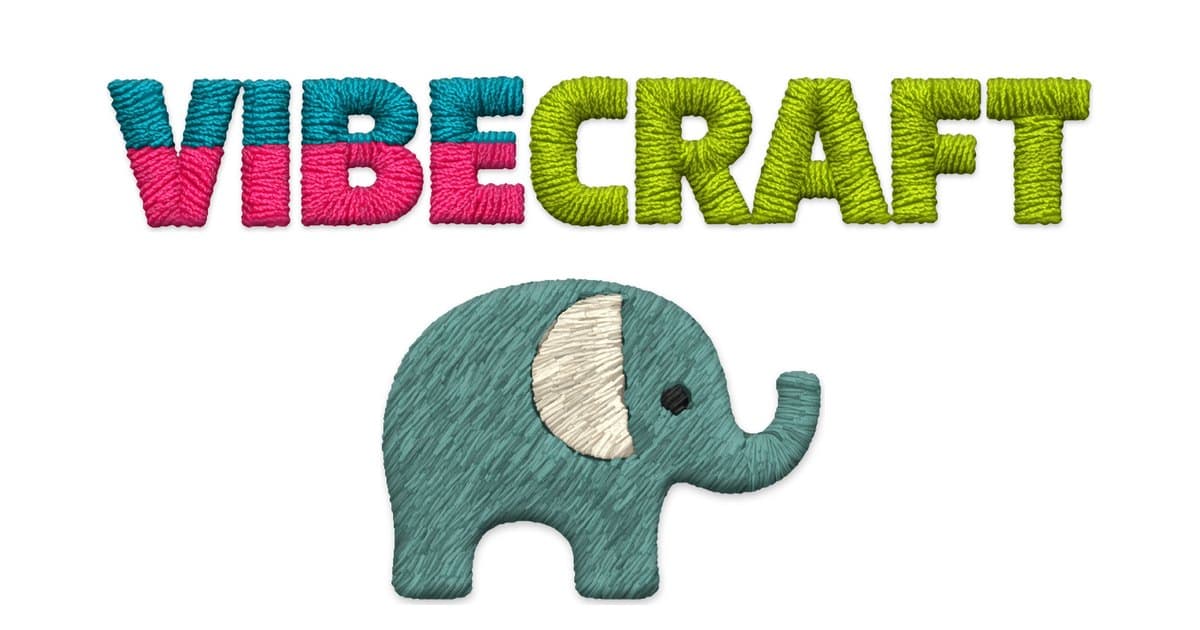
Some jobs are too fiddly to explain in one prompt, but too repetitive to redo by hand every time. This is the story of one of them, and how we turned it into something Claude can now do with very little help.
The job: take a photo of a logo stitched in thread, redraw it as a clean digital image, then animate it so the logo unravels, one thread at a time, as you scroll.
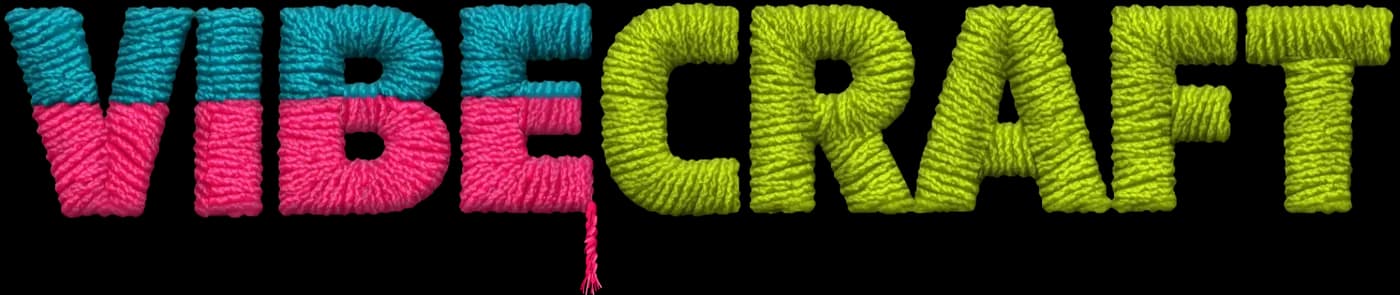 Pull the thread yourselfThe finished animation, in a new tab. Scroll to unravel it.
We did it twice. The first time, which we call Training, we worked side by side with Claude for about ten days, correcting it at every step. Then we asked Claude to package what it had learned into a plugin: a reusable recipe with checkpoints where it stops and asks us. The second time, Production, we gave that plugin a brand new logo and a cheaper Claude model.
It's one logo, one plugin and one rerun, so treat it as a sign of what's possible, not a proven method.
At a glance
The second run cost about a twentieth as much, took about an hour, and needed two messages from us. It also missed four of its own quality checks, so cheaper and faster came with caveats.
| Training | Production | |
|---|---|---|
| Logo | VibeCraft, 9 letters | A teal elephant |
| Model | Claude Opus 5.5 | Claude Sonnet 5.5, a cheaper model |
| Cost | About $116, plus $26 to build the plugin | About $5, estimated |
| Time | About ten days | Under 70 minutes |
| Messages from us | Dozens of detailed critiques | Two: the request and "proceed" |
| Quality checks missed | Not tracked | 4 of 9 |
What we mean by a pipeline
Not one clever prompt, but a package with four parts:
- Checkpoints. Seven stages, with stops at the important ones where Claude asks a short multiple-choice question and suggests an answer.
- Scripts for the heavy lifting. The repeatable work is code, so Claude picks settings and judges results instead of starting from scratch.
- A lessons file. Every correction we made the first time, written down as a rule Claude reads before it starts.
- Quality checks. Numbers that say whether the result is good enough, plus a check up front that stops the run if the photo won't work.
Training: building it by hand
Training started with a short request: recreate this photo of our stitched logo as a digital image, and keep going until it matches. Claude drew it stitch by stitch, compared its version with the photo and kept refining. After 33 versions it matched the letter shapes almost exactly.
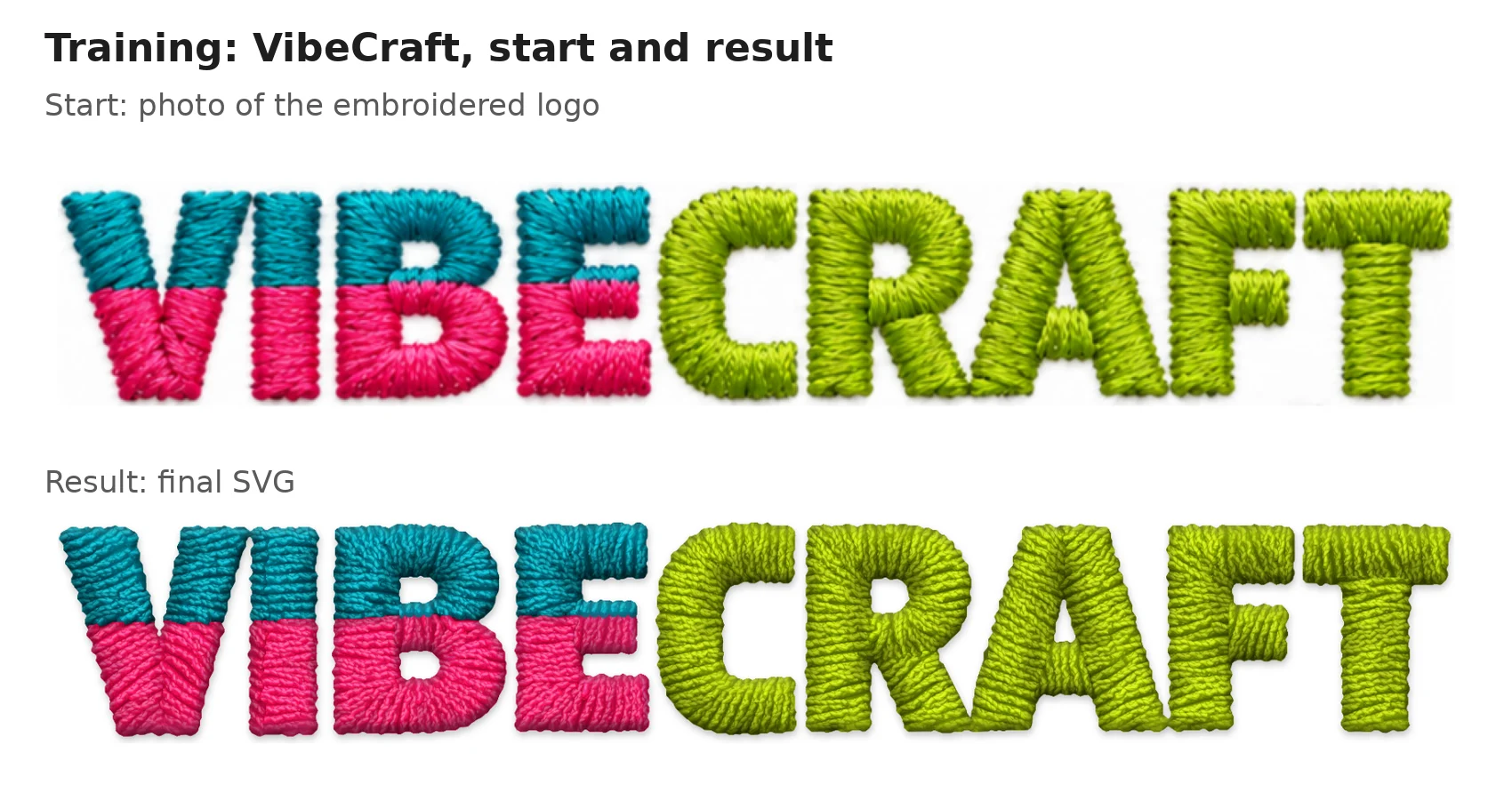
The numbers missed what our eyes caught: threads running the wrong way around the corners of some letters, and a shadow that was too heavy. Claude fixed them letter by letter. On its own initiative it also matched the photo's lighting, which lifted the shading match from about 79% to 97%.
Then came the animation. We wanted the logo to come apart colour by colour as you scroll, pulled by a single loose thread. Claude asked seven questions before starting, and our answers shaped the result: a short thread hangs from the E, swaying, with "Scroll to unravel" beside it. Pull it, and the pink comes out first, then the cyan, then the green, as one continuous thread.
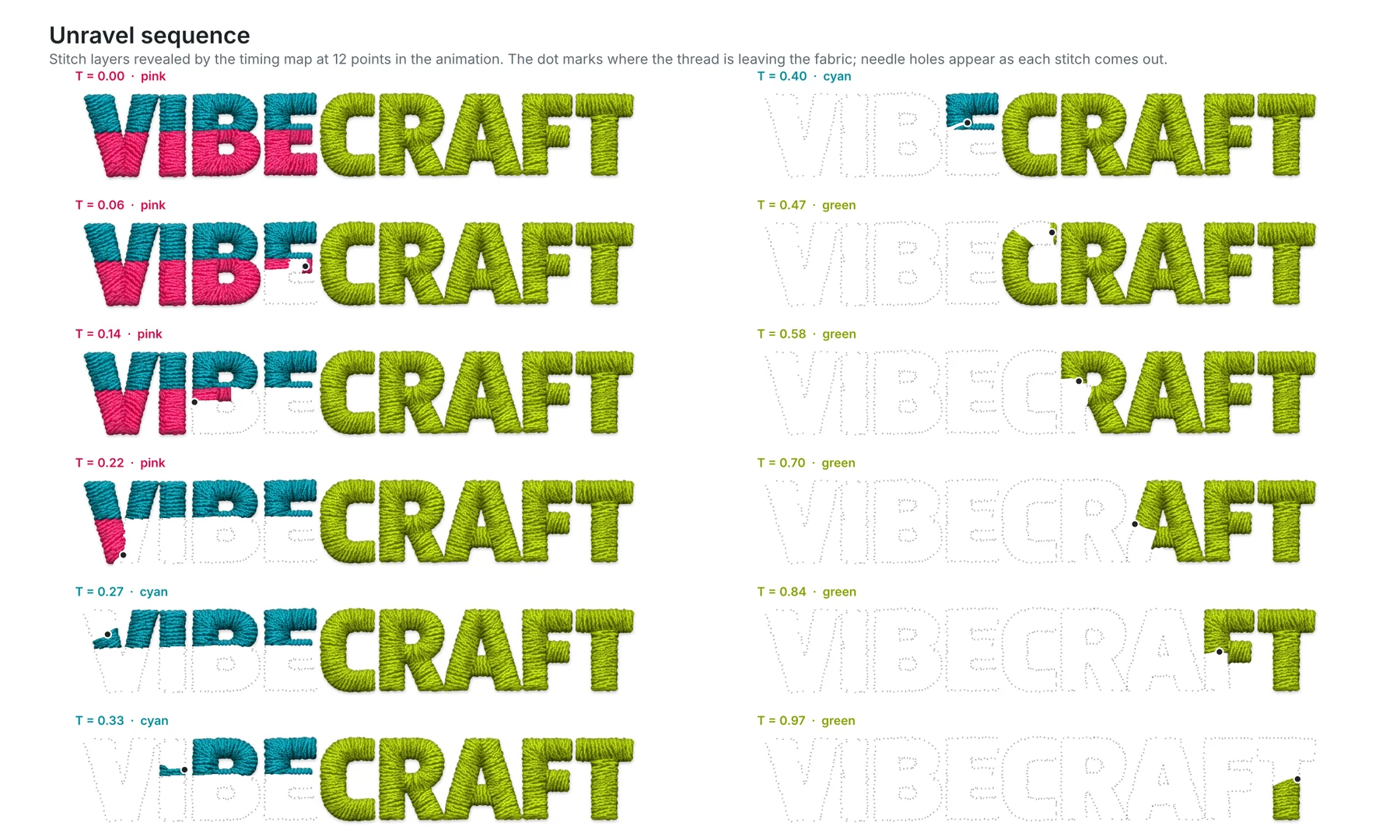
The last rounds were about feel: the tassel wiggled too much, the string bounced, and the T came apart in the wrong order. Claude could only test the motion with still frames, so it told us the movement itself needed a human eye. Our verdict: it looked great.
All told, Training cost about $116 over 75 back-and-forth turns, almost every one of them driven by our critiques.
Packaging it as a plugin
Next we asked Claude to turn all of that into a plugin that could do it again from a new photo. It built a seven-stage recipe from the exact code that had made our logo, then proved it by rebuilding our logo identically. Testing it on altered versions of the logo caught real bugs before a real job could hit them. Building the plugin cost about $26, over two versions.
You can try it yourself, no coding needed.
- Download the ZIP. There's no need to unzip it.
- Add it to Claude. In the Claude desktop app, open Customize, then Plugins. Choose Add, then Upload plugin, and pick the ZIP.
- Give it a logo. Start a task in Cowork, upload a photo of an embroidered logo, and ask Claude to recreate it and make it unravel. Claude checks in with you after each step.
The first time you run it, Claude may ask to install a few free tools it needs, like image tools and a browser it uses to test the animation. Say yes; it can take a few minutes. It works best on lettering stitched on plain, light fabric.
Production: a new logo, a cheaper model
For the real test we started a fresh chat on Claude Sonnet 5.5, a cheaper model, and asked the plugin to work on an embroidered teal elephant. That was harder than it sounds: the plugin was built for lettering, and an elephant is a few big shapes.
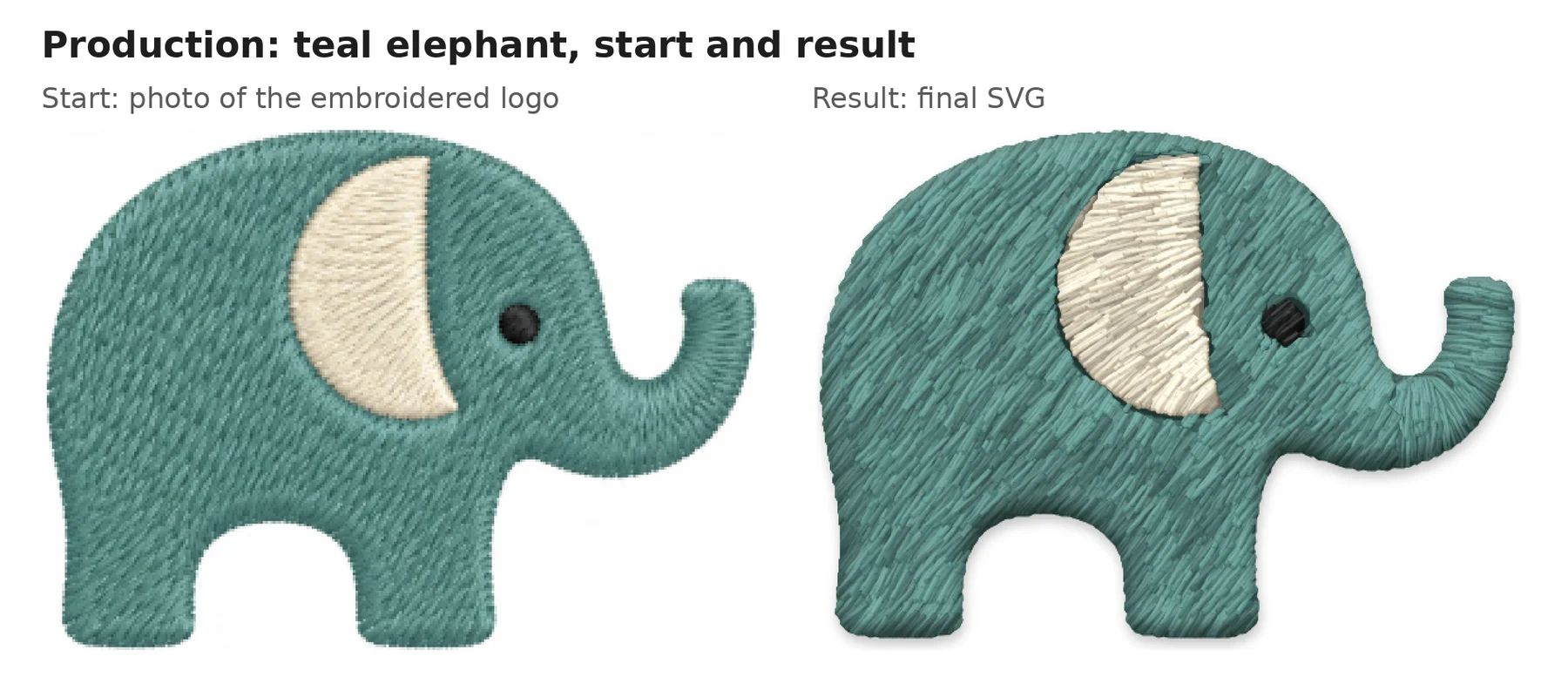
How the run went:
- The photo check failed, because the elephant didn't look like lettering. Claude looked closer itself, judged the stitching real, and asked whether to go on. We said "proceed."
- A small detail nearly got lost. The elephant's eye is tiny, and the colour finder missed it. Claude measured it by hand.
- Matching the look took about seven tries and landed within the plugin's targets.
- The unravel order was the hard part. Two fixes did nothing; splitting the body into three sweeps worked.
- Everything else ran on defaults. We took Claude's suggested answer at almost every checkpoint.
The whole run took under 70 minutes.
Cost and speed
Training cost about $116; Production is estimated at about $5. Most of Training's money paid for figuring things out, not for work that has to be repeated.
Training, measured
Building the plugin, measured
Production, estimated
Almost all of that spend is Claude re-reading the conversation so far, which it does at every step. A long back-and-forth gets expensive fast; a short, guided run stays cheap.
- The plugin paid for itself quickly. It cost $26 to build. If redoing a logo by hand costs anything like Training's first pass, one reuse covers it.
- One figure is an estimate. Training's cost comes from the session's own tally. Production's is Claude's estimate, because it couldn't see the bill.
- Three things changed at once. Production used a cheaper model, a lighter review and a different kind of logo, so we can't say how much each one saved.
Human attention
The pipeline changed what we had to do, not just how much.
| Training | Production | |
|---|---|---|
| What we did | Studied pictures and wrote detailed critiques | Picked from options Claude had prepared |
| Who found the problems | Mostly us | Mostly the plugin's checks and Claude |
A caution: fewer messages isn't the same as less judgment. We approved Production quickly, so our bar was lower than in Training, where we wanted a perfect match.
How good was the result?
Side by side, the difference is clear. Training unravels colour by colour and letter by letter. Production cuts the elephant with two straight lines, and its back stands alone for a moment, which is the main flaw.
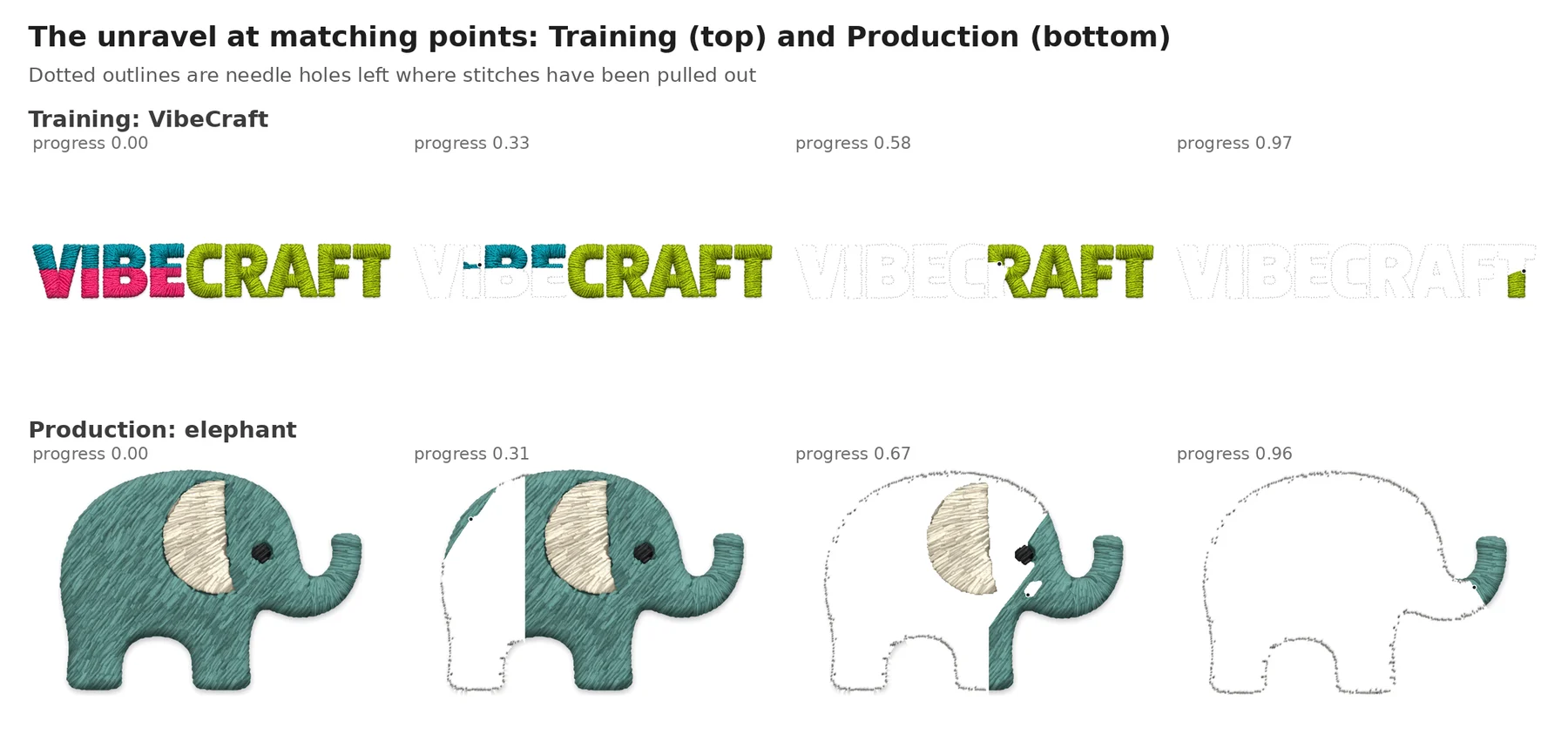
Production met 5 of its 9 quality checks. It nailed the shape and the shading, but missed on thread direction, how cleanly the thread leaves the fabric, and two measures of how the loose end moves. Most of those misses point at gaps in a plugin built for letters, rather than at the cheaper model.
Lessons for building your own
These come from a single case, so treat them as observations rather than rules.
- Discover with a strong model and a demanding reviewer. The expensive first run is where the lessons come from.
- Write every correction down. A rule Claude reads first means the same mistake isn't made twice.
- Build the recipe from what worked, and prove it. Rebuilding the original exactly gave us a test for every later change.
- Turn critiques into choices. Multiple-choice checkpoints with a suggested answer let us steer in a few clicks. That's where most of the saved effort came from.
- Stop early when the input is unusual. The photo check flagged the elephant within two minutes and let a person decide.
- Measure every run the same way. Record cost, time and missed checks each time, so the next comparison isn't an estimate.
What's next for the plugin
The elephant showed where the plugin still assumes it's working on letters: the photo check, how it names the pieces, and how it orders a large shape's unravel. The fixes are mostly small, and the first few would remove most of the hand-work this run needed.
How we put this together
This is written from the two chat transcripts. Production's cost is Claude's estimate, at Claude Sonnet 5.5's list prices on Anthropic's pricing page as of October 2026. A few things we couldn't measure: Training's active hours, a few of our answers that didn't show in the transcript, and how the animations feel on a real phone.
