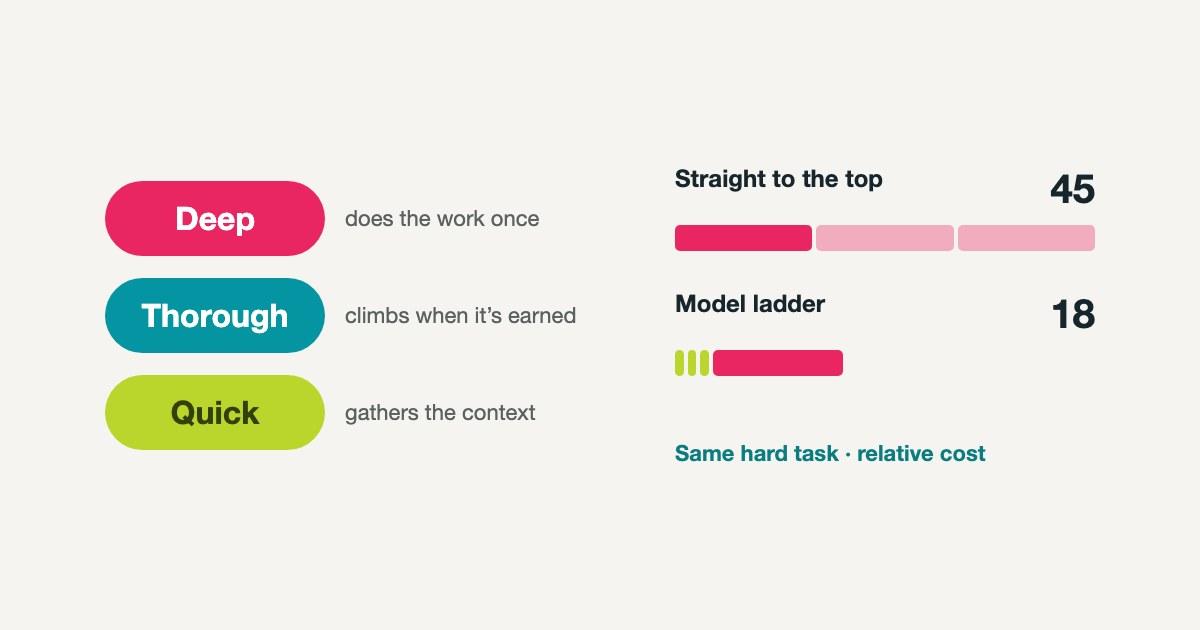
When a request needs a powerful A.I. model, the usual move is to send it straight there, or to let another large model decide where it goes. We take a different route. A classifier reads every turn, smaller models gather the context, and the big model only gets the work once the work is ready for it. You get to weigh in along the way, and the expensive answer lands the first time.
When the machine takes the wheel
Most A.I. chat works one of two ways. Either you pick a model from a menu, or a large model reads your message and picks one for you. Either way, your request goes onward as it is, often to a big model, usually on the very first message.
That sounds efficient, but it skips the part every good piece of work starts with: figuring out what's actually needed. A big model handed a one-line request doesn't stop to ask. It fills every gap with its own assumptions and writes a long, confident answer. When those assumptions are wrong, you read it, explain what you meant, and wait for a rewrite. Then maybe another.
The cost isn't only money. It's the time spent reading answers you didn't need, re-explaining, and steering the conversation back to what you wanted in the first place. The machine set the direction, and you spent the conversation correcting it.
How a model ladder works
Even a job that will end up on a large model usually goes best when it doesn't start there. The early part of almost any task is gathering context: the goal, the material, what "done" looks like, what can't change. That work doesn't need deep reasoning, and smaller, faster models handle it well.
We use three levels: Quick, Thorough and Deep, standing for small, medium and large models. A model ladder moves between them in three steps:
- Start low. Every conversation begins on Quick. Plenty of requests never need more.
- Build context cheaply. The small model asks the few questions that matter and collects the real material, not a summary of it.
- Climb when it's earned. Once there's enough context to justify it, the chat proposes moving up, with a brief you check first.
Straight to the topcost 45
- Deep writes a full answer, filling the gaps with assumptions +15
- Deep rewrites after “that’s not our setup” +15
- Deep rewrites after “we can’t change that part” +15
Three long answers, two thrown away. The machine set the direction.
Model laddercost 18
- Quick asks for the material and the setup; you answer +1
- Quick asks what can’t change; you answer +1
- Quick writes a brief; you check it and approve the climb +1
- Deep answers once, from the brief +15
One long answer, built on real context. You weighed in three times before it was written.
Same cost, different outcome
Cost is the easy thing to compare, and sometimes it comes out close. Here's a real request run three ways: "Our checkout service randomly double-charges some customers under load. Can you figure out why and fix it?"
| You pick | Large-model router | Model ladder | |
|---|---|---|---|
| What happens | Your selected model answers right away | A large model routes it, then the chosen model answers | Quick asks two rounds of questions, writes a brief and proposes a climb |
| Who steers | You chose the model; the model decides everything else | The machine, end to end | You: you answer, review the brief and approve the climb |
| The answering model sees | One sentence | One sentence | The code, the setup, the test plan and a brief |
| Your first chance to weigh in | After the full answer | After the full answer | Before anything expensive runs |
| Risk of rework | High | High | Low |
| Cost, in relative units | 4 to 15 | 4 to 7 | 7.2 |
The router's cost depends on the size of the model doing the routing, so it can come in a little under the ladder or about the same. Cost isn't where the two really differ. With the router, a large model guesses at the problem and an answer arrives; your first chance to say "that's not it" comes after you've paid for it. With the ladder, you've weighed in several times before anything expensive runs.
On the ladder, there are four places to steer:
- Answer a question. Fill in what's missing, or skip it and let the chat go ahead on stated assumptions.
- Check the brief. See exactly what the bigger model will be told, and correct anything that's off.
- Approve or decline the climb. Move up, or keep it quick. Your choice sticks for the task.
- React to the answer. "That's not right" brings an offer to move up a rung, with everything gathered so far.
With a model you pick, or a large-model router, only the last one exists: you see the full answer first, then react. On the ladder, most of the steering happens while it's still cheap to change course.
Outclassed: why a classifier makes the call
Something has to decide when to ask, when to answer, and when to climb. Many systems give that job to a large language model. It reads the conversation, reasons about it in text, and names a model.
We use a classifier. It's a different kind of tool, not a smaller chatbot. It doesn't chat or write anything. It reads the conversation, answers a fixed set of about 40 narrow questions, and returns a score for each. Plain rules in code turn those scores into a decision.
Large-model router
- YouSend a messageWhatever you typed, as you typed it.
- A large modelReason and pickReasons in text and names a model. One broad judgment.
- Its pick“Use model X”Hard to check.
- Model XAnswerWith whatever arrived.
The model ladder
- YouSend a messageWhatever you typed, as you typed it.
- A classifierScore itAbout 40 narrow questions, a score for each. Writes no text.
- Code, no modelApply the rulesPlain rules turn the scores into a decision. Readable and tunable.
- The chatAnswer, ask or climbAnswers, asks for what’s missing, or proposes a climb.
- Scores, not prose. Every answer comes back as a number in a fixed shape. There's nothing to interpret, and the classifier can't drift off into answering the request itself.
- Narrow questions, not one big one. "Which model?" is hard to check. "Did they paste the code, or only describe it?" is easy to check, and easy to fix when it's wrong.
- Readiness, not just difficulty. A router names a model and passes along whatever arrived. The classifier also measures what's missing, which is what lets the chat ask before it climbs.
- Light enough for every turn. It runs on every message, including "thanks" and "make it shorter", at a tiny fraction of the cost of even a Quick answer.
Two questions, every turn
The classifier's questions boil down to two. How hard is this? And do we have what that level needs? On its own, the chat proposes a climb only when both say yes. The other way up is you pushing back.
How hard it is comes down to four traits:
- Reasoning depth. Rewording, or novel problem-solving?
- Connected steps. One piece, or many that depend on each other?
- Specialist knowledge. Everyday, or deep expertise?
- Scale. A paragraph, or a whole codebase?
Importance isn't on the list. An email to your CEO is still an email. Stakes count when you say so: "this is critical, go deeper."
Whether the context is ready depends on the level:
| Level | What it needs before it starts |
|---|---|
| Quick | Nothing essential missing. A description is fine. |
| Thorough | All the essentials, plus how you'll judge "done". |
| Deep | The real material pasted in, the constraints, and enough that an expert could start without asking. |
The higher the level, the higher the bar. When a task is hard enough for a bigger model but the context isn't there yet, the small model asks first.
Two real conversations
A quick job stays quick
"Rewrite this to sound friendlier: Your invoice is overdue. Pay immediately." The classifier rates it near zero on every trait, the context is complete, and Quick answers right away. No questions, no climb. Every reply also has an optional report showing why the chat did what it did.

A hard job asks before it climbs
The checkout double-charge bug scores well into Thorough territory. But there's no code and no setup, and an expert would need to ask questions before starting. So instead of handing it up, Quick asks for exactly the two missing essentials, in a small form.
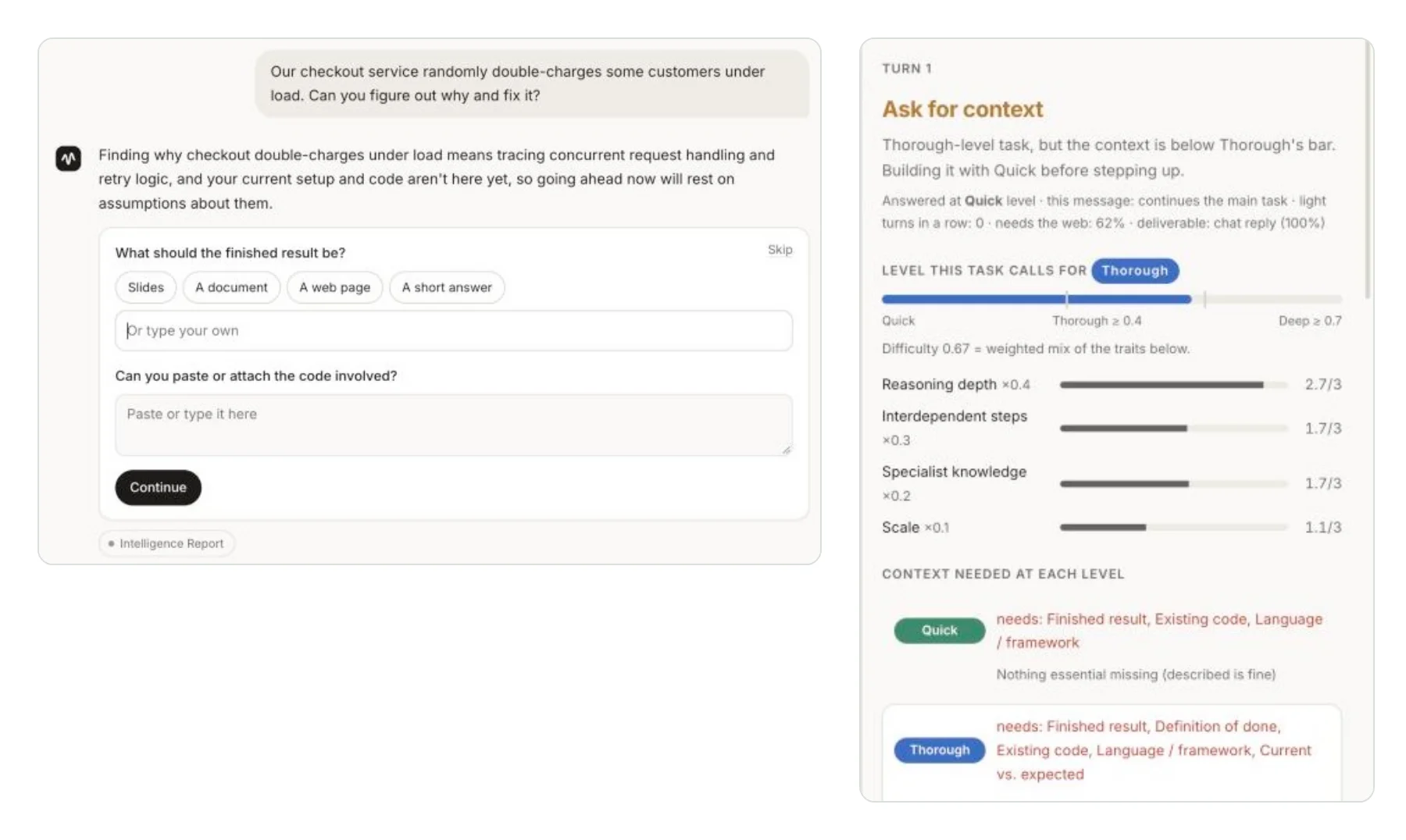
Two rounds of answers later (paste the code, say how it's tested), the context is there. Now Quick writes a brief and proposes the climb. You can read exactly what the bigger model will be told, correct anything that's off, or decline and keep it quick.
- Goal
- Find why checkout sometimes double-charges under load, and fix it.
- Constraints
- Existing web stack and database; a third-party payment service; clients retry on timeout.
- Done when
- Integration tests pass and the fix holds when load is replayed.
- Noticed
- The payment call has no duplicate protection, and the “already paid?” check isn’t locked together with the charge. Observations, not confirmed causes.
- Open questions
- Is each cart guaranteed one order? Can retry settings change?
Suggestion: more thinking power
This needs careful reasoning about timing and trade-offs, so a stronger model will handle it better.
Up when it's earned, back down when it's not
A conversation's needs change as it goes. Here's how the checkout-bug conversation might continue over ten turns. Follow the dot on the right: it shows which level is answering, and every move has a reason you can see.
Four rules keep the ladder steady:
- No jumping on noise. A task that only just looks harder doesn't trigger a climb. The signal has to be clear, or hold for two turns in a row.
- "That's not right" climbs one rung. Pushing back brings an offer to move up a level right away, without waiting for a clearer signal. You're the best signal the system has.
- Side questions don't move it. A quick aside in the middle of a hard task is answered by whichever level is in charge.
- Light turns come back down. After a couple of easy requests on a big model, the chat suggests stepping back down. Say no, and it stays put.
What each approach costs you
| Good at | Costs you | |
|---|---|---|
| You pick | No routing step at all. Predictable. Works for people who know the models well. | Most people guess, then leave it set. Too high wastes money; too low gets shallow answers. The model only gets what you typed. |
| Large-model router | Little to build. Reads unusual requests with nuance. You never have to choose. | A large-model call on every message. It routes whatever arrived, ready or not. The machine steers; you react. |
| Model ladder | Big models get the work once it's ready. You can steer at every step, while it's cheap to change course. Fewer rewrites, and routing costs almost nothing. | More design up front. Fixed questions can miss unusual requests. A question or two before hard work starts. |
Climb on purpose
Large models do their best work when they're handed a well-prepared task. Getting the task to that point is work small models do well, as long as something is watching for the moment the context is ready.
That's the classifier's job. It doesn't need to be smart the way a large model is smart. It needs to ask the same narrow questions on every turn, quickly and consistently, and give you a say at every step.
Small models build the context. You steer along the way. The large model does the work once.
